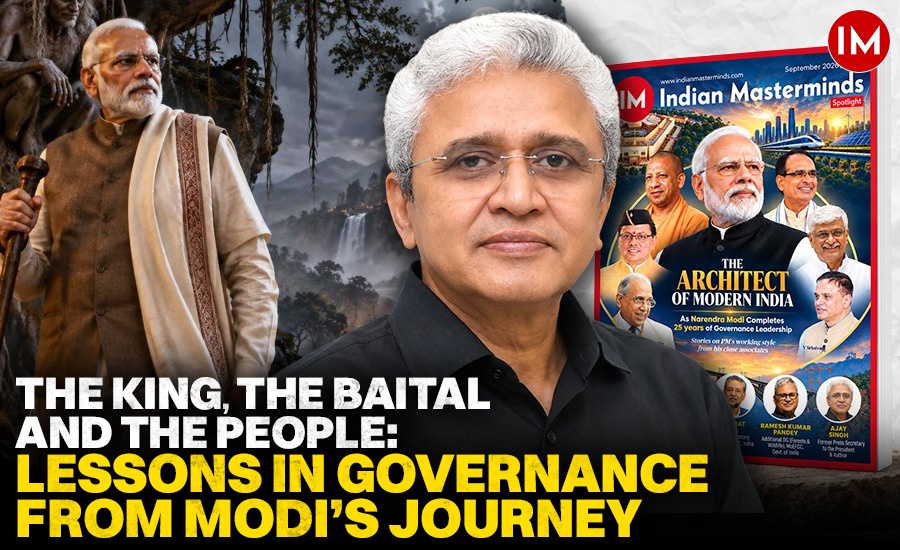
In Indian social consciousness, the ancient folktales of “Singhasan Battisi” and “Baital Pachisi” define the essential characteristics of good governance. These stories, told by the witty ghost Baital to King Vikramaditya, are cleverly turned into moral queries that test the king’s wisdom, righteousness, humility, self-sacrifice, truthfulness and compassion. Each story ends with a warning to King Vikramaditya of self-destruction should he fail in his dharma.
Prime Minister Narendra Modi has long been mindful that political power is transient — an awareness rooted in his days as an RSS worker. In 2001, when he took over as the chief minister of Gujarat, he asked for only a table, a chair, an internet connection and two telephones in his state guest-house room to run the state. He was in no hurry to shift to the chief minister’s residence, which was occupied by his predecessor, Keshubhai Patel.
Trained In Governance
His acquaintance with the complex machinery of governance was limited. During his days as an RSS worker and later as a BJP leader, he devoted himself largely to organisation-building in Gujarat and subsequently at the national level. He was far removed from the day-to-day issues of governance. Yet he did not hesitate to undergo tutorials from senior bureaucrats and cabinet colleagues. He asked his own officers how to read a file and make a noting on it.
While it did not take him long to understand the complexities of governance, he was equally quick to realise the gap between the government machinery and ordinary people. He launched various initiatives to bridge this gap by gearing up the administration to respond to people’s needs.
Also Read – Sabang to Great Nicobar: India’s Quiet Strategic Bet at Malacca’s Northern Gateway
Training The Bureaucrats
Having realised that the bureaucracy in the state had been following a beaten track, he started devising training programmes to motivate and energise it in coordination with the Indian Institute of Management Ahmedabad.
In a novel initiative, he asked senior bureaucrats to revisit the places of their first posting and assess whether things had changed. Within a year, he successfully streamlined the state bureaucracy and aligned it with the social and political objective of developing Gujarat.
Tough Calls
In the process, he did not hesitate to take tough decisions that were initially thought to be politically counterproductive. Take, for instance, the manner in which he reformed the power sector in the state by dividing electricity distribution into three distinct sectors: domestic, agriculture and industry. He ensured that the subsidy meant for the agriculture sector would not get diverted to industry, which paid a higher tariff.
At the same time, Gujarat became the first state to ensure 24-hour power supply for domestic consumption. No doubt, he faced stiff resistance from a powerful farmers’ lobby before the 2007 Assembly elections. But Modi remained unfazed despite cautionary advice from bureaucrats to keep the plan on hold.
Ears To The Ground
That reform was one of several tough calls that tested his political resolve during those years, and together they marked Modi’s stint in Gujarat as chief minister, evolving him into a mature and astute administrator devoted to the development of the state. His governance style was distinctly marked by two-way communication between people and the government. That helped him fashion people-friendly policies.
Like the kings of ancient Indian folklore, he kept his ears to the ground to get real-time feedback. There are many anecdotes about him getting to know of incidents much before the official machinery had any inkling of them. In Gujarat, he was backed by a strong feedback mechanism through which officials were unafraid to inform him even of unpleasant news.
The National Stage
This was the backdrop against which Modi transitioned to the national stage. When he took oath as the Prime Minister of India in 2014, he was seen by his adversaries as a novice in national politics. They thought that his state-level experience would not be enough to sail him through the turbulent waters of national politics. Modi proved them wrong.
At his swearing-in ceremony, he invited heads of state from South Asian countries and marked a successful beginning in international diplomacy. Similarly, his maiden speech from the ramparts of the Red Fort emphasised the dignity of women, cleanliness and the need to build toilets in every house and school.
Novel Initiatives
The cleanliness drive evoked popular support, particularly from women and children. This was followed by another ambitious drive to bring the whole country under the umbrella of financial inclusion by enabling everyone to open a bank account.
The digital infrastructure that India has built over the past 12 years, anchored by platforms such as UPI and Aadhaar, ranks among the most extensive in the world. Elements of it, particularly real-time digital payments, are increasingly studied by developed nations. In physical infrastructure too, the country has seen unprecedented growth in highway construction, port development and the number of airports.
Soon Modi will complete an uninterrupted run as head of government for 25 years, first as chief minister and then as prime minister of the country. The adulation and support Modi has enjoyed for so long is unparalleled in a democratic nation. It would be naïve to attribute Modi’s success only to demagoguery and craftiness.
Janata Is The New Baital
People of the country, having learnt through generations the values of chivalry, kindness, righteousness and the dharma of the king in ancient Indian folklore, are discerning enough to separate truth from falsehood.
Much like Baital, who kept probing King Vikramaditya about his dharma, tested his patience, and examined his ability to listen and respond to queries with utmost humility, people today apply their own democratic filter to judge their rulers. The risk of going astray from those metrics of ideal governance can prove to be the undoing of any regime. That Modi has remained a democratically elected leader for this long, demands rigorous intellectual inquiry — not casual dismissal.
(Author is former Press Secretary to President Ramnath Kovind & President Draupadi Murmu & author of The Architect of the New BJP: How Narendra Modi Transformed the Party)
Also Read – Eco Warrior Awards 2026: When Civil Servants Turn Wildlife Into Art