There are landscapes that look empty until you learn how to read them.
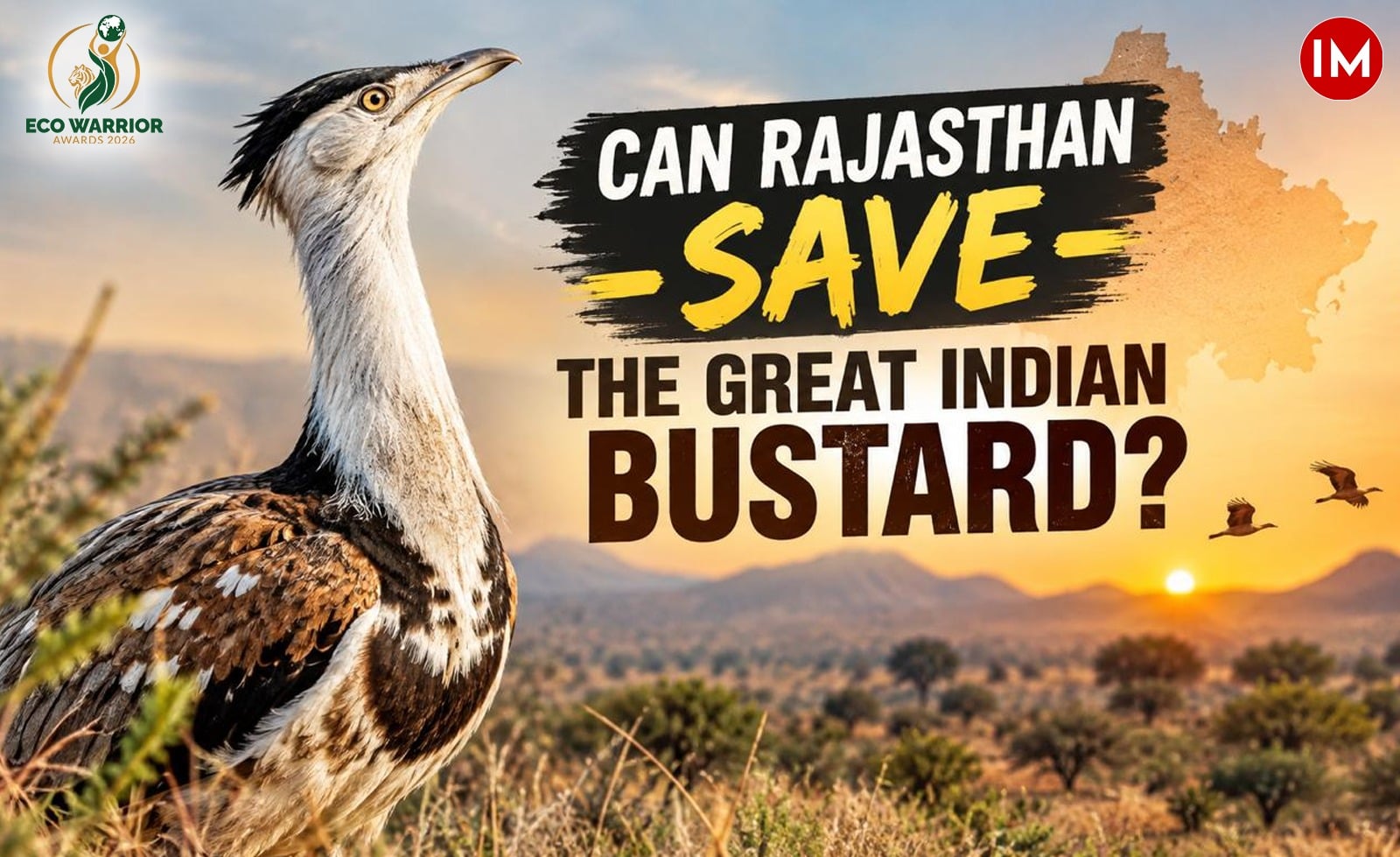
Across the sweeping grasslands and dry open plains of Rajasthan’s Thar, life moves quietly. And somewhere in that vastness walks one of India’s most remarkable birds: the Great Indian Bustard (GIB).
Once found widely across the arid and semi-arid landscapes of India and Pakistan, the bird has disappeared from much of its former range. Today, Rajasthan holds the country’s only viable population, concentrated in the Jaisalmer district.
Around 130 birds survive here. That number explains why Rajasthan has become the heart of the country’s Great Indian Bustard conservation effort.
Also read: India Becomes First Nation to Achieve Artificial Breeding of Great Indian Bustard
A Bird That Cannot Afford Many More Losses
The Great Indian Bustard is an extraordinary bird. Standing more than a metre tall and weighing up to 12 kg, it is among the heaviest flying birds in the world.
But its size is not its greatest vulnerability.
The species reproduces slowly. A female lays just one egg, incubates it for around 22 days and raises the chick alone for nearly a year. Eggs and chicks also face considerable predation.
For decades, the bird’s decline was driven by hunting and egg collection. Later came the transformation of grasslands into agricultural land, intensive grazing and poorly planned afforestation.
In Rajasthan, another threat has become increasingly important: energy infrastructure. Power lines and other infrastructure can turn the bird’s open habitat into a dangerous landscape. For a species already numbering only around 130 individuals in its last viable stronghold, every avoidable death matters.
Rajasthan Became the Conservation Centre
Conservation efforts for the GIB began in the 1980s with the creation of protected areas. But protection alone could not reverse the decline.
The urgency eventually led the Ministry of Environment, Forest and Climate Change to develop the National Bustard Recovery Guidelines in 2013.
In 2016, the Habitat Management and Conservation Breeding of the Great Indian Bustard project began under the Wildlife Institute of India (WII), in collaboration with the MoEFCC, Rajasthan Forest Department, International Fund for Houbara Conservation and other partners.
Rajasthan was central to this effort because the Thar still held the country’s only viable population. The strategy was not simply to protect the birds that remained. It was to understand their habitat, reduce threats and create a safety net in captivity, while working towards restoring the landscapes they need in the wild.
From Eggs in the Wild to Chicks in Rajasthan
One of the most ambitious parts of the programme has been conservation breeding. Two specialised facilities were operationalised in Rajasthan: at Sam in 2019 and Ramdevra in 2022.
The founder population was established using eggs collected from the wild. These eggs were transported in specialised portable incubators and hatched under intensive care.
The results have been striking.
The captive population has crossed 90 birds as of 2026, while the programme has achieved an egg-to-adult conversion rate of 80%, considerably higher than the global standard of 48% for similar bustard programmes.
Captive breeding began in March 2023, followed by the use of artificial insemination in October 2024 to increase production. So far, 60 captive-bred chicks have been produced.
For Rajasthan, these are not merely numbers inside a breeding centre. They represent the possibility of putting birds back into landscapes where the species once lived.
The Thar Is Also Their Laboratory
While some GIBs are being raised under controlled conditions, others in Rajasthan are being watched in the wild. Landscape-level surveys covering approximately 20,000 sq km have helped establish population baselines.
The estimates offer an important piece of news: the Thar population has remained broadly stable, at 128 ± 19 birds in 2017–18 and 130 ± 21 in 2024–25.
Scientists are also following the movements of the birds. Ten wild females in Jaisalmer have been fitted with GPS tags, allowing researchers to understand where the birds travel, which habitats they select and how they use the landscape.
The research has also revealed uncomfortable realities. Nest survival is around 40%, while chick survival is approximately 50%. The findings point towards adult mortality as an important factor limiting recovery.
In other words, producing more chicks is only one part of the answer. Rajasthan must also remain a landscape where those birds can survive.
Saving the Grasslands, Not Just the Bird
That is where habitat management comes in. The GIB needs open grassland. Its breeding habitat requires a mix of short and tall grasses and sufficient insects for chicks to feed on. Outside the breeding season, the birds also use agro-pastoral landscapes.
The conservation vision therefore extends far beyond the boundaries of a protected area. The plan proposes Critical Conservation Areas of 200–500 sq km, with more than 25% perennial grassland cover.
In Rajasthan, potential restoration landscapes include Desert National Park, the Salkha Mokla area and the Pokhran Field Firing Range within the Priority GIB Area.
The aim is to create secure breeding grounds of 5–10 sq km by controlling livestock grazing, removing woody infestation and allowing natural grasses to regenerate. At the same time, conservation efforts are addressing threats such as power infrastructure, nest predators and free-ranging dogs.
The First Release Is Already on the Horizon
The conservation programme has now entered its most closely watched phase. Pilot releases of captive-bred GIBs in Rajasthan are beginning in 2026.
The idea is deliberately cautious. Birds will first be released in Rajasthan, and the protocols will be assessed before surplus birds are considered for release in other range states. That makes sense.
Rajasthan is not just another stop in the recovery plan. It is the foundation on which the species’ future is being built. If the Thar can support a secure, growing population, the hope is that this success can eventually help revive the bird across parts of its former range.
A Future Written Across the Thar
There is something fitting about the Great Indian Bustard’s fight beginning again in Rajasthan. The bird evolved for open country, and its survival depends on keeping that country open, connected and alive.
The conservation programme has bought precious time, through breeding centres at Sam and Ramdevra, scientific monitoring across the Thar, habitat restoration and efforts to bring communities and agencies into the conversation.
But the real measure of success will come when captive-bred birds no longer need to be protected behind the walls of a breeding centre. It will come when they can walk once again across Rajasthan’s grasslands, breed in the wild and raise their young without the landscape becoming a trap.
For now, the Thar is holding on to its last great population of the Great Indian Bustard. And in Rajasthan, the effort to make sure that population does not become a memory has entered its most important chapter.
Also read: Saving the Last Howls: The Fight to Protect Maharashtra’s Indian Grey Wolves