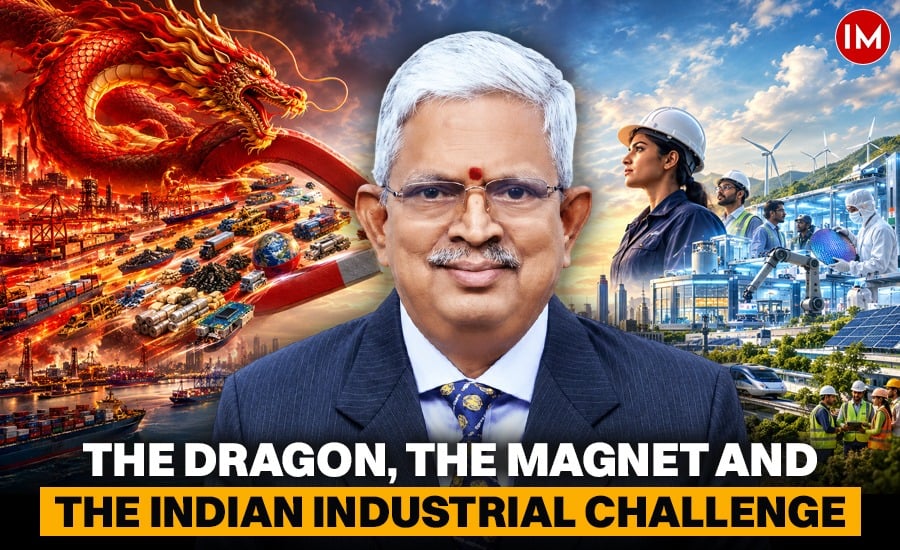
By P Sesh Kumar
A viral post comparing China’s industrial rise with India’s startup economy has reopened a larger question: what is India building for the next twenty years? China has built deep ecosystems around rare earths, magnets, batteries, robotics and semiconductors, while India has made significant progress in smartphones, digital infrastructure and services but remains dependent on imported technology and critical materials. India’s challenge is therefore not simply about choosing between consumer startups and deep tech. It is about creating the capital, skills, infrastructure, policy stability, research ecosystem and scale needed for long-term manufacturing. The question is whether India can turn its ambitions into globally competitive industrial capabilities.
A Tweet, a Magnet and a Mirror
Every few months India holds up a mirror to itself, flinches, and puts it away. The latest mirror arrived at six in the evening on 22 September 2026, in the shape of a post by Harsh Goenka on X. China, he wrote, is building dominance in rare earths, magnets, batteries, electric vehicles, robotics, semiconductors and advanced manufacturing, and its strategy is disarmingly simple: to “own the raw material, the technology, the manufacturing and eventually the entire ecosystem.” Indian business, meanwhile, was busy with softer pickings, and even its celebrated software success rested largely on labour-cost arbitrage. He ended with a question that has since been viewed more than ninety thousand times and drawn over five hundred replies: what are we building that the world will need tomorrow?
Also read – When The Remover Of Obstacles Meet India’s Broken Roads
His exhibit was a company most Indians have never heard of. JL Mag, founded in 2008 and listed in both Shenzhen and Hong Kong, makes neodymium-iron-boron permanent magnets, the tiny, ferociously strong components that spin the motors of electric cars, wind turbines, air conditioners, industrial drives and, increasingly, humanoid robots. According to Business Today’s account, it ended 2025 with 40,000 tonnes of annual capacity, produced about 38,000 tonnes while running above ninety per cent utilisation, is adding another 20,000 tonnes at Baotou, and targets 60,000 tonnes by the end of 2027. It already recycles used magnets, supplies rotors for humanoid robots, runs bases in Ganzhou, Baotou and Ningbo, and is building a plant in Mexico. These figures come from a single press report and should be treated as indicative until checked against the company’s filings; but even with generous haircuts the picture is unmistakable.
Let us now set that beside India’s own answer. In November 2025 the Union Cabinet approved a Rs 7,280-crore Scheme to Promote Manufacturing of Sintered Rare Earth Permanent Magnets, designed to create 6,000 tonnes a year of integrated capacity across five beneficiaries of up to 1,200 tonnes each, with a two-year gestation period and five years of sales-linked incentives. By August 2026 the global tender had drawn twenty bids The arithmetic is brutal. JL Mag’s Baotou extension alone is more than three times India’s entire national target; its 2027 capacity is ten times it. One company in one Chinese city is outbuilding one sovereign nation’s flagship programme, and India’s plants, if all goes to schedule, will begin selling magnets only around 2028, by which time JL Mag intends to have already reached 60,000 tonnes.
Nor is the lament new, which is precisely what makes it damning. In April 2025, at the Startup Mahakumbh in New Delhi, Commerce Minister Piyush Goyal asked whether India was content to produce delivery boys and girls while China made chips and EV batteries, mocked the children of billionaires launching fancy ice-cream and cookie brands, noted that India had only about a thousand deep-tech start-ups, and asked the startup world whether it merely wanted to keep shop: “Dukaandari hi karni hai?” Goenka backed him then, arguing that the country had to shift its mindset from quick wins to long-term value. Eighteen months later the same industrialist is asking the same question in almost the same words. The diagnosis, evidently, landed. The treatment did not.
2. How the Dragon Built Its Hoard
China did not stumble into magnet supremacy; it planned for it with the patience of a chess player and the ruthlessness of a monopolist. Deng Xiaoping’s much-quoted aside that the Middle East has oil and China has rare earths was not a boast but a programme. For three decades Beijing tolerated the toxic tailings of Baotou and the scarred hills of Jiangxi, consolidated hundreds of small miners into a handful of state champions, used export quotas to drive foreign competitors out of business, and then invested relentlessly downstream, where the money and the leverage actually lie.
The results are now a matter of record. The International Energy Agency reports that China accounts for about 91 per cent of global rare-earth refining, and that its share of sintered permanent-magnet production has climbed from roughly half in 2005 to 94 per cent in 2024.7 Mining is the least concentrated link in the chain, at around 60 per cent; the choke point is separation, metallisation, alloying and magnet-making.8 The IEA’s own estimate is that genuine diversification would require refining capacity outside China to rise four-fold and magnet capacity six-fold, and it names metallisation, specialised equipment and skilled labour as the weakest links elsewhere.
And China has shown that it is willing to use the hoard. In April 2025 it placed seven rare earths and their magnets under export licensing; in October 2025 it extended controls to further heavy rare earths, refining equipment and, most strikingly, to foreign products containing even trace quantities of Chinese-origin material. That second wave was later suspended for a year, reportedly until 10 November 2026, as part of the bargaining with Washington.10 India’s auto-component makers learnt the lesson the hard way in 2025, when magnet consignments froze at Chinese ports and relief came only when Beijing chose to begin issuing licences to Indian buyers.11 A supply chain that can be switched off by a licensing clerk in another capital is not a supply chain; it is a leash.
Behind the minerals sits money on a scale no democracy has matched. The Centre for Strategic and International Studies, in its Red Ink study, estimated that China spent about 1.7 per cent of GDP on industrial policy in 2019, through subsidies, tax breaks, below-market credit and state investment funds, more than twice the proportion of any other major economy it examined.12 China now spends about 2.43 per cent of GDP on research and development, and fully 77 per cent of that is funded by business.13 The Australian Strategic Policy Institute’s Critical Technology Tracker captures what that compounding produces: China led high-impact research in just three of sixty-four critical technologies in 2003–07 and in fifty-seven of them in 2019–23.14
Robotics tells the same story in steel and servo-motors. The International Federation of Robotics recorded 295,000 industrial robots installed in China in 2024, fifty-four per cent of the world total and a global record; for the first time, Chinese suppliers outsold foreign brands in their own home market.15 16 India installed a record 9,120 robots that year, enough to climb to sixth place in the world, but still barely a thirty-second of China’s tally.17
Three further advantages deserve naming. The first is political latitude: no electoral cycle interrupts a twenty-year plan, local party secretaries are promoted on industrial output, and land is owned by the state and can be handed to an investor in weeks. The second is the ecosystem: in clusters such as Ganzhou, Baotou and Ningbo, the mine, the separator, the alloy-maker, the magnet plant, the motor-maker and the tooling shop sit within trucking distance, and an engineer who leaves one firm walks into its supplier. The third is the head start itself, because industrial learning curves reward whoever has already produced the most units; every tonne JL Mag makes lowers the cost of the next.
Fairness requires the other side of the ledger. China’s model has a bill, and it is being presented. Beijing is now waging a campaign against “involution”, the destructive race to the bottom in which overcapacity and price wars erode margins; the median net margin of listed Chinese automakers fell to 0.83 per cent in 2024, and the solar chain reportedly lost about forty billion dollars in a year.18 19 Deflation, local-government debt and trading partners’ anti-dumping walls are the price of building first and asking questions later. The lesson for India is not to copy the Chinese machine, which a democracy cannot and should not do, but to understand which of its parts were indispensable.
3. In Defence of the Ice-Cream Wallah
Before the verdict, the steel-man, because the consumer-startup founders have a better case than their critics allow. When Goyal spoke in 2025, Zepto’s Aadit Palicha replied that consumer companies create jobs, pay taxes and draw in foreign capital, and that the state should support Indian start-ups rather than scold them.Ashneer Grover went further: China, too, began with food delivery before it graduated to deep tech, and politicians might first aspire to twenty years of ten-per-cent growth before lecturing today’s job creators. Mohandas Pai pointed out that India does have founders in robotics, IoT, EV charging and battery management, and that they struggle because the state spent years harassing start-ups with the angel tax and still bars endowments and insurers from backing them.
There is hard logic here. Capital is not patriotic; it is rational. A consumer app offers feedback in weeks, revenue in months and an exit in a few years. A magnet plant, a cell gigafactory or a fab offers losses for a decade, exposure to a Chinese price cut at any moment, and no certainty that anyone in India will buy the output. Asking a venture fund with a ten-year life to finance a twenty-year bet is asking it to breach its fiduciary duty. The irony, moreover, is that China has never stopped chasing instant delivery either: Meituan, Alibaba and JD.com have poured billions into subsidy wars for one-hour “instant retail”. The difference is not that Chinese entrepreneurs disdain groceries; it is that Chinese state capital simultaneously builds the magnet plants.
India’s record is also not the unrelieved gloom that a viral post implies. Where an anchor investor arrived with its supply chain in tow, production-linked incentives worked spectacularly: India’s smartphone exports reached about Rs 2.6 trillion in 2025-26, and iPhones alone crossed Rs 2 trillion, making Apple the country’s single largest branded export.22 In high-impact research, ASPI ranks India among the top five nations in forty-five of sixty-four critical technologies.14 The talent exists; the papers exist; the assembly lines are arriving. What has not yet arrived is the deep, upstream, capital-intensive layer on which everything else sits.
4. But the Critique Still Bites
Even if we grant all that, the allocation question remains stark. Zepto’s consolidated net loss for 2025-26 was Rs 5,905 crore on operating revenue of Rs 22,624 crore, with 1,139 dark stores.23 The company has raised more than 2.3 billion dollars over its short life, and its valuation has since been marked down from seven billion dollars to about 4.5 billion, with its listing deferred.25 Put plainly, one quick-commerce firm’s loss in a single year equals roughly four-fifths of the entire seven-year outlay of India’s national magnet programme. That comparison is this note’s own arithmetic, not a finding of any source, but it is the sharpest possible expression of where Indian risk capital has been willing to go.
The criticism also reaches beyond start-ups to the cash-rich family conglomerates that Goenka himself belongs to. India’s gross expenditure on research and development has hovered between about 0.6 and 0.85 per cent of GDP for nearly two decades and stands at 0.64 per cent, with business funding only about 41 per cent of it against 77 per cent in China. Even as private R&D has grown, it has clustered in generics, IT services, automotive parts and consumer technology, not in fabrication, advanced materials or critical-mineral processing. Much of corporate India’s capital expenditure has gone into ports, airports, cement, telecom towers, retail and now data centres: heavy on assets, light on proprietary technology, and frequently dependent on licensed or imported know-how. Goenka’s jab at software’s labour-cost arbitrage stings because it is largely true; a services industry that earns by billing hours has little reason to own intellectual property.
5. The Anatomy of a Lag
If entrepreneurs respond to incentives, the real question is why India’s incentives point so consistently towards the cone and away from the magnet. The answer lies in seven overlapping constraints, each manageable on its own and collectively paralysing.
Politics on a five-year clock
Hard-tech industrial policy is a twenty-year contract written by governments that face voters every five. India’s federal design adds a second layer: land, labour, power, water and much of industrial regulation sit with states whose priorities, parties and capacities differ sharply. Competitive welfare spending crowds out capital budgets, and policy itself has been volatile, from the retrospective tax of 2012 that was only repealed in 2021 to the angel tax that tormented start-ups for over a decade before its abolition in 2024. Investors price regime risk into every rupee, and the price is highest precisely for the long-gestation bets India says it wants. None of this argues for China’s political model; it argues for binding, cross-party, legislated commitments that outlast a government.
Capital, cost and the missing middle
World Bank data show manufacturing at about 13 per cent of India’s GDP in 2024, down from 15 per cent in 2018, against 19 per cent in Indonesia, 23 in Malaysia and 24 in Vietnam; in absolute terms India’s manufacturing value added is about one-tenth of China’s.27 The Federal Reserve notes that China, Japan, Korea and Taiwan all carried manufacturing shares of 25 to 35 per cent at comparable stages of their growth miracles, while India remained under 15.28 Behind these ratios lie a high cost of capital, a banking system wary of long-tenor technology risk, and a missing middle of firms too large to be informal and too small to invest in process engineering. An MSME that cannot get working capital against its receivables will not be financing a separation plant.
Regulation: the mineral locked inside the atom
Here the self-inflicted wound is deepest. India holds about 6.9 million tonnes of rare-earth oxide reserves, the third largest in the world after China and Brazil, yet produced only about 2,900 tonnes in 2024 against China’s 270,000.29 The reason is geological and bureaucratic at once. Most Indian reserves sit in monazite-bearing beach sands that also contain thorium, so they have long been governed as atomic minerals, handled for decades largely by a single public-sector firm, IREL, founded in 1950 and placed under the Department of Atomic Energy in 1963, which historically treated rare earths as by-products.30 29 Industry advisers note that India still lacks advanced separation and refining technology and contributes under one per cent of world output.31 Coastal-zone rules, forest and environmental clearances and the absence of a private separation industry complete the lock. The new magnet scheme even betrays the constraint in its fine print: assured NdPr oxide from IREL is promised only to the three lowest bidders.11 A country that must ration its own feedstock to its own subsidised factories has not yet decided to become a rare-earth power.
Courts: where contracts go to age
A factory is a bundle of contracts wrapped around a parcel of land, and India’s courts are slow to honour both. The Law Minister told the Rajya Sabha in July 2026 that 5.64 crore cases were pending across Indian courts, including more than 96,000 in the Supreme Court and 80,660 that have lingered in High Courts for over thirty years.32 A litigant survey by DAKSH found that about two-thirds of civil cases in district courts concern land and property,33 a single-survey estimate but one consistent with judicial observation; in November 2025 the Supreme Court itself reportedly described the experience of buying property in India as traumatic.34 The state is also the largest litigant, which means an investor may end up suing the very government that invited it. Chinese courts are neither independent nor fair by Indian standards, but they are fast, and in capital-intensive industry time is the most expensive input of all.
Labour: codes on paper, rules in waiting
The four labour codes finally came into force on 21 November 2025, folding twenty-nine central laws into one architecture.35 The Industrial Relations Code raises the threshold for prior government permission for lay-offs, retrenchment and closure to establishments with more than 300 workers, and allows fixed-term employment.36 This is real reform. But labour is a concurrent subject, many states are still notifying their rules, central trade unions have mounted nationwide protests,37 and investors will wait to see whether the codes survive their first industrial dispute. The deeper labour constraint is skill: a fab, a cell plant or a magnet line needs process engineers and technicians in numbers India has not trained. Tellingly, the IFR expects India’s robot installations may contract in 2026 as PLI support runs out,17 a sign that automation is being bought with subsidy rather than with conviction.
Land: presumptive titles and perpetual disputes
India’s land records establish presumptive rather than conclusive title, so ownership is always open to challenge. Holdings are fragmented, mutations lag sales, and the Right to Fair Compensation and Transparency in Land Acquisition, Rehabilitation and Resettlement Act, 2013 requires social-impact assessment and, for private and public-private projects, the consent of a large majority of affected families. These protections exist for good reason, but together with litigation they mean a greenfield plant can spend years assembling a contiguous, clean parcel. Where India has moved fast, as at Dholera and Sanand, it has done so by pre-assembling state land into industrial regions, which is itself an admission that the ordinary market for industrial land does not work.
Scale: missions in crores, rivals in trillions
The final constraint is ambition measured against the adversary. The battery story is the cautionary tale. Under the Rs 18,100-crore Advanced Chemistry Cell PLI launched in 2021 to create 50 GWh, only 1.4 GWh, or 2.8 per cent, had been commissioned within the timeline by October 2025, all of it by Ola Electric; the scheme had created 1,118 jobs against an estimated 1.03 million, disbursed zero incentives, and left India almost entirely dependent on imported cells.38 Beneficiaries were served penalty notices of Rs 12.5 lakh a day for Ola and Rs 5 lakh a day each for Reliance New Energy and Rajesh Exports,39 the last of which had progressed little beyond land acquisition amid reports of financial discrepancies.38
Semiconductors show more promise but the same shape. Of twelve units approved under the India Semiconductor Mission, three are in commercial production, namely Micron, CG Semi and Kaynes, and all are back-end assembly, test and packaging operations that process wafers made elsewhere.40 41 India’s first commercial front-end fab, Tata Electronics’ 300-millimetre facility at Dholera, is still under construction, with first silicon targeted for December 2026 and the first fab commissioning expected around 2028.42 40 Artificial intelligence repeats the pattern: the IndiaAI Mission’s Rs 10,372-crore outlay has onboarded more than 38,000 GPUs for shared compute,43 a respectable national facility that nonetheless would be a rounding error in the capital plans of a single Chinese or American hyperscaler. If we add robots installed at one-thirty-second of China’s rate and magnets planned at one-tenth of a single Chinese firm’s capacity, the gap is not one of direction but of order of magnitude.
6. The Scorecard of Good Intentions
No one can accuse the government of inaction. Make in India arrived in 2014, Startup India in 2016, production-linked incentives across fourteen sectors with a Rs 1.97-lakh-crore outlay in 2020-21, the Semiconductor Mission and its sequel, the IndiaAI Mission, the magnet scheme, and in July 2025 a Rs 1-lakh-crore Research Development and Innovation Scheme to provide long-tenor, low- or zero-interest finance for private R&D, anchored in the Anusandhan National Research Foundation chaired by the Prime Minister.44
The trouble lies in the gap between announcement and outcome. By December 2025, only Rs 28,748 crore had been disbursed under the PLI schemes, about fifteen per cent of the outlay.45 The government points, fairly, to about Rs 2 lakh crore of realised investment and Rs 18.7 lakh crore of incremental production by September 2025,46 but those gains are concentrated in mobile phones, where an anchor brought its own ecosystem.
The auditor’s lens explains why.
First, paying on production rather than capital expenditure leaves the investor to carry all the up-front risk, so only firms already willing to make a large bet ever claim the money.
Second, incentives can relocate assembly but cannot conjure an ecosystem; the battery scheme failed because cathodes, anodes, separators and refined lithium did not exist in India, and the same danger hangs over magnets without domestic oxide, metal and alloy stages.
Third, the effort is scattered across ministries: Heavy Industries runs magnets and batteries, Electronics runs chips and AI, Mines runs critical minerals, Atomic Energy controls monazite, and no single authority owns the value chain end to end.
Fourth, schemes report outputs, such as approvals, memoranda of understanding and investment “commitments”, far more readily than outcomes such as domestic value addition, import substitution and cost parity with China.
A programme of this size deserves outcome-level audit scrutiny, with published value-addition data, before the next tranche of money is voted.
7. What It Would Actually Take
We cannot replicate Chinese political latitude, and we should stop pretending that slogans can substitute for it. What we can do is fix the things that lie within democratic reach, and do them at a scale that matters. We must begin by choosing a few hills and taking them properly: sintered magnets, battery cells and their precursors, mature-node and power semiconductors, and robotics components, each funded to minimum efficient scale rather than spread thinly across fourteen sectors. A 6,000-tonne magnet programme is a pilot, not a policy; the ambition should be an order of magnitude larger over a decade, sequenced with oxide, metal and alloy capacity so that the magnet plants are not merely re-importing Chinese intermediates.
We must then unlock the atom. The thorium in monazite can remain under strict state custody while the rare-earth value chain is opened to private and joint-venture separation and refining, with beach-sand blocks auctioned on transparent terms, IREL recast as a custodian and offtaker rather than a gatekeeper, and a strategic stockpile of NdPr and dysprosium built while prices allow. It must guarantee demand, because no private firm will build against a Chinese price war without it: railways, defence, wind and electric-mobility procurement can carry phased domestic-content requirements for magnets and cells, as Washington now does through defence procurement rules.
Capital rules need rewriting too. Pension funds, insurers and university endowments should be permitted, with prudent limits, to invest in deep-tech and infrastructure-technology funds, which is exactly Mohandas Pai’s complaint; the RDI Scheme must actually deploy money quickly through professional fund managers; and a legislated tax-stability charter for strategic manufacturing would do more than any new subsidy. The courts and the land registry are as much industrial policy as any incentive: time-bound commercial benches for industrial land and contract disputes, a binding litigation policy that stops the state appealing everything, and conclusive titling scaled from pilots to plug-and-play industrial parks with clean, pre-cleared land.
States must notify their labour rules and co-design skilling for process engineers with the firms that will employ them. Partnerships with Japan, which diversified after China’s 2010 embargo, and with Australia and the United States, can supply technology and offtake that India cannot generate alone; magnet recycling, which JL Mag already runs, should be designed in from the start.
And the entrepreneurs have their part. Selling ice cream is no sin; never graduating beyond it is. The consumer platforms have built world-class logistics, payments and data capabilities and will, in time, throw off serious cash; the family conglomerates already do. The test of our capitalism over the next decade is whether that cash is recycled into owning technology rather than renting it.
8. Verdict: The Cone Is Not the Crime
Harsh Goenka is right about the direction of travel and too harsh on the travellers. China’s lead in the industries that will define the next twenty years is not the product of better entrepreneurs; it is the compound interest of forty years of directed capital, political latitude, tolerance for environmental and financial pain, and ecosystems built cluster by cluster. India’s founders chase ice cream and instant delivery because the system rewards them for it and punishes the alternative with locked minerals, stagnant R&D, clogged courts, contestable land, unsettled labour rules, volatile policy and schemes too small to matter against a competitor that thinks in trillions.
The uncomfortable truth is that the fault lies less in the stars of Indian enterprise than in the scaffolding of the Indian state, and scaffolding, unlike culture, can be rebuilt by deliberate choice. China is building tomorrow’s infrastructure; India is delivering today’s ice cream in ten minutes. The question is not whether the ice cream should arrive. It is whether, twenty years from now, the magnet in the scooter’s motor, the cell in its battery and the chip that routed the order will be Indian. On present evidence, they will be Chinese. That verdict is not yet final, but the window to appeal it is closing.
About The Author– Mr. P Sesh Kumar is a retired 1982-batch officer of the Indian Audit and Accounts Service (IA&AS) who served as Director General of Audit at the Comptroller & Auditor General of India.
Disclaimer—(The views and opinions expressed in this article are solely those of the author and do not necessarily reflect the views of Indian Masterminds. For feedback or queries, please write to [email protected].)
Also Read – Children Need a Digital Safety Standard, Not Just a Screen-Time Rule