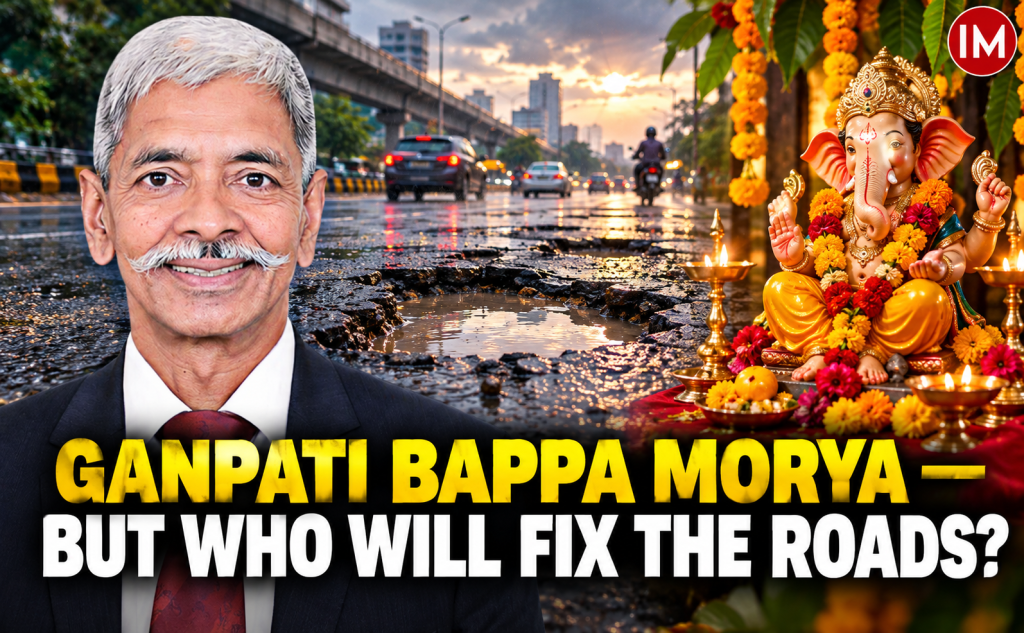
Every year, a few days before Lord Ganesha arrives, I find myself doing the same odd little ritual. I check the sky for rain, and then I check the road outside my gate for craters. This year is no different. Ganesh Chaturthi celebrated on Monday, 14 September 2026, and the roads, true to form, are already keeping their own separate calendar of collapse.
There is something almost theatrical about it. The remover of obstacles arrives in a nation that cannot remove a pothole. I say this not as a cynic, but as a soldier who has spent thirty-six years believing that infrastructure is destiny — for an army, and for a nation.
ROADS ARE POWER, NOT JUST TAR
In my years in uniform, I learned early that a nation’s roads are never just roads. They are strategic assets. Border roads decide how fast a brigade can move to the Line of Actual Control. Highways decide how fast an economy can move goods to a port. China understood this decades ago and built accordingly along its frontier. India, to its credit, has closed much of that gap through the Border Roads Organisation and a genuinely ambitious national highway push.
But ambition without durability is a strategic liability, not an asset. When the London Times runs a piece titled ‘It’s roads to ruin as Indians count cost of Modi, the motorway PM’, that is not just an embarrassing headline. It is a dent in the credibility India needs as it courts global capital and positions itself as a counterweight to China’s infrastructure diplomacy. Perception, in geopolitics, is often half the battle.
THE MONSOON’S ANNUAL AUDIT
This year’s monsoon has been unusually unkind to India’s newest showpieces. The Delhi-Dehradun Expressway, inaugurated by the Prime Minister on 14 April 2026 at a cost of roughly $1.26 billion, developed large potholes and cracks within three months of opening. The Lucknow-Kanpur Expressway caved in barely weeks after its own inauguration, prompting the NHAI to initiate proceedings to declare the developer, PNC Infratech, a non-performing contractor.
Also Read – How Prime Minister Narendra Modi transformed governance, delivery and India’s global standing
The newly commissioned Pune-Mumbai ‘Missing Link’, built at a cost of nearly ₹6,695 crore, had to be shut for a day in early July after a landslide near one of its tunnels. In Mumbai, a pedestrian died after falling into an uncovered manhole in Sakinaka, forcing the civic body to suspend four officials. The Times of India, in an editorial bluntly titled ‘Pothole Nation’, called it what it is — a systemic failure, not a monsoon accident.
None of this is new to us, if we are honest. What is new is the scale of the embarrassment, arriving right as India talks of its journey from a $5 trillion economy to a $10 trillion one, by 2033-34 and further, to a top-three global economy by the time we mark our centenary in 2047.
LOGISTICS WINS WARS, NOT SLOGANS
Napoleon is credited with saying that an army marches on its stomach. I would add — and it marches on its roads. No campaign plan, however brilliant, survives contact with a broken supply line. In the forces, a commanding officer owns the outcome of his unit, failure included. There is no ambiguity, no committee to blame, no monsoon to hide behind.
Civil infrastructure needs that same command culture. Accountability cannot be an afterthought invoked only when a viral video embarrasses the establishment. The NHAI‘s move against PNC Infratech is a step in the right direction — it treats a construction failure the way the military treats an operational one, as a matter demanding consequence, not just correction.
THE BOARDROOM LESSON IN EVERY POTHOLE
An Independent Director should look at a collapsing expressway as a governance failure inside a company because that is precisely what it is. Somewhere between the detailed project report, the contractor’s bid, and the final quality check, oversight broke down. That is not an act of God. That is a failure of assurance.
Every rupee spent redoing a road that should have lasted fifteen years is capital destroyed, not capital deployed. Every re-tarred stretch also carries a quiet environmental cost — wasted bitumen, wasted cement, an unnecessary carbon footprint — the kind of number an ESG audit should be flagging, not ignoring. Boards overseeing infrastructure companies would do well to treat quality assurance with the same rigour they reserve for financial audits. A balance sheet can look healthy right up until the road it financed caves in.
India’s road-building story has, too often, bought the equipment — the expressways, the flyovers, the ribbon-cuttings without fixing the assurance soil testing, drainage design, contractor accountability, third-party quality audits. Until that fundamentally changes, every monsoon will keep finding us out, however impressive the scorecard looks in dry weather.
A REFLECTIVE ENDING
This Ganesh Chaturthi, as Bappa is welcomed into homes across the country, I will make my own quiet, slightly stubborn wish. Not for grander expressways or bigger inauguration banners, but for roads that simply survive the rain they were always going to face — because monsoons, unlike political cycles, are entirely predictable.
A nation preparing to mark its centenary in 2047 deserves an infrastructure story it does not have to apologise for every July. Ganpati Bappa Morya- May your next year’s visit find fewer potholes waiting to greet you and a republic that has finally learned to fix the fundamentals.
About the Author- Colonel M V Shashidhar (Retd) is a Defence & Strategic Affairs Expert, Certified Independent Director (IICA), ESG Advocate and Governance Thought Leader
Disclaimer—(The views and opinions expressed in this article are solely those of the author and do not necessarily reflect the views of Indian Masterminds. For feedback or queries, please write to [email protected].)
Also Read – Narendra Modi: The Leader I Have Seen Beyond the Public Persona