For a forest officer, protecting a tiger reserve is not only about guarding trees and wildlife. It is also about dealing with people, old encroachments, limited staff, difficult terrain and years of unresolved issues.
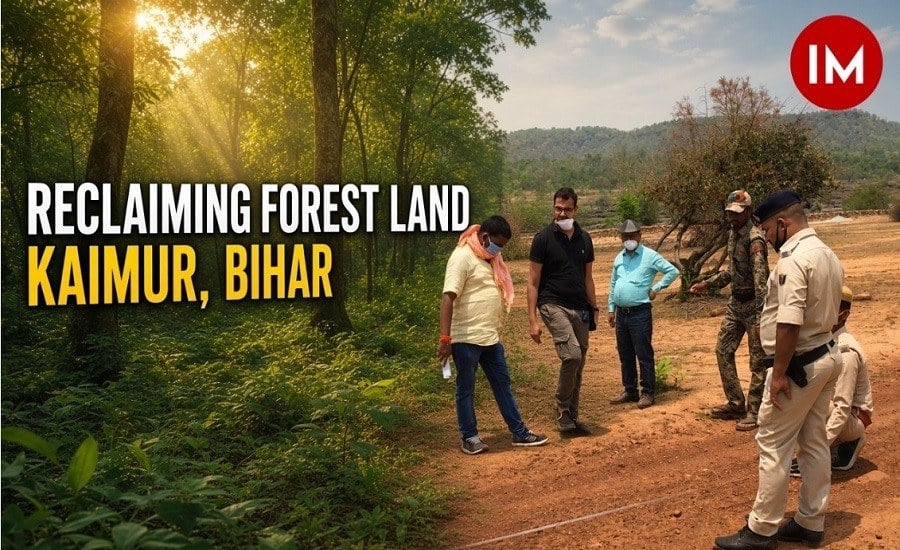
Currently posted at Valmiki Tiger Reserve in Bihar, 2016-batch Indian Forest Service officer Vikas Ahlawat faced many of these challenges while working to strengthen forest protection and restore degraded areas during his tenure at Kaimur. His approach combined field action with community engagement. Instead of treating every problem only as an enforcement issue, he also tried to understand the reasons behind it and find practical solutions.
One of the biggest challenges was encroachment. Forest land was spread across several locations, while the available staff was limited. At one point, only a handful of forest guards were available against the large area that needed protection.
“The biggest challenge was dealing with local communities who were carrying out agricultural activities on the forest land. We had to find a way where forest protection and the concerns of local people could be addressed together,” Ahlawat explained.
Tackling Encroachment Through Dialogue
One of the most difficult cases involved the area near the Mundeshwari Temple. Around 200 shops had come up on forest land over many years. Earlier attempts to remove them had not succeeded.
Ahlawat and his team decided to approach the issue differently.
The forest department first held discussions with the district administration. They also sought support from the state government. The team identified nearby government land where the affected shops could potentially be relocated.
The proposal was simple. Instead of removing people without an alternative, an effort was made to provide another location while protecting the forest area.
The exercise required discussions with officials, local representatives and the community. It was not an overnight solution. But the process helped create a better understanding of the need to protect the forest.
At the same time, village-level meetings became an important part of the strategy.
The forest department met villagers and discussed pending encroachment cases. Several families came forward and expressed their willingness to stop cultivation on forest land if their cases could be resolved.
“Village by village, we started meeting people. Many villagers came forward and said they were willing to stop cultivation if their cases could be resolved early,” said Ahlawat.
This created space for dialogue where there had earlier been confrontation.
Building Protection Around the Forest
Ahlawat’s work was not limited to removing existing encroachments. The focus was also on preventing fresh encroachment.
Large-scale soil and moisture conservation works were taken up inside the forest. These structures helped conserve water and improve the forest landscape. They also created a clearer physical presence of the forest boundary.
The officer recalls that the work was spread across several sites rather than being concentrated in one location.
In addition, the team worked on strengthening boundary demarcation. The objective was to make the forest boundary more visible and reduce the possibility of future encroachment.
Around 1,500 acres of forest land were brought under plantation and restoration efforts during the period.
But Ahlawat also realised that plantation alone was not enough.
Why Local Species Matter
One of the lessons that emerged from the field was the importance of using species suited to local conditions.
Plantations can survive for the first few years with protection and maintenance. But once that support reduces, survival becomes more difficult, especially in remote areas where cattle grazing and other local pressures continue.
Ahlawat therefore emphasised the importance of local species and natural regeneration.
He also observed that several traditional trees growing on government land around villages were already being protected by local communities.
“People are purposefully protecting some of these traditional trees. There is a substantial amount of government land around the villages where local communities have traditionally protected trees,” he explained.
This understanding helped the department look beyond conventional plantation models and recognise the role of communities in protecting local vegetation.
Mapping Trees and Understanding the Landscape
The restoration work also involved documentation and field-level mapping.
In several villages, thousands of trees were identified and tagged. The exercise helped create a better understanding of the vegetation around the forest landscape.
Technology was used to support this work. Surveys and mapping helped the team understand forest boundaries, habitation areas and the distribution of vegetation.
Such information is useful for long-term management because forest protection depends not only on what is inside a protected area but also on what happens around it.
Nurseries Closer to the Field
Another practical intervention was the development of nurseries closer to the areas where plantation work was required.
The team established several nurseries in and around local areas. A large share of the plantation material could therefore be sourced closer to the planting sites.
This helped reduce transportation costs and made plantation work more practical.
The approach also connected restoration with local participation. When activities were carried out closer to villages, people could see the work and engage with it more easily.
Community Trust Became a Conservation Tool
For Ahlawat, community participation was not an additional activity. It was part of forest protection itself.
In several villages, voluntary contributions and local participation were encouraged. Small interventions were used as confidence-building measures.
The idea was to show communities that forest protection did not mean ignoring their needs.
In areas where the department had faced resistance earlier, these interactions helped create support for conservation activities.
This became particularly important in dealing with encroachment. The team understood that long-term protection would be difficult if local communities remained disconnected from forest management.
Strengthening Grasslands and Wildlife Habitat
The restoration efforts also extended to grassland areas.
Several hundred acres of land were cleared of encroachment and brought back under protection. The objective was not simply to remove people from the land. It was to ensure that the restored areas remained free from future encroachment and were maintained as wildlife habitat.
The work also supported grassland management and natural habitat restoration.
Ahlawat believes that the impact of such restoration becomes visible over time. One indicator is wildlife movement and sightings in areas that were earlier under pressure.
A 15-Hour Operation Against Tendu Smuggling
Forest protection also required strong enforcement.
In 2021, an operation against illegal smuggling of tendu leaves lasted around 15 hours. With the support of the police, the team seized 15 vehicles and secured the prosecution of 10 accused persons.
The operation demonstrated the importance of coordination between the forest department and other enforcement agencies.
Illegal forest produce trade can place additional pressure on forest resources. Stopping such networks therefore becomes an important part of protecting the landscape.
“I Was Lucky to Have a Strong Team”
Despite the scale of the work, Ahlawat does not attribute the achievements only to himself.
During the conversation, he repeatedly acknowledged the contribution of his team and other departments.
“I have not done that much as an officer. I was lucky enough to get a good team,” he said.
That statement reflects another important aspect of his working style.
The work at Valmiki Tiger Reserve involved forest staff, local communities, the district administration, police personnel and other stakeholders. Large-scale restoration and protection could not have been achieved by one officer working alone.
For Ahlawat, the role of an officer is to bring these different efforts together.
From Restoration to Eco-Tourism
The larger vision also included eco-tourism.
Plans were developed for an eco-tourism circuit connecting important sites in the region. The proposed circuit was intended to link different locations and create a wider tourism experience around the landscape.
The idea was to connect conservation with awareness and local economic opportunities.
The broader objective was clear: a protected area should not only be protected from threats. It should also become a source of awareness, pride and livelihood opportunities for surrounding communities.
Conservation Through People, Protection and Persistence
The experience of Vikas Ahlawat at Valmiki Tiger Reserve shows that forest conservation is rarely a single intervention.
It involves removing encroachments, restoring land, protecting boundaries, conserving soil and water, raising plantations, mapping resources, stopping illegal activities and working with communities.
Most importantly, it requires persistence.
At Valmiki, the effort has been to move from short-term action to long-term protection.
Encroached land was reclaimed. More than 1,500 acres were taken up for plantation and restoration. Local communities were brought into discussions. Forest protection was strengthened through enforcement and infrastructure.
The work also showed that conservation does not always begin with a dramatic operation. Sometimes it begins with a village meeting, a conversation with a family, a mapped boundary or a small restoration structure.
For Ahlawat, these individual steps together create a larger change.
And in a landscape as important as Valmiki Tiger Reserve, that change means more secure forests, better habitats and a stronger relationship between people and the protected area.