There are some leaders whom we admire from a distance. There are others from whom we learn simply by watching them live and work. Narendra Modi ji belongs to the second category. My association with him over the years has given me the opportunity to observe not only the Prime Minister and political leader that the country sees, but also the person behind the public persona—the swayamsevak, the organiser, the administrator and, above all, the sevak who has dedicated his life to the nation.
When I reflect on his remarkable journey, three words immediately come to mind: organisation, dedication and vision. These three dimensions have remained visible throughout his life—from his early years and his association with the Sangh, through his organisational responsibilities and his tenure as Chief Minister of Gujarat, to his leadership of the country.
His journey is not merely a story of political success. It is the story of a person who learnt to organise people around a larger purpose, dedicated himself completely to that purpose and eventually articulated a vision capable of inspiring an entire nation. I have often seen him with a different perspective which I have chronicled in my book ‘Apnapan-Narendra Modi Sang Mere Anubhav’ (Affection – My Experiences With Narendra Modi). Drawing from nearly three decades of personal association, Modi comes across not merely as a political leader but as an administrator driven by relentless curiosity, technological foresight, attention to detail and an unwavering commitment to continuous improvement.
One of my earliest memories dates back to the early 1990s, immediately after the Ekta Yatra to Kashmir where at the height of militancy, the then BJP chief Dr. Murli Manohar Joshi, unfurled the National Flag at Lal Chowk in Srinagar. During those years, I frequently met Narendra Modi at the Delhi residence of Dilipbhai Sanghani, then the Member of Parliament from Amreli, where Modi would stay whenever he visited the national capital.
Also Read – How Prime Minister Narendra Modi transformed governance, delivery and India’s global standing
The accommodation was modest—a small room that doubled as his workplace. Yet what left a lasting impression on me was not the simplicity of the setting but Modi’s complete immersion in work. Wrapped in a muffler during winter or carrying a simple cotton towel over his shoulder, Modi would spend hours working on a desktop computer with extraordinary concentration.
Today such a scene may appear commonplace, but in the early 1990s it was remarkably uncommon. Computers were rare, particularly among political leaders. In many circles, these things were viewed as expensive luxuries rather than practical tools. Some even regarded them with suspicion.
Narendra Modi, however, had already recognised technology’s transformative potential. Long before digital governance became fashionable, he understood that technology could fundamentally change the way governments functioned and connected with citizens. That conviction would later shape initiatives ranging from Digital India to direct benefit transfers, online public services and transparent governance.
I do remember another incident from 1998, when Modi was in charge of the Bharatiya Janata Party’s campaign for the Madhya Pradesh Assembly elections. During a meeting with party workers, Modi asked a simple question: “How many of you have an email ID?”
The question drew laughter rather than answers. Senior BJP leader Babulal Gaur, who later became Chief Minister of Madhya Pradesh, jokingly remarked, “You keep talking about ‘female, female’—what difference will that make?” confusing the unfamiliar word “email” with “female”. The room erupted in laughter.
Looking back today, the episode reflects not ignorance but the technological landscape of that era. Email was virtually unknown to most political workers. Yet Modi was already encouraging digital communication years before it became an everyday necessity. This incident is an example of Modi’s remarkable ability to anticipate future trends long before they became mainstream.
Another episode reveals a different dimension of Modi’s leadership—his habit of probing beneath the surface of every issue. During a programme organised by the Ministry of Jal Shakti, the Prime Minister was walking towards the stage after viewing an exhibition on the Amrit Sarovar initiative. I briefly explained the concept to him. Ordinarily, the conversation could have ended there. Instead, Modi returned to the subject a little later. “How much water does that Amrit Sarovar actually hold?” he asked. “From what I saw, it seemed rather shallow. If that is the case, how will fish farming become viable? What is its actual water storage capacity?”
What began as a routine briefing instantly evolved into a discussion about functionality, sustainability and public benefit. For Modi, information is never merely informational. Every fact leads to questions, every question to possibilities, and every possibility to practical outcomes. This is one of the Prime Minister’s defining qualities. He is extraordinary listener. He does not listen as a matter of courtesy; he listens with complete attention. He seeks context, understands implications and looks for opportunities to improve outcomes. Even an ordinary conversation often becomes the starting point for practical solutions because he is constantly searching for ways to convert ideas into public value.
Perhaps the most revealing anecdote concerns the Pravasi Bharatiya Divas held in Indore in 2023. Soon after the event concluded, Modiji called me and put a straightforward question: “How was the programme?” I responded that it had been highly successful. Large numbers of delegates had attended, visitors appreciated the arrangements, enjoyed exploring the markets and interacted warmly with local residents.
The Prime Minister listened before asking another question that reflected his administrative instincts. “Do you have any system for collecting feedback? Have you created any mechanism to assess the participants’ experience?” Without waiting for a response, Modi began sharing reports that had already reached him through his own channels. He pointed out that the main hall had fallen short of seating capacity. Some officials had occupied seats reserved for distinguished guests. The venue had become noisy. Several delegates were left waiting outside because of overcrowding and were understandably disappointed.
For me, what stood out was not merely the speed with which the Prime Minister had obtained this information but the comprehensiveness of the feedback network. Success, Modi believes, cannot be measured only by applause or attendance. Every event must be evaluated honestly so that shortcomings become lessons for the future.
The conversation did not end there. Modi then drew my attention to a matter of protocol. The event had been attended by three Presidents—the President of India, Ram Nath Kovind, Guyana’s President Dr Mohamed Irfaan Ali and Suriname’s President Chandrikapersad Santokhi.
“When such distinguished dignitaries are present,” Modi advised, “those speaking before them should keep their remarks brief and meaningful.” Both me and Jyotiraditya Scindia had delivered lengthy speeches. “It would have been better to speak briefly,” Modi observed. “Taking too much time is not appropriate in such situations.” For me, the advice was not criticism but an enduring lesson in leadership and public conduct. It demonstrated that even seemingly minor aspects of an event—timing, etiquette and respect for protocol—are integral to effective governance.
These recollections reinforce a broader theme that runs throughout my book : Narendra Modi’s administrative style is rooted in preparation, precision and constant learning. The book also highlights qualities that have become closely associated with his governance model over the past decade.
Whether reviewing flagship schemes, monitoring implementation through technology, interacting directly with beneficiaries or insisting on measurable outcomes, Modi repeatedly emphasises that policies succeed only when execution is closely monitored. His preference for real-time dashboards, digital tracking, direct communication with officials and continuous review reflects the same mindset visible in these personal anecdotes.
Modi has a strong belief that governance must remain citizen-centric. Programmes are not judged by announcements but by their impact on ordinary lives. Feedback, field reports and direct interaction with beneficiaries are treated as indispensable tools for improving delivery. This emphasis on accountability has shaped initiatives ranging from infrastructure development and water conservation to welfare delivery and digital governance.
Another recurring characteristic is Modi’s extraordinary memory for detail. Whether discussing a development project, a public event or a government scheme, he is known to revisit conversations, recall figures and ask follow-up questions months later. For colleagues and officials alike, this creates a culture where preparation is expected and superficial answers rarely suffice.
Ultimately, the book is less about dramatic political moments than about the everyday habits that define leadership. The stories are simple—an old desktop computer in a modest room, an early conversation about email, a few probing questions about a village pond, a post-event phone call seeking honest feedback. Yet together they reveal a consistent pattern of thinking.
Modi is a leader who embraced technology before it became fashionable, who values facts over assumptions, who listens more than he speaks, who treats criticism as a tool for improvement and who believes that governance is an ongoing process of learning rather than a series of completed achievements.
These habits—not merely political success—form the foundation of Narendra Modi’s approach to governance. They explain why, for him, every conversation is an opportunity to learn, every challenge a chance to innovate and every experience a lesson for building better public administration.
To understand Modi ji’s working style, one must first understand his extraordinary understanding of organisation. For him, organisation is not merely about structures, offices or systems. It is about people. It is about bringing together individuals with different abilities and experiences, giving them a common purpose and creating the confidence that their collective effort can achieve something much larger than what any one person could accomplish alone.
His formative years in the Rashtriya Swayamsevak Sangh played an important role in shaping this approach. The discipline, social commitment and spirit of service that he experienced there became an important part of his personality. But his understanding of organisation did not remain confined to any one institution. Over the years, he demonstrated an ability to build teams, connect with people, inspire workers and transform individual effort into collective strength.
This quality became particularly visible during his years in Gujarat. As Chief Minister, he developed a model of governance that sought to bring together development, agriculture, infrastructure, social welfare and people’s participation. The experience of Gujarat eventually became part of a larger national vision.
When Modi ji came to the national stage, he carried this organisational experience with him. He understood that India’s transformation could not be achieved by government alone. It required Jan-Bhagidari—people’s participation. That has become one of the defining features of his style of governance.
From Seva to Rashtra Pratham
The second defining quality is dedication—Samarpan. Modi ji’s life has taught me that dedication is not simply working hard. It is the willingness to place a larger purpose above personal considerations.
There is a beautiful idea in our tradition: “Vasudhaiva Kutumbakam”—the entire world is one family. This spirit of looking beyond oneself and working for the welfare of others has remained central to Modi ji’s thinking. His understanding of seva is similarly expansive. Service is not something undertaken occasionally. It is a way of life.
This is why the idea of Antyodaya has such importance in his thinking. The true test of development is whether it reaches the person standing at the last mile. The measure of governance is not simply how much has been achieved at the top, but whether the weakest and most deprived person has experienced a change in his or her life.
The examples are visible in many forms: providing food security to millions, ensuring that benefits reach intended beneficiaries, transferring assistance directly into farmers’ accounts, encouraging young people to create their own opportunities and bringing dignity and confidence to those who have historically remained at the margins. For Modi ji, development is meaningful only when it improves the life of the ordinary citizen. This is why seva and Antyodaya are inseparable from his understanding of governance.
Think Beyond the Present
One of the qualities I have particularly admired in Modi ji is his maturity as a leader. He does not look at every decision only from the perspective of its immediate outcome. His thinking is often about what a decision will mean five, ten or twenty years from now.
This ability to think beyond the immediate is essential in national leadership. A country cannot be transformed only through short-term measures. It needs a direction, a long-term objective and the patience to pursue that objective consistently.
Modi ji’s vision of a Viksit Bharat—a developed India—reflects this approach. He has encouraged Indians to look at development not merely as an economic objective, but as a comprehensive national transformation—an India that is technologically capable, economically strong, socially inclusive, culturally confident and respected across the world.
What is particularly significant is that he has sought to turn this vision from a government objective into a people’s aspiration. That is the difference between announcing a goal and creating a national mission.
The Six Pillars of His Working Style
I have observed that Modi ji’s working style can be understood through six principles: Purpose, Prioritisation, Plan, Persistence, Proof and Propulsion.
Purpose comes first. Every important decision must have a larger objective. It should not be limited to an immediate or temporary benefit but should contribute to lasting change. Then comes Prioritisation. Everything cannot have equal importance. A leader must identify what is most important, concentrate his energies on it and move forward with clarity. The third is Plan. An idea can inspire people, but a plan converts that idea into action.
Then comes Persistence. Difficulties and obstacles are inevitable. What distinguishes successful leadership is the willingness to continue despite them. The fifth is Proof. Ultimately, leadership must be demonstrated through results. Ideas, plans and promises acquire meaning only when they translate into visible outcomes and make a difference in people’s lives. And finally, Propulsion—the ability to give momentum to an idea, a programme or an institution and carry it forward with energy and determination.
This sequence is important. It moves from purpose to prioritisation, from planning to persistence, from proof to propulsion—from identifying what must be done to demonstrating results and then creating the momentum for greater transformation.
From Government to Jan-Bhagidari
Perhaps one of the most significant aspects of Modi ji’s leadership is his effort to transform citizens from beneficiaries into participants. He believes that government can provide direction and create systems, but lasting transformation requires society to become a partner.
I have seen this philosophy reflected in small but powerful changes in everyday life. Young people who once waited for opportunities have been encouraged to create them. Small shopkeepers have embraced digital payments. Citizens have increasingly begun to see themselves as contributors to national development. These may appear to be individual examples, but together they represent something much larger: a change in mindset. This is the essence of Jan-Bhagidari.
The philosophy is captured in the expression “Sabka Saath, Sabka Vikas, Sabka Vishwas, Sabka Prayas.” Development is not the responsibility of the government alone. It becomes sustainable when people participate in it.
For me, this is one of Modi ji’s most important contributions to the practice of governance: he seeks to create ownership among citizens.
Discipline with Compassion
Modi ji’s leadership also demonstrates an unusual combination of discipline, courage, compassion and foresight. Discipline gives direction to effort. Courage gives the strength to take difficult decisions. Foresight allows a leader to anticipate the future. But all these qualities must ultimately be balanced by compassion. I have seen that his understanding of public service is deeply connected with the dignity of the individual.
A farmer is not merely a beneficiary of a government scheme. A woman receiving support is not merely a number in a government database. A poor family receiving assistance is not merely an administrative statistic. Behind every policy is a human being. This sensitivity towards the ordinary citizen is an important part of his leadership.
It is also why Antyodaya occupies such a central place in his thought. The ultimate purpose of governance is to ensure that the person at the farthest end of society is also able to experience the benefits of development.
The Message: A New Confidence in India
The third dimension is Sandesh—the message. Modi ji has given India a message that goes beyond any particular government programme or political moment. He has encouraged Indians to look at themselves not merely as citizens of a country with a glorious past, but as participants in building a glorious future. He has sought to awaken a new confidence: the confidence that India can lead, innovate, compete and contribute to the world. At the same time, he has connected national progress with individual responsibility. His message to young Indians is not simply to ask what the country can provide them, but also to ask what they can contribute to the country. This is an important change in national consciousness.
The aspiration for a developed India is therefore not simply about economic growth. It is about creating a society in which citizens believe that their own effort matters to the nation’s future.
What Modi Ji Has Taught Me
I have spent more than three decades in public life, working in organisations and government. My association with Modi ji has therefore been a source of many lessons. The most important is perhaps this: leadership is not about the position one occupies; it is about the responsibility one accepts. Modi ji’s journey demonstrates this continuity.
The responsibilities changed—from swayamsevak to organiser, from Gujarat to the national stage—but the underlying spirit of service remained constant. He has never treated public life merely as a political opportunity. For him, it has been an instrument for national service. His emphasis on Rashtra Pratham—Nation First—gives this approach its ultimate direction.
Personal ambition, political considerations and individual interests must remain secondary when the larger national interest is at stake. That is a lesson that extends beyond politics. It is relevant to every citizen, every profession and every generation.
A Vision That Has Become a People’s Aspiration
When I look at Narendra Modi ji’s life and leadership, I see a remarkable continuity between his experiences, his values and his vision. The strength of organisation taught him the importance of collective effort. Samarpan taught him to dedicate himself to a larger purpose. And his vision has sought to give that purpose a national direction.
Today, the dream of a developed India is no longer merely an idea discussed in policy circles. It has become an aspiration that millions of Indians can see themselves participating in. That, to me, is the mark of mature leadership: to think beyond oneself, to think beyond one’s own time and to give people the confidence to believe in a larger future.
I see Modi ji not merely as the Prime Minister of India, but as a sevak of Bharat Mata and of the people of this great country. His journey reminds us that great nations are not built by governments alone. They are built when governments, institutions and citizens come together with a shared purpose. And that is perhaps the most enduring lesson I have learnt from Narendra Modi ji: Put the nation first. Serve the people. Take everyone along. And never stop believing in the possibility of a better India.
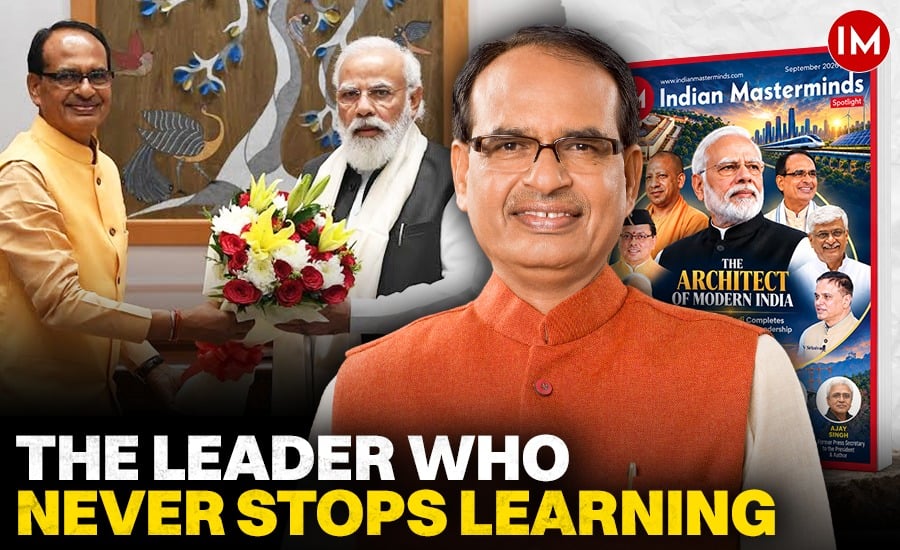
(The article is written by Shivraj Singh Chouhan, Union Minister of Agriculture and Farmers Welfare of India which was published in the September edition of Indian Masterminds Spotlight)
Also Read – “Sports Has Always Been More Than a Career for Me”: Dr Radhika Mishra Clears MPPSC Sports Officer Exam