There have been only a few personalities in the vast landscape of Indian politics who have not merely governed their country but have also stirred the global consciousness and helped reshape it. The life and leadership of our Hon’ble Prime Minister, Shri Narendra Modi, stand as a living embodiment of that transformative spirit.
September 17 is therefore not merely a day to celebrate the birthday of India’s successful Prime Minister. It is a celebration of the resolve, vision and unwavering commitment to the nation that, over the past decade, has fundamentally transformed India’s identity on the global stage.
Turning Vision into Governance
Coming from the sacred land of Uttar Pradesh, where the civilisational traditions of Lord Ram and Lord Krishna have always taught us the values of dharma and duty, I see Prime Minister Modi’s leadership as a guiding light that has taken the very idea of sushasan—good governance—from its literal meaning to something tangible, touching and transforming the everyday lives of ordinary citizens.
As Chief Minister, entrusted with the welfare of 250 million people of Uttar Pradesh, I have found the Prime Minister’s guidance serving as a compass at every step. His greatest strength, in my view, is his ability to turn imagination into reality and resolve into accomplishment.
For Prime Minister Modi, governance does not end with framing policies. It is a means of bringing a smile to the face of the person standing at the very last rung of society—the antyodaya that Pandit Deendayal Upadhyaya spoke of. When we see the mantra of Sabka Saath, Sabka Vikas, Sabka Vishwas and Sabka Prayas taking shape on the ground, we realise what good governance truly means: policies reaching every citizen without discrimination on the basis of caste, creed or differences of opinion.
The Double-Engine Model
In Uttar Pradesh, we have made this very vision of Prime Minister Modi the cornerstone of our governance model.
When the double-engine government began its journey, one of our first commitments was to dismantle the entrenched corruption and administrative dysfunction that had eaten into the system like termites. Prime Minister Modi has consistently made one point clear: a system that harasses its own citizens can never be called good governance.
Uttar Pradesh therefore adopted a policy of zero tolerance towards crime. The results are there for everyone to see. The backbone of organised crime has been broken and criminals today understand that the law will prevail. This is not merely the outcome of police action. It reflects the political will established under Prime Minister Modi’s leadership—a political ethos in which security and good governance have become inseparable.
Governance to the Last Mile
One of the most important tests of good governance is whether the benefits of development remain confined to metropolitan centres or reach the remotest villages of the country.
Prime Minister Modi brought to India transformative instruments such as Digital India and Direct Benefit Transfer, which have plugged the channels through which corruption and leakages once flourished. In Uttar Pradesh, we have worked relentlessly to take these initiatives to every section of society.
Today, through DBT, money reaches the bank accounts of entrepreneurs, farmers, workers and students directly. The culture of middlemen has been virtually eliminated. When a poor farmer receives his PM-Kisan Samman Nidhi directly in his bank account, the light in his eyes is perhaps the most powerful measure of the success of good governance.
Infrastructure of a New India
Prime Minister Modi has also given a new momentum to India’s infrastructure story. The expanding network of expressways, modern railways, metro systems and airports across the country reflects the vision of Gati Shakti. Uttar Pradesh, today, has emerged as the country’s ‘Expressway State’.
Every time we see these roads taking shape, we are reminded that development is not merely an economic activity. It is a bridge that connects a nation—its people, markets, aspirations and opportunities.
The industrial corridors emerging along these expressways are creating employment for the youth of Uttar Pradesh and accelerating the state’s journey towards becoming a one-trillion-dollar economy.
A Leadership Rooted in Discipline
In my years of working with Prime Minister Modi, there is one quality I have experienced very closely: his extraordinary work ethic and his unmatched commitment to the nation.
He works virtually round the clock in the service of the country and expects the same sense of commitment from those who work with him. His daily routine and work culture are marked by discipline, precision and an acute respect for time.
I recall an important administrative meeting where a few officials arrived slightly late. Without anger or reprimand, the Hon’ble Prime Minister conveyed, with remarkable courtesy but equal firmness, that the time of the people and the work of the nation must always come first.
That incident taught me an important lesson: discipline in leadership cannot be demanded merely of others. It must first be practised by the leader himself.
Leading with Sensitivity in a Crisis
Prime Minister Modi’s leadership during the Covid-19 pandemic became an example for the world. At a time when the entire world was struggling with an unprecedented crisis, he worked not only to protect the lives of Indians but also gave the country the larger vision of Atmanirbhar Bharat, strengthening India’s economic resilience.
In Uttar Pradesh, the One District, One Product (ODOP) initiative connected traditional artisans and craftspeople with global markets. It became a powerful extension of the Prime Minister’s call for Vocal for Local.
Under his guidance, we also made extensive arrangements in Uttar Pradesh for the safety, return and employment of migrant workers during the pandemic. Our efforts received appreciation at the global level.
During those difficult days, the Prime Minister would call several times a day to understand the situation on the ground. But his concern went beyond seeking information. Like a guardian, he would ensure that Uttar Pradesh received every possible assistance from the Union government.
His approach during the pandemic offered another enduring lesson: difficult administrative decisions must be taken firmly, but always with sensitivity and compassion.
Empowering Women, Transforming Families
Women’s empowerment is another defining dimension of Prime Minister Modi’s model of good governance—one that has begun to transform the social landscape of the country.
From Beti Bachao, Beti Padhao to the Ujjwala Yojana, Pradhan Mantri Awas Yojana and Mission Shakti, a series of historic initiatives have been undertaken to make women safer, more empowered and economically self-reliant. The long-term impact of these measures is now visible across the country.
In Uttar Pradesh, the safety, dignity and self-reliance of women have been accorded the highest priority. Today, our mothers and sisters are not only more confident about their security but are also participating increasingly in governance and administration.
When a rural woman joins a self-help group and becomes a Lakhpati Didi, she does not merely change her own life. She transforms the economic destiny of her entire family and, in many cases, the social fabric of her community.
Development Without Losing Our Roots
The balance between environmental consciousness and cultural heritage is another distinctive feature of Prime Minister Modi’s approach.
Whether it is the rejuvenation of the Kashi Vishwanath Dham, the construction of the grand Ram Temple in Ayodhya, or the transformation of Kedarnath and Mahakal Lok, Prime Minister Modi has demonstrated that true development does not require a nation to turn away from its roots.
On the contrary, modernity and development acquire greater meaning when they move forward while preserving a civilisation’s cultural and spiritual heritage.
When Uttar Pradesh celebrates Deepotsav in Ayodhya or writes a new chapter of development in the ancient lanes of Kashi, we feel a deep sense of pride. We are witnessing an era in which India is reconnecting with and reclaiming the civilisational confidence of its glorious past.
A Deep Respect for Tradition
During his tenure as Chief Minister of Gujarat and even before that, whenever Prime Minister Modi visited Gorakhpur or interacted with Gorakshpeeth, his reverence for the traditions of the Peeth was always natural and deeply rooted.
Despite his extraordinarily busy schedule, he has always accorded complete respect to tradition. Whether it is the occasion of the Khichdi Mela or a review of the service activities associated with the Peeth, he pays attention to even the smallest details.
His effort has always been to ensure that Sanatan culture and India’s heritage receive recognition on the global stage.
The Encompassing Governance
Another defining characteristic of Prime Minister Modi’s leadership is its ability to embrace every section of society.
He has consistently worked to bring the most neglected and marginalised sections into the mainstream—whether sanitation workers, street vendors or persons with disabilities.
Through the PM SVANidhi scheme, street vendors and hawkers were connected with the formal banking system and given an opportunity to achieve economic self-reliance. Uttar Pradesh has emerged as one of the leading states in the implementation of this scheme.
This is the human face of good governance—the face that goes beyond statistics and touches the aspirations and emotions of the ordinary citizen.
A Collective Resolve for Viksit Bharat
As Prime Minister Modi completes another year of his life, it is also an occasion for all of us to renew our resolve to contribute wholeheartedly to his vision of Viksit Bharat 2047.
Uttar Pradesh is continuously working towards this goal. Our resolve is to transform India’s most populous state into the country’s greatest economic and social powerhouse, thereby contributing to the India that Prime Minister Modi envisions.
The life of our Hon’ble Prime Minister teaches us a fundamental truth: work undertaken with the spirit of Nation First can never be in vain. His indomitable spirit, immense public support and far-sighted policies inspire us every day to work with renewed energy and determination.
On behalf of the people of Uttar Pradesh and on my own behalf, I extend my heartfelt wishes for the Prime Minister’s long, healthy and fulfilling life. Under his leadership and guidance, India is not merely reclaiming its ancient civilisational position as Vishwaguru; it is also showing the way towards the welfare and well-being of humanity as a whole.
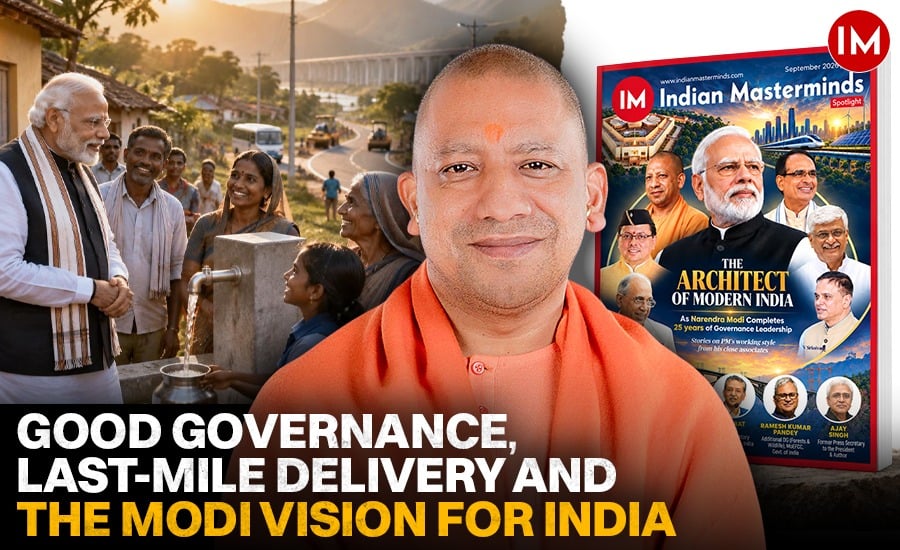
(The article is written by Uttar Pradesh’s Chief Minsiter Mr. Yogi Adityanath which was published in the September edition of Indian Masterminds Spotlight)
Also Read – How S. Ganeshalingam Is Taking Pudukkottai’s Conservation Efforts From Forests to Sea