A forest department’s work does not end at protecting trees. In Pudukkottai, conservation is being carried from dry forest landscapes to farms, villages and coastal waters. It includes planting trees, protecting forests, restoring mangroves, saving dugongs and rescuing sea turtles. It also involves working closely with farmers, students, fishermen and local communities.
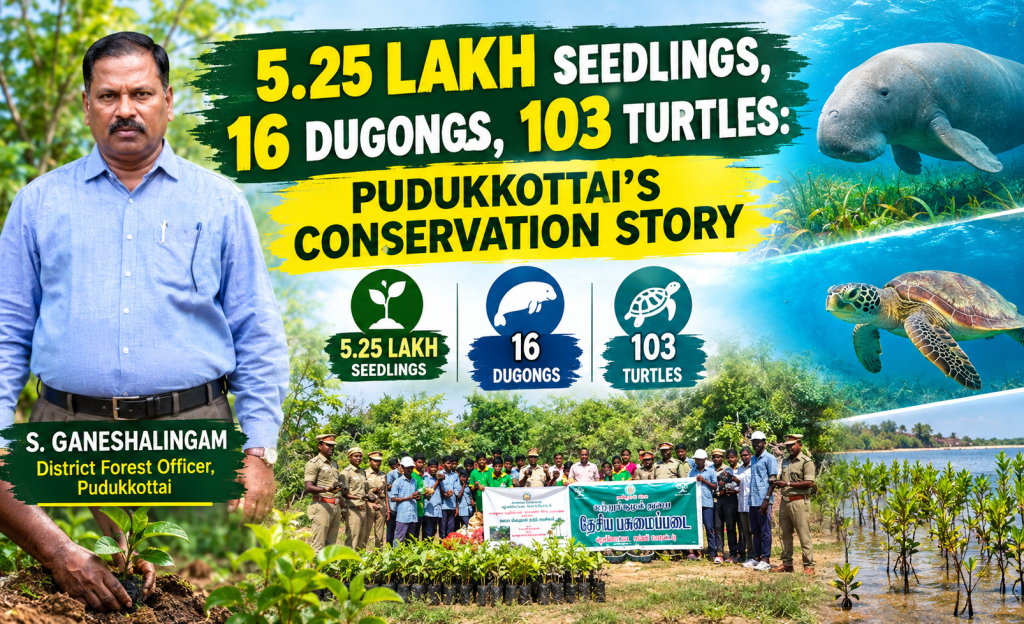
At the centre of this field-oriented approach is S. Ganeshalingam, District Forest Officer, Pudukkottai. Under his leadership, the Forest Division has focused on turning conservation plans into visible action on the ground through regular inspections, field reviews and close coordination with frontline staff.
Speaking to Indian Masterminds, Mr. Ganeshalingam explained that the emphasis has been on taking schemes beyond paperwork and ensuring that their impact is visible in the field. “Our focus is to ensure that conservation programmes result in real field action. Regular inspection, monitoring and coordination with our staff and local communities help us sustain the work,” he said.
PROTECTING FORESTS THROUGH FIELD ACTION
Forest protection remains the foundation of the programme.
The Pudukkottai Forest Division has strengthened patrolling, check posts and entry-pass systems. Fire prevention has also received attention through fire lines, fire-watchers and checks on inflammable material.
Encroachment prevention and removal are another important part of the work. Regular meetings with Forest Range Officers, Foresters, field staff and Village Forest Committee members help assess problems and take corrective action.
The results are reflected in enforcement data. During 2025–26, 23 wildlife offences and 84 other offences were recorded. The Division reported that 14 wildlife cases and all 84 other cases were successfully resolved.
For Ganeshalingam, field supervision is an important part of this process. Inspections help officers understand whether protection measures are working and where improvements are required.
5.25 LAKH SEEDLINGS PLANTED
The dry and low-rainfall character of Pudukkottai makes plantation survival a challenge. The Forest Division has therefore focused not only on planting but also on long-term maintenance.
Under the Green Tamil Nadu Mission (GTM), more than 5.5 lakh seedlings were raised and over 5.25 lakh seedlings were planted across nearly 987 hectares.
The programme follows the principle of “Right Species – Right Site – Continued Protection.” Badam, Vengai, Athi, Sisu, Neermaruthu and Illuppai were selected according to site conditions.
Plantation work begins with field assessment. On farmers’ lands, officials check soil, water availability, irrigation, fencing, land records and the farmer’s ability to maintain the plantation. The DFO also conducts divisional-level verification. After approval, the Forest Department undertakes site preparation, pit digging and planting. The locations are geotagged, with details of the beneficiary, species, land and plantation area recorded for monitoring.
The work continues after planting. Field staff guide farmers on watering and protection. Dead seedlings are replaced where necessary, while unwanted vegetation and grazing-related pressures are controlled.
“Planting is only the beginning. The real work is to ensure that the seedlings survive, grow and become a stable green cover,” Ganeshalingam said.
MAINTAINING 15,000 PLANTS
Under the GTM–NHAI scheme, first-year maintenance was carried out for 15,000 plants in the Pudukkottai, Keeranur and Thirumayam ranges. The focus was on regular care to improve plant health and survival.
The work was also inspected by the PCCF, Chennai, the CCF, Trichy, and the Minister for Backward Classes Welfare. The visiting officials appreciated the work during the field inspection and suggested that the effort be strengthened further. Such inspections have added another layer of accountability to plantation management.
RESTORING THE COAST
Pudukkottai’s conservation work extends beyond forests. In the coastal areas of Aranthangi Range, the Forest Division has taken up mangrove and Casuarina restoration as measures for water, soil and shoreline conservation.
A 20-hectare mangrove plantation was established and maintained for one year. Another 45,000 Casuarina saplings were raised and planted across 15 hectares, at 3,000 seedlings per hectare.
Mangroves were planted using a modified fish-bone design in the Muthukuda/Mumbalai coastal area. Awareness activities and name boards were also introduced to involve stakeholders.
Palmyrah planting has added another layer to the restoration effort. The species is being planted around waterbodies and along forest and coastal boundaries to help reduce soil erosion and create natural protective barriers. Under the Palmyrah Mission, 41,800 Palmyrah saplings/seeds were planted in Village Forest Council and Eco Development Committee villages.
MAKING COMMUNITIES PART OF CONSERVATION
The Forest Division has also placed community participation at the centre of its work. Farmers are involved in plantation programmes. Village Forest Councils and Eco Development Committees participate in conservation activities. Schools and colleges are brought into plantation and awareness drives.
Programmes are organised on forest conservation, climate change and wildlife protection during occasions such as World Environment Day and World Ozone Day. Sapling distribution and campaigns encouraging people to plant trees on birthdays have also been used to build wider public participation.
“People living around forests and coastal areas are important partners in conservation. Their participation makes protection stronger and more sustainable,” Ganeshalingam told Indian Masterminds.
16 DUGONGS RESCUED AND RELEASED
The most distinctive part of Pudukkottai’s conservation work is perhaps its marine programme. Dugong protection has been strengthened through permanent monitoring sites, periodic patrolling and awareness among fishing communities.
Since 2023, 16 dugongs have been rescued and released alive. The effort involved the Forest Department, Omkar Foundation, Wildlife Institute of India, fishing communities and other stakeholders. The programme also supports fishermen. Compensation is provided when fishing nets are damaged during accidental wildlife entanglement. Incentives are also provided for safe release.
This creates a system where fishermen become active participants in marine wildlife protection.
103 SEA TURTLES SAFELY RELEASED
The same community-based approach has been used for sea turtles. Since 2023, 103 Green Sea Turtles have been rescued and safely released into the sea. The Forest Department has worked with the Wildlife Institute of India, Omkar Foundation, fishing communities and other partners for rapid rescue and release.
Around ₹3.50 lakh has been provided as compensation and support under relevant conservation schemes. The aim is to encourage fishermen to report entanglements quickly and release turtles safely.
FROM RESCUE TO HABITAT RESTORATION
The Division has now moved beyond rescuing individual animals to restoring their habitat. In 2024–25, seagrass was established across 1,000 sq m, recorded as the first such effort in Pudukkottai district under the award documentation.
Seagrass provides important feeding habitat for dugongs and Green Sea Turtles. Additional sites are planned in Manamelkudi and P.R. Pattinam villages. Around ₹15 lakh has been allocated for 2026–27 to expand seagrass conservation and restoration.
A JICA delegation visiting the Dugong Conservation Centre in Aranthangi Range was also briefed on dugong protection, seagrass restoration, patrol boat monitoring and community-led turtle rescue.
A FOREST-TO-SEA CONSERVATION MODEL
Pudukkottai’s work brings together forest protection, plantation, coastal restoration, wildlife rescue and community participation. The figures show the scale: 5.25 lakh-plus seedlings planted, 987 hectares covered, 20 hectares of mangroves restored, 45,000 Casuarina saplings planted, 41,800 Palmyrah saplings/seeds planted, 16 dugongs rescued and 103 Green Sea Turtles released.
For Ganeshalingam, the larger goal is to connect these interventions into one conservation system.
“Forest protection, restoration and wildlife conservation cannot work in isolation. When field staff, communities, institutions and conservation partners work together, we can protect both habitats and species,” he said.
From a plantation site to a fishing village, and from a forest patrol to a dugong rescue, Pudukkottai’s conservation effort shows how field action can connect forests, communities and the sea.