For years, the wetlands of Bihar were full of life, but much of that life remained undocumented.
Every winter, thousands of birds arrive in Bihar after travelling long distances along the Central Asian Flyway. They gather on riverbanks, oxbow lakes, floodplains and wetlands. Some stay for the winter. Others use these habitats as feeding and staging grounds.
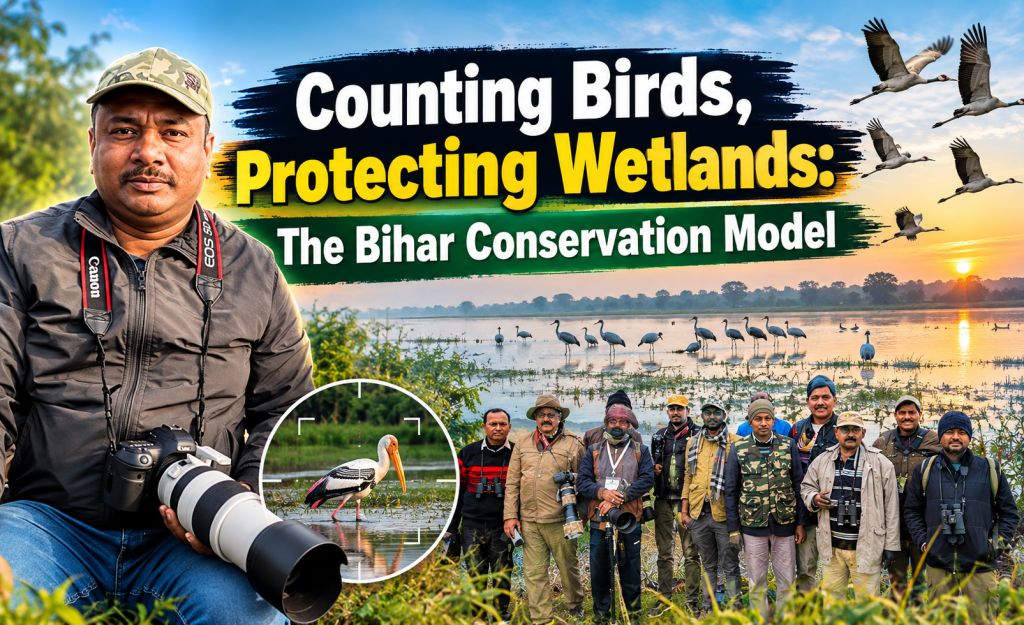
For Sudhakar S, a 2007-batch Indian Forest Service officer of the Bihar cadre, the realisation came through years of being in the field. He is currently serving as Regional Chief Conservator of Forests, Muzaffarpur Region, and State Nodal Officer for the Asian Waterbird Census (AWC), Bihar, under the Department of Environment, Forests and Climate Change, Government of Bihar.
His journey into bird conservation began in 2017, when he was posted as Divisional Forest Officer, Bhagalpur Forest Division.A major part of his work involved the Vikramshila Gangetic Dolphin Sanctuary. The sanctuary covers a 60-km stretch of the Ganga and includes vast floodplains, sandbars and wetlands.
Sudhakar and his team began spending Sundays on the river. They used a 24-seater boat to patrol the sanctuary and observe birds.
“We would spend the whole day on the river. Field staff, local birders, NGOs, Ganga Praharis and Dolphin Mitras would often join us. These trips opened our eyes to the biodiversity of the Ganga and its floodplains,” says Mr. Sudhakar S told Indian Masterminds.
The winter months brought migratory birds from Siberia, Mongolia, China and other parts of Central Asia. As winter ended, the sandbars revealed another spectacle. They became breeding grounds for birds such as Red-wattled Lapwings, Small Pratincoles and Little Ringed Plovers.
But watching birds was only the beginning.
Also Read – 209 Van Dhan Kendras, 62,000+ Beneficiaries: IFS Gaithaolu Thaimei’s Tribal Livelihood Work in Manipur
FROM BIRD WATCHING TO SCIENTIFIC MONITORING
The team soon realised that many wetlands were ecologically important but poorly documented. This led to a more structured approach. In 2020, the Bihar Forest Department entered into an MoU with the Bombay Natural History Society (BNHS) during CMS COP13 in Gandhinagar. The partnership helped establish a Bird Ringing and Monitoring Station in Bhagalpur.
It was the fourth such station in India and the first to be funded entirely by a state government. The next major step came in 2022, when Bihar launched the Asian Waterbird Census across its wetlands. What began with 68 wetlands in 16 districts has now expanded to 145 wetlands across 32 districts in 2026.
The scale of monitoring has also grown rapidly. The census recorded 45,173 birds in 2022. By 2026, the number had risen to 1,48,906 individuals, with 222 species recorded in that year’s census. Across the years, the surveys have documented 298 wetland and wetland-dependent bird species.
“The biggest change has been that wetland monitoring is no longer limited to a few locations or a few people. We now have scientists, forest staff, students, birders and local communities contributing to the same effort,” says Sudhakar.
DATA THAT CAN SHAPE CONSERVATION
The census is not simply about counting birds. The data is helping the Forest Department understand which wetlands are important, what threats they face and where conservation efforts need to be focused.
The surveys have highlighted important ecological networks along the Ganga, Gandak and Kosi rivers. They have also brought attention to oxbow lakes such as Kanwar, Ghatora and Gogabeel. The data has supported the identification of potential Ramsar sites and preparation of Ramsar Information Sheets.
Bihar had one Ramsar site in 2020. The number rose to three by 2024 and six by 2025. The surveys have also recorded globally threatened and Near Threatened species, including the Greater Adjutant, Common Pochard, Ferruginous Duck, Black-headed Ibis, Indian Skimmer and Steppe Eagle.
The 2026 AWC recorded 58 Central Asian Flyway concern species, including seven priority species, with more than one lakh individuals recorded.
TURNING CITIZENS INTO CONSERVATION PARTNERS
One of the most important parts of the model is the involvement of people who live around wetlands. Sudhakar and his team worked with universities, NGOs, researchers, students, fishermen and local communities. Groups such as Wetland Mitras, Dolphin Mitras, Ganga Praharis and Garud Saviours became part of the conservation network.
Students and researchers helped with surveys, data collection and habitat assessment. NGOs helped with community mobilisation and awareness programmes. Local communities took on an even more direct role.
In the Kosi floodplains, Garud Saviours help protect breeding colonies of the endangered Greater Adjutant on private farmland. They also help rescue fallen chicks and report threats.
“What we wanted was to make conservation a shared responsibility. A forest department cannot protect every wetland or every bird on its own. The people living around these habitats have to become their first line of stewardship,” says Sudhakar.
FROM BHAGALPUR TO KALRAV
Public awareness became another important part of the effort. During his Bhagalpur posting, Sudhakar’s team organised awareness programmes around the Vikramshila Gangetic Dolphin Sanctuary. Dolphin Day and Garud Diwas brought together students, scientists, NGOs, villagers and nature enthusiasts. Monthly discussions were also organised at the Nature Interpretation Centre in Bhagalpur.
These efforts eventually led to the first Bhagalpur Bird Festival in 2020. The three-day event brought together hundreds of participants. The idea then grew into Kalrav, Bihar’s first state-level bird festival, held in 2021 at Nagi-Nakti Bird Sanctuary in Jamui.
Bird walks, ringing demonstrations, expert sessions and discussions helped take wetland conservation beyond the Forest Department.
TECHNOLOGY MEETS CITIZEN SCIENCE
Technology has strengthened this growing network. The Bird Ringing and Monitoring System mobile application allows digital collection of bird and habitat information. Data such as bird counts and habitat conditions can be recorded and consolidated more efficiently.
The approach has also helped the department identify threats such as habitat degradation, pollution, land-use change and illegal hunting. This makes it possible to move from reactive action to more targeted conservation planning.
BUILDING THE NEXT PHASE
The work, however, is far from over. Bihar plans to expand its volunteer network and deepen citizen science across the state’s riverine landscapes. The department is also working on a state action plan for the Central Asian Flyway.
Another long-term goal is to establish a permanent study centre for migratory birds and wetland monitoring. At the same time, threats such as habitat degradation, poaching and illegal bird trapping continue to require sustained vigilance.
For Sudhakar, the next phase is about making the model stronger and more local. “The future of this programme depends on creating a much wider network of volunteers and making wetland stewardship part of local communities, schools and everyday life,” he says.
From a boat moving quietly along the Ganga to a state-wide network counting birds across 145 wetlands, Bihar’s waterbird conservation story has travelled a long way. At its heart is a simple idea: when science meets local knowledge and community participation, counting birds can become a powerful tool for protecting the places they depend on.
Also Read – Bihar’s ‘Rani Mistris’ Break the Male Monopoly, Earn ₹10,000 Extra Through Skilled Work