For many tribal communities in Manipur, forest produce has traditionally been an important source of livelihood. But collecting forest produce is only one part of the economic chain. Processing it, adding value, packaging it attractively and finding markets can determine how much income eventually reaches the community.
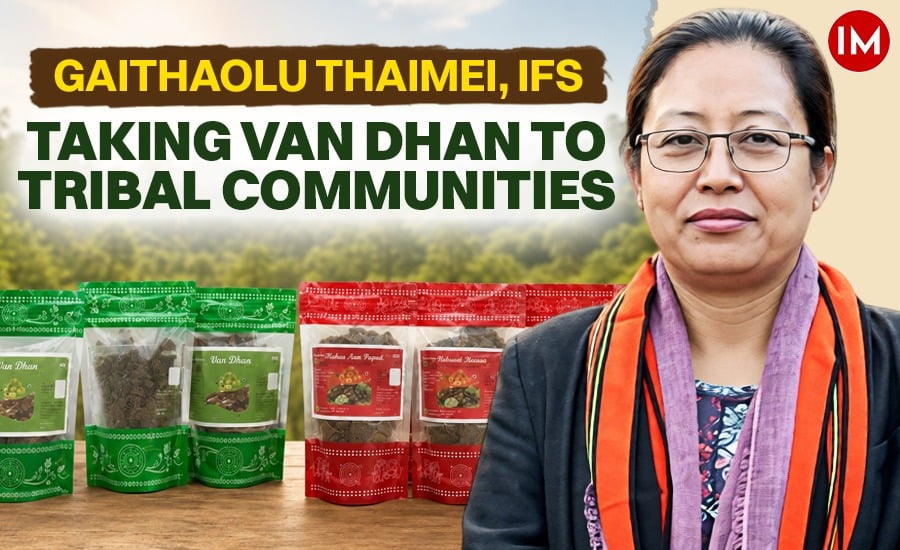
This is where Gaithaolu Thaimei, IFS (Manipur cadre, 2007 batch), Nodal Officer, TRIFED, Manipur, has been working to strengthen tribal livelihoods through entrepreneurship, market linkages and better utilisation of forest-based products.
Through the implementation of the Pradhan Mantri Van Dhan Yojana (PMVDY) and other tribal livelihood programmes, her work has focused on helping tribal communities move beyond the sale of raw forest produce towards value-added products that can reach wider markets.
209 Van Dhan Vikas Kendras Supporting Over 62,000 Beneficiaries
The Pradhan Mantri Van Dhan Yojana is a TRIFED initiative under the Ministry of Tribal Affairs. Launched nationally in 2018, the scheme was introduced in Manipur in 2019 as a livelihood programme for forest-dependent tribal communities.
The model works through Van Dhan Vikas Kendras (VDVKs), where tribal communities receive support for skill development, processing, packaging, branding and marketing of minor forest produce.
During 2025-26 alone, nine VDVKs were formed in Manipur, covering 131 Self-Help Groups (SHGs) and 2,433 beneficiaries.
The overall scale is considerably larger. Manipur now has 209 VDVKs involving 3,171 SHGs and 62,836 beneficiaries.
Under Ms Thaimei’s coordination, the SHGs are supported through team meetings, advocacy programmes, workshops and training sessions conducted with the help of master trainers. The focus is not restricted to production. Communities are also introduced to improved packaging, branding and tools that can help them add greater value to their products.
This approach has helped several traditional products move towards organised retail markets.
From Forest Produce to Market-Ready Products
The range of products emerging from the Van Dhan programme in Manipur reflects the diversity of the state’s forest and agricultural resources.
Van Dhan groups are producing candies made from wild apple, amla, plum, sumac and perilla, along with spices such as Sirarakhong chilli, turmeric, cinnamon and Sichuan pepper. Other products include wild nuts, jams, juices, squash, pickles and bamboo shoots.
The initiative has also supported products beyond food processing, including Nungbi pottery, scented soaps, scented candles, sanitizers, organic manure, agarbatti and hill brooms.
A major part of the strategy has been to give these products a recognisable identity.
The “Manipur Naturals” brand has been developed to position these value-added products under a common “Made-in-Manipur” identity and create better visibility for products originating from tribal communities.
The objective is straightforward: instead of selling forest produce in its raw form, communities can process and package it, build a marketable product and retain a larger share of its economic value.
Building Local Food Processing Capacity
Another component of the work has been the establishment of Mini TRIFOOD units under the Pradhan Mantri Formalisation of Micro Food Processing Enterprises (PMFME) programme, a joint initiative involving the Ministry of Food Processing Industries, Ministry of Tribal Affairs and TRIFED.
In Manipur, 10 Mini TRIFOOD units have been established.
These units are created by combining two active VDVKs and providing them with processing and upgraded processing machinery, packaging facilities and other infrastructure required for better product preparation.
The idea is to address one of the common challenges faced by small tribal enterprises: having access to the equipment and facilities required to process products at a scale and quality suitable for wider markets.
With better processing and packaging facilities, tribal entrepreneurs can expand their activities while creating more sustainable income opportunities within their communities.
Reaching Particularly Vulnerable Tribal Groups
Ms Thaimei’s work also extends to the implementation of PM-JANMAN (Pradhan Mantri Janjati Adivasi Nyaya Maha Abhiyan), a Government of India initiative focused on the socio-economic development of Particularly Vulnerable Tribal Groups (PVTGs).
Under the livelihood component, skill development and entrepreneurship training through VDVKs have been identified as a means of supporting PVTG families dependent on forest produce.
In Manipur, VDVKs have been formed and made operational in 41 of the 46 villages identified under the initiative.
The work is also linked to the Dharti Aaba Janjatiya Gram Utkarsh Abhiyan (DAJGUA), another Government of India programme aimed at the holistic development of tribal-majority villages.
Under this initiative, VDVKs have been formed in 268 villages against a target of 516 villages in Manipur.
Bringing Departments and Partners Together
An important feature of the implementation has been convergence between different departments and organisations.
The Van Dhan programme in Manipur involves coordination with the Forest Department, Commerce & Industries Department and Tribal Department, helping connect tribal livelihood initiatives with expertise, resources and institutional support available across the state government.
Private entrepreneurs and government skill-development wings have also been brought in as knowledge partners.
Another focus has been providing upgraded processing machinery and equipment to entrepreneurial units, helping SHGs improve the way their products are processed and prepared for consumers.
The value-added Van Dhan products are also certified by FSSAI, supporting their entry into formal food markets.
Creating an Entrepreneurship Ecosystem Around Tribal Products
The work of Gaithaolu Thaimei, IFS, reflects a broader shift in the way tribal livelihood programmes can be implemented — from simply supporting production to building an ecosystem around skills, processing, branding, certification and market access.
With 209 VDVKs, 3,171 SHGs and more than 62,000 beneficiaries already covered in Manipur, the Van Dhan programme has created a sizeable network of tribal entrepreneurs and producers.
The growth of the Manipur Naturals brand and the establishment of Mini TRIFOOD units further add a market-oriented dimension to this network.
For tribal communities, the value of such initiatives lies not only in the number of centres established but also in the ability to turn traditional knowledge and locally available resources into products that can generate income.
Through her role as Nodal Officer, TRIFED, Gaithaolu Thaimei has contributed to strengthening this process in Manipur — connecting tribal producers with training, technology, processing facilities and markets while working with multiple government departments and external partners to expand livelihood opportunities.