For Laishram Birmangol Singh, IFS, wildlife conservation has involved more than protecting animals in their natural habitats. His work has focused on giving threatened species a stronger chance of survival through scientific management, captive breeding and species recovery programmes.
A 2020-batch Indian Forest Service officer of the Manipur cadre, Mr Singh has built considerable experience in conservation breeding during his tenure as Director of Manipur Zoological Garden since 2020. He is currently posted as Director, Keibul Lamjao National Park.
His field of interest lies particularly in the captive breeding of endangered species. Over the years, his efforts have contributed to important conservation milestones involving the Asian Giant Tortoise, Burmese Python, Sangai and Nongin, some of Manipur’s most significant threatened species.
First Artificial Incubation of Asian Giant Tortoise in Manipur
One of Mr Singh’s notable achievements has been the successful artificial incubation of the Asian Giant Tortoise (Manouria emys phayrei), a critically endangered species.
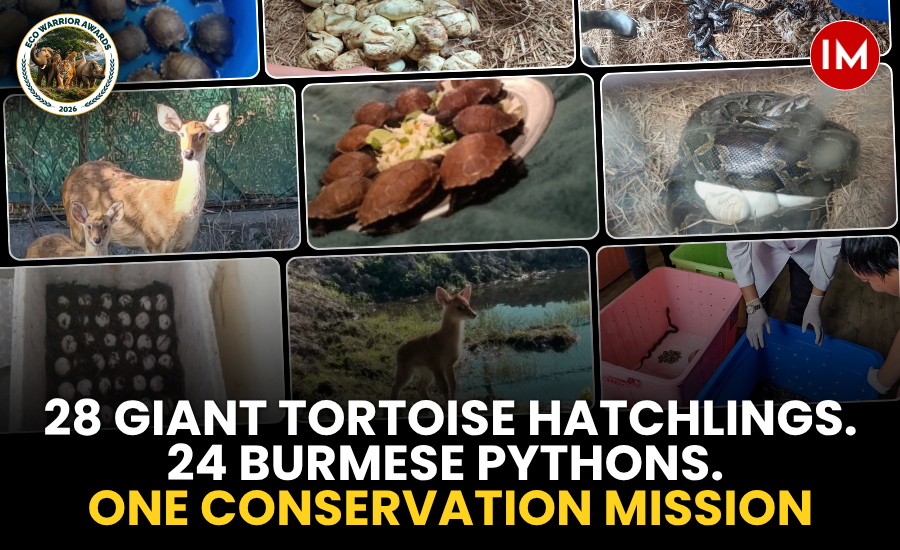
Under his leadership, the team at Manipur Zoological Garden successfully conducted the first artificial incubation of the species in Manipur, resulting in the hatching of 28 tortoises in 2025.
The achievement is significant because successful captive breeding and artificial incubation can provide an important support system for species whose wild populations face continuing threats.
Mr Singh is now looking to build on this success by establishing a full-fledged conservation and recovery programme for the Asian Giant Tortoise in collaboration with Turtle Survival Alliance Foundation-India.
Beyond breeding, his work has also included capacity-building workshops and awareness programmes aimed at improving understanding of the species and encouraging greater participation in its conservation.
24 Burmese Pythons Hatched in 2024–25
Another major achievement during his tenure at the zoo was the successful hatching of 24 Burmese Pythons (Python bivittatus) during 2024–25.
The breeding programme is part of the broader effort to strengthen ex-situ conservation of threatened wildlife. Successful captive breeding can help maintain viable populations under controlled conditions while also generating knowledge that can contribute to long-term species recovery.
The programme also carries the potential for future reintroduction into suitable natural habitats, with the broader objective of strengthening wild populations.
For Manipur Zoological Garden, the achievement further strengthened its role in conservation breeding and aligned with the wider ex-situ conservation objectives of the Central Zoo Authority.
Strengthening the Sangai Conservation Breeding Programme
Among the species most closely associated with Manipur’s natural heritage is the Sangai (Rucervus eldii eldii), the critically endangered brow-antlered deer found in the state.
The Sangai Conservation Breeding Programme was initiated under the Central Zoo Authority in 1992. During his tenure as Director, Mr Singh strengthened the programme at Manipur Zoological Garden, which serves as the coordinating zoo for the conservation of the species in India.
The zoo has maintained a viable captive population of Sangai and, under Singh’s leadership, breeding has progressed up to the sixth generation.
In the last three years, six fawns have been produced, adding to the captive population and supporting the long-term conservation effort for the species.
Maintaining a captive population over several generations requires sustained scientific management, careful monitoring and appropriate breeding practices. The progress achieved under Mr Singh’s tenure has therefore added another layer to the state’s efforts to safeguard the Sangai.
Manipur Becomes the Only State to Achieve Captive Breeding of Nongin
L Birmangol Singh has also contributed to the conservation breeding of Nongin, or Mrs. Hume’s Pheasant (Syrmaticus humiae), the State Bird of Manipur.
During his tenure, successful hatching and survival of Nongin chicks were achieved at Manipur Zoological Garden.
The accomplishment is particularly significant because Manipur became the only state in India to achieve successful captive breeding of this threatened species.
For a species with conservation concerns, successful breeding and survival in captivity can provide valuable knowledge about reproduction, husbandry and population management. It also strengthens the capacity of the zoo to serve as a centre for species conservation.
Linking Science With Species Recovery
Mr Singh’s work reflects a conservation approach in which captive breeding is not viewed as an isolated zoo activity but as one component of a larger species-recovery strategy.
From the first artificial incubation of the Asian Giant Tortoise to the successful hatching of Burmese Pythons, continued breeding of Sangai across generations and the successful captive breeding of Nongin, his tenure has been marked by a focus on measurable conservation outcomes.
His work has also combined breeding programmes with awareness initiatives and capacity building, recognising that the survival of threatened species depends on scientific expertise as well as wider understanding and participation.
His Diploma Course in Management from the Wildlife Institute of India, Dehradun, has further complemented his professional experience in wildlife management and conservation.
Now serving as Director of Keibul Lamjao National Park, Mr Singh brings this experience into a landscape that is central to Manipur’s wildlife heritage.
His conservation work demonstrates how scientific breeding programmes, institutional capacity and long-term species management can complement protection in the wild. At a time when several threatened species require coordinated intervention, such efforts can play an important role in strengthening conservation outcomes for future generations.