When an elephant enters a village at night, every minute matters.
For forest teams, reaching the animal is not always easy. The terrain may be hilly, mobile networks may fail, and an elephant can take several routes through farms and plantations. By the time a team receives a panic call and reaches the spot, the situation can already have become dangerous for both people and the animal.
This was one of the challenges faced by N. Vengatesh Prabhu, an IFS officer of the 2019 batch, Tamil Nadu cadre, serving as District Forest Officer, Coimbatore.
When he took charge of the division in February 2024, he began looking at human-elephant conflict differently. His focus was not only on responding to incidents but on predicting them, reaching the site faster and making communities part of the solution.
The results became visible within two years. In 2022-23 and 2023-24, elephant deaths in the division were in double digits at 11 and 13 respectively. This came down to five in 2024-25 and six in 2025-26.
FROM REACTIVE RESPONSE TO EARLY WARNING
One incident soon after he took charge made the challenge clear.
In September 2024, an elephant died after coming into contact with an illegally connected electric fence. During harvest periods, some farmers use solar-powered fences to protect their crops. If the fencing system or battery develops a problem, there is a risk of farmers directly connecting it to a transformer or electric line.
For Prabhu, such deaths were different from natural mortality.
“Natural deaths like diseases or infighting between elephants are common. But whenever an elephant dies due to anthropogenic causes, it is a failure on our part,” he said.
He began holding regular meetings with farmers, local NGOs and different government departments. Police, EB, revenue and other line departments were brought into the discussions.
A public grievance meeting was also held on the first Friday of every month. Instead of expecting villagers to travel to the District Forest Office, the meetings were taken to range offices, government schools and other public places.
The discussions focused on human-elephant conflict, the concerns of farmers and what both the community and Forest Department could do to reduce risks.
MAKING ELECTRIC FENCES SAFER
The meetings also helped address electric fencing.
Tamil Nadu’s Power Fences Rules, 2023 require fences erected within five kilometres of forest boundaries to be registered. With the support of the Electricity Department, the Forest Department carried out joint inspections and ensured that prescribed safety measures were followed.
Farmers were encouraged to use proper backup batteries and energisers instead of unsafe direct connections.
These small interventions became part of a larger strategy to prevent elephant deaths before they occurred.
The division also began using thermal drones for elephant monitoring, marking a shift from reactive response to early warning.
Earlier, forest teams often received calls late at night after elephants had already reached villages or farms. With thermal drones, teams could detect elephants as they moved out of forest areas and alert people in advance. The technology could also help teams guide elephants towards safer passages.
A COMMAND CENTRE BUILT AROUND RESPONSE TIME
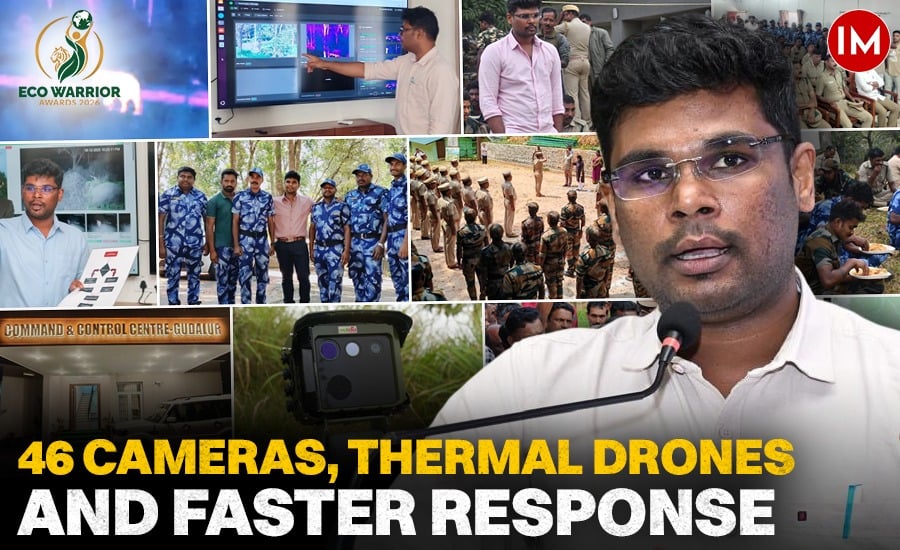
Prabhu then pushed for an integrated AI-powered Command and Control Centre.
The project was funded through the Modernisation of Forest Force programme. Instead of creating a system that merely detected elephants, the team designed it around the entire response chain.
The centre has 46 thermal and night-vision cameras installed at carefully selected locations. The locations were identified using five years of compensation data, including places where human injuries, human deaths and major crop losses had occurred.
The system does not simply trigger loud alarms when an elephant is detected.
The idea is to alert trained forest staff, who can then reach the location and guide the elephant safely. The officer stressed that elephants should not be “driven” like vehicles because aggressive chasing can make the situation more dangerous.
A dedicated wireless communication network connects the command centre with rangers, foresters and patrolling vehicles. This is especially important in hilly areas where mobile connectivity may be unreliable.
The command centre operates 24×7. When the AI system detects an elephant, the alert becomes a digital “ticket”. A response team is sent to the location. Once the situation is made safe, the team reports back and the incident is closed.
This allows the department to measure response time and identify where delays occur.
AI ALERTS REACH VILLAGES
The system also takes the warning directly to communities.
When the AI detects an elephant with more than 80 per cent accuracy, an SMS alert is automatically generated for one person from each family in the nearby village.
Public display boards have also been installed at bus stands and other locations. These warn people when an elephant has been detected nearby.
This is particularly useful for people who may be unfamiliar with the area, including visitors and relatives travelling into villages.
Thermal drones add another layer of protection. They can detect elephants and broadcast warnings from the air. Forest teams can also use them to guide people indoors when an elephant is nearby.
USING DATA TO PREDICT HOTSPOTS
Every incident recorded by the command centre adds to a growing database.
The department has used this information to create hotspot maps showing where elephants are repeatedly detected and where teams are frequently required to respond.
The plan is to position rapid-response teams closer to these hotspots so that they can reach elephants faster.
This is important in landscapes where elephants may have several routes through a plantation, while forest teams may have only one road available. In some cases, even that road may end far from the animal, forcing personnel to continue on foot.
Thermal drones help overcome this challenge by showing the team where the elephant is and helping them approach safely.
COMMUNITY TRUST IS PART OF CONSERVATION
Technology alone, however, cannot solve human-elephant conflict.
Prabhu also focused on building trust with his staff and local communities.
One major incident occurred in September 2024 at the Chirambody Range, an interstate border area. After an elephant death, villagers protested and refused to hand over the body.
Around 400–600 people gathered during the protest. Prabhu personally went to the spot and spoke with the villagers.
He also worked closely with his forest staff, conducting regular training sessions, mock drills and team meetings.
For him, the strength of an officer lies in the team implementing the plan on the ground.
The division has also created Tadum volunteers, bringing local community members into the early-warning network. When elephants are spotted, these volunteers can immediately alert the Forest Department through the numbers connected to the command centre.
FROM CONFLICT TO COEXISTENCE
For Prabhu, all these measures point towards a larger change in thinking.
He believes human-elephant issues should not be viewed only as “conflict management”. People living near forests depend on agriculture for their livelihoods, and crops such as sugarcane and banana can be important sources of income.
The answer, therefore, is not simply to keep people and elephants apart.
“It is high time that we should call it coexistence management and move towards coexistence planning. For this, all the line departments, community participation and technology are needed,” he said.
His model brings together AI cameras, thermal drones, wireless communication, rapid-response teams, safer electric fencing, data-based hotspot mapping and community volunteers.
The objective is simple: detect the elephant early, warn people quickly, guide the animal safely and reduce the time taken to respond.
In a landscape where humans and elephants share the same roads, farms and forest edges, that shift—from reacting to incidents to planning for coexistence – could be the most important intervention of all.