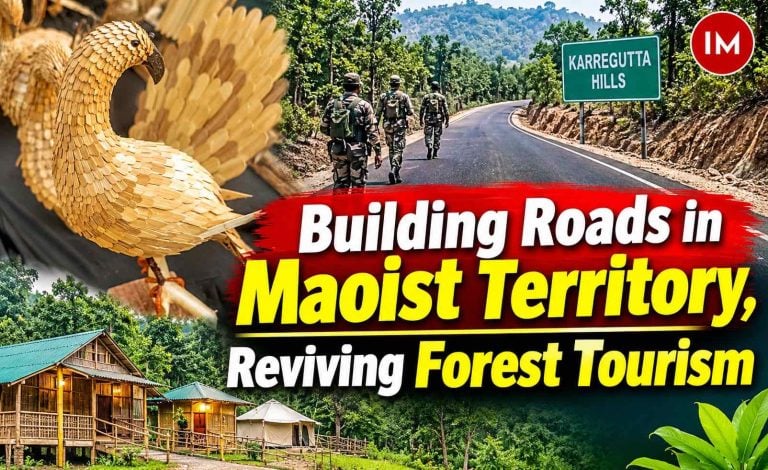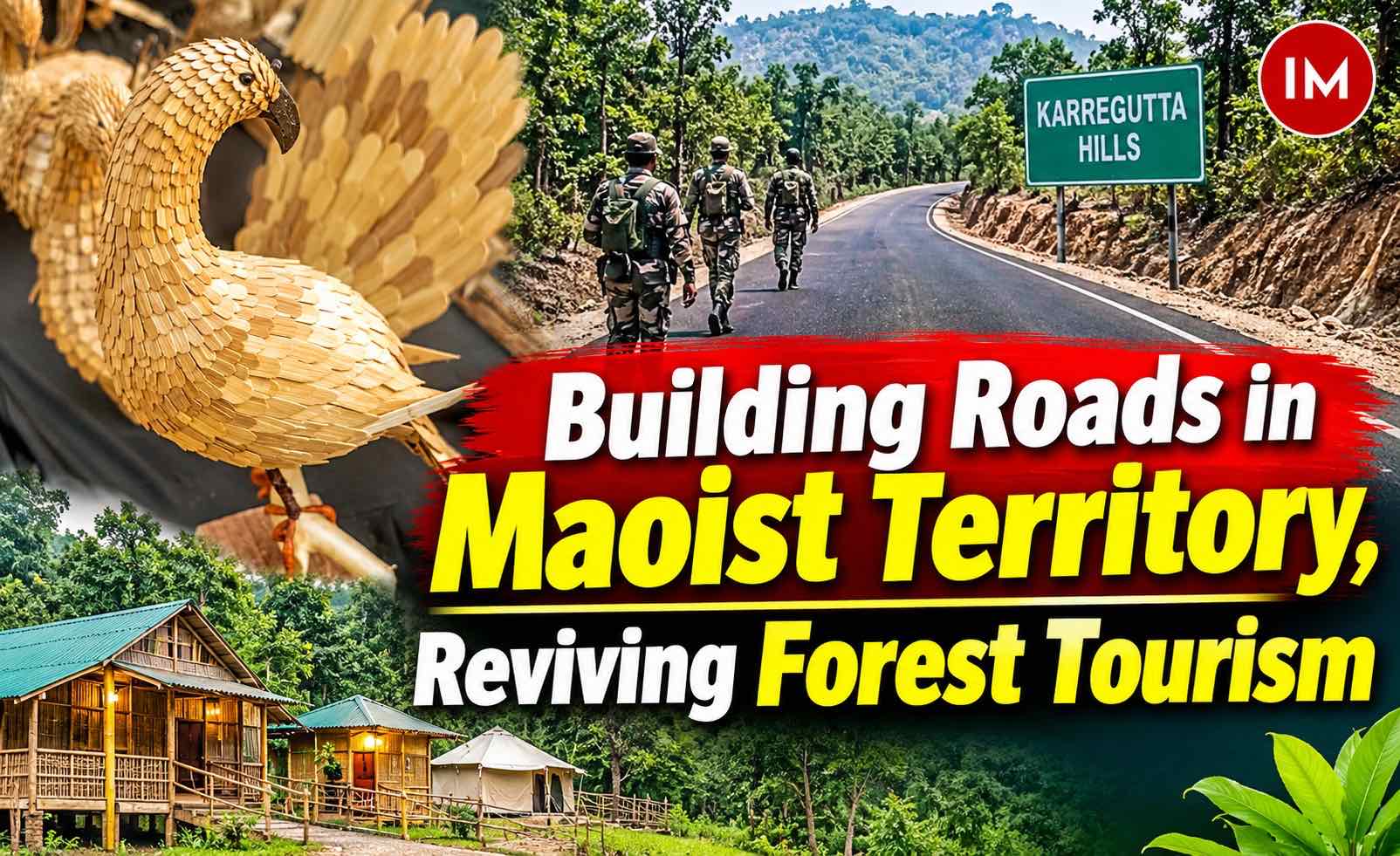
For years, the Karregutta Hills along the Telangana-Chhattisgarh border remained largely beyond the reach of government machinery. Dense forests, steep slopes and deep gorges made the terrain difficult to access. But there was another, more serious challenge. The hills had become a stronghold of Maoist groups, with explosives planted along routes and security forces facing constant threats. Even reaching certain parts of the forest on foot could prove fatal.
In such a landscape, building a road was not simply an infrastructure project. It was a difficult exercise involving security, coordination and considerable determination. A 29-km earthen road was eventually constructed through the hills in just seven months. It changed how security forces accessed the region and also opened new possibilities for forest protection and eco-tourism.
Behind this effort was a coordinated initiative involving the Forest Department and security agencies.
Rahul Kishan Jadhav, an Indian Forest Service officer of the Telangana 2018 batch, played an important role in these initiatives during his tenure as District Forest Officer (DFO), Mulugu. He is presently serving as DFO, Mancherial.
Speaking to Indian Masterminds, Jadhav explained how the road was constructed in one of the most challenging forest landscapes in the region and how improved connectivity gradually opened the area to government agencies and development activities.
BUILDING A ROAD THROUGH A MAOIST STRONGHOLD
The Karregutta Hills were once among the most inaccessible areas along the Telangana-Chhattisgarh border. The Maoist groups had used the difficult terrain to their advantage for years. The hills provided them with natural hiding places and allowed them to move across several states, including Telangana, Chhattisgarh, Andhra Pradesh, Odisha, Madhya Pradesh and Maharashtra.
The physical geography made construction equally difficult. The hills have steep slopes, deep gorges and several streams. There was only one relatively moderate slope through which vehicles could attempt to climb. In most other places, reaching the higher areas meant travelling on foot.
But the terrain was only one part of the problem.
Improvised Explosive Devices (IEDs) had been planted along routes and access points. Their exact locations were often unknown. During Jadhav’s posting, several villagers and shepherds suffered serious injuries, while some lost their lives in IED blasts.
The absence of mobile network connectivity added another layer of difficulty. Anyone entering the forest would remain out of communication until they returned. Forest staff also faced serious risks while responding to fires in the hills.
“The Karregutta Hills were completely dominated by banned and violent Maoist groups. The steep terrain, unknown IED locations, lack of mobile connectivity and constant security threats made even reaching the hills a major challenge,” Jadhav told Indian Masterminds.
The project required close coordination with the Police Department, Greyhounds, the Special Intelligence Branch (SIB), the Central Reserve Police Force (CRPF) and other security forces. Despite the difficult conditions, the 29-km road was completed in approximately seven months.
A ROAD THAT CHANGED THE SECURITY LANDSCAPE
The construction was carried out in phases. The first phase involved an eight-km earthen road connecting Murmuru village at the base of the hills to Pamnuru, located on the higher plateau.
This stretch made it possible for security vehicles to reach areas that were earlier accessible mainly on foot. The CRPF subsequently established a Forward Operating Base at Pamnuru.
The camp became an important centre for security operations and helped forces extend their presence deeper into the hills.
For the first time, the Indian Tricolour was unfurled at this previously inaccessible location. It became a powerful symbol of the government’s efforts to restore peace in the region.
In the next phase, the road was extended from Pamnuru to Jella, Doli and Tadpala, completing the entire 29-km stretch.
The improved connectivity allowed security forces to move quickly through remote areas. They could conduct operations more effectively, recover weapons and explosives, and strengthen their presence in locations that had earlier remained difficult to reach.
Several IEDs planted across the region were also detected, while caches of dumped weapons were recovered.
The change was also reflected in the movement of senior officials. The Director General of Police (Head of Police Force) and the Principal Chief Conservator of Forests (Head of Forest Force) of Telangana jointly inspected the hills through an aerial survey. They also landed in the area, marking an important moment for a region that had remained inaccessible for so long.
The road brought benefits beyond security. Forest staff could now reach fire-prone areas more easily, improving the department’s ability to respond to forest fires.
OPENING THE DOORS TO ECO-TOURISM
While the hills had long been associated with security challenges, they also held enormous natural beauty.
Karregutta is among the highest-elevation landscapes in Telangana. It has several waterfalls, scenic peaks and rich forest stretches. Doli Gutta, the highest peak in Telangana, is also part of this hill range.
For trekkers, adventure enthusiasts and nature lovers, the region offers considerable potential. With improved access, the government began exploring ways to develop it as a responsible eco-tourism destination.
Although there are no permanent habitations on the hills, several villages lie in the plains around their foothills. The presence of CRPF camps has also helped extend emergency healthcare and local transport support to communities when required.
The proposed eco-tourism activities could create further opportunities. Local residents could be trained as nature guides, while eateries and other tourism-related services could generate additional income.
The idea is to make tourism a source of livelihood without disturbing the natural environment.
REVIVING TADWAI WITH A CONSERVATION FOCUS
Jadhav’s efforts during his Mulugu posting also included the revival of the Tadvai Eco-Tourism Complex near Eturnagaram Wildlife Sanctuary.
The complex had six cottages, a dining room and open spaces surrounded by a peaceful forest landscape. However, after the COVID-19 period, the cottages had remained unused since 2020. Maintenance had stopped, and the rooms had gradually deteriorated.
Jadhav and his team took up the renovation of all six cottages. The aim was to improve the visitor experience while retaining the natural character of the property. The cottages were given modern interiors but kept their rustic exteriors.
The department also introduced two safari routes inside Eturnagaram Wildlife Sanctuary.
The first was a forest safari that took visitors deeper into the sanctuary and offered views of its natural landscape. The second combined a safari, trekking and a visit to Blackberry Island.
The initiative attracted considerable public interest. Schools and colleges from Warangal and Kothagudem were also encouraged to visit. For many students, the experience offered an opportunity to understand forests beyond textbooks.
The idea was not just to attract tourists but to develop an appreciation for wildlife and conservation among young visitors.
BLACKBERRY ISLAND: TOURISM WITHOUT CONCRETE STRUCTURES
One of the most interesting additions to the Tadvai experience was Blackberry Island.
Despite its name, it is not an island in the traditional sense. It is a sandbank formed by the deposition of sand along a stream that meanders through the forest. The area also has several Jamun trees, which contributed to its name.
Its location amid the forest gives it a distinct landscape, making it suitable for nature-based camping.
To introduce night camping, the Forest Department created basic facilities using bamboo and other locally suitable materials. Bamboo structures, machans and shelters were installed to provide visitors with a comfortable experience without introducing permanent construction.
Since the site falls within a wildlife sanctuary, concrete structures were avoided. They would not only have affected the natural surroundings but also disturbed the ecological character of the location.
Solar energy was another important part of the initiative. Solar panels and batteries were installed to provide basic lighting and charging facilities inside the tents.
Permanent electricity poles and transmission lines were deliberately avoided to minimise the impact on the forest.
“The idea was to ensure that tourism does not come at the cost of the forest. At Blackberry Island, we used bamboo structures and solar energy instead of permanent concrete construction and conventional electrical lines. This allowed visitors to enjoy the location while keeping its ecological character intact,” Jadhav told Indian Masterminds.
WHEN CONNECTIVITY BECOMES A TOOL FOR CONSERVATION
The developments in Karregutta and Tadvai reflect two important aspects of forest administration. One is the need to ensure that even remote and difficult landscapes remain accessible to government agencies. The other is the importance of making conservation meaningful for local communities.
In Karregutta, a road built through a challenging and conflict-affected landscape helped security forces regain access, strengthened forest protection and created possibilities for future livelihoods.
At Tadvai, the revival of old cottages, introduction of safari routes and development of low-impact camping facilities brought visitors closer to nature.
Both initiatives point towards a larger idea: forests need protection, but they also need responsible public engagement. When infrastructure is planned carefully and tourism respects ecological limits, development and conservation can move together.
Read Also: India’s Air Pollution Problem: Why Does Clean Air Remain a Seasonal Promise?