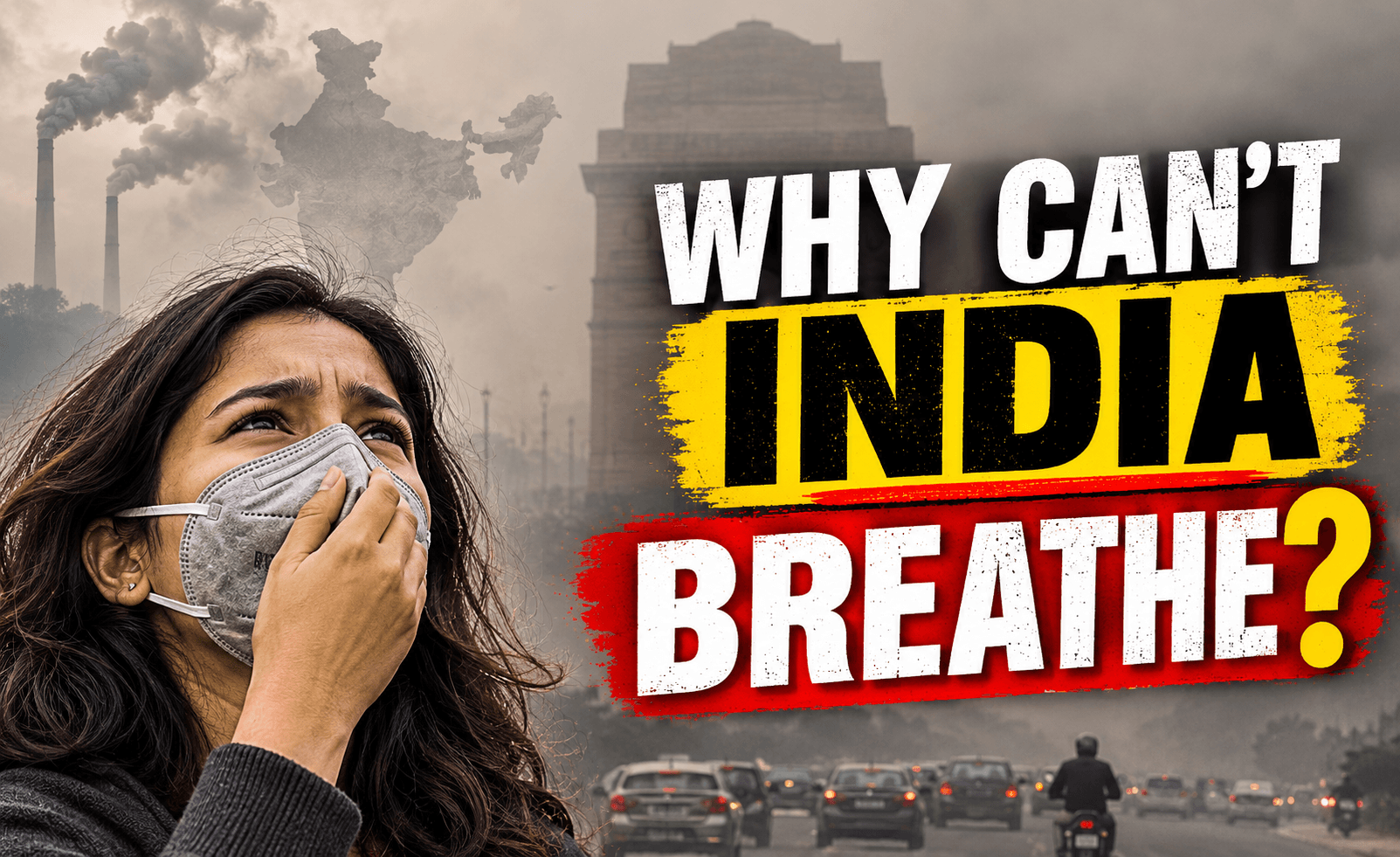
In late ‘90s Delhi winters used to be a gloomy affair. Smog used to descend so thick that at the busiest ITO crossing, one would often find difficulty to see the traffic signal on the other side of the crossing. A thin layer of soot deposited on the light coloured shirts by the evening. Gradually, the culprit was found – Diesel, which was replaced with CNG over a period of 4-5 years and Delhi started breathing a bit normally.
The situation seems to be back to square one. Every winter, air pollution returns to Delhi and public conversations. Schools consider closures, construction restrictions are announced, vehicles face curbs and people check the Air Quality Index. Then the season changes and urgency fades. Pollution, however, does not disappear; only its sources and intensity undergo a change.
That is the weakness in India’s clean-air response: a year-round public health and governance challenge is still treated as a seasonal emergency.
Also read: India’s Cities Have Smart Technology. Do Their Municipalities Have Enough Power to Govern?
Not Just Stubble Burning
Delhi’s winter smog is often reduced to a debate over crop-residue burning. It does contribute, but it is not the whole explanation. A February 2026 expert assessment considered by the Commission for Air Quality Management (CAQM), based on source-apportionment studies from 2015 to 2025, found that winter pollution in Delhi-NCR came from several sources: secondary particulates 27 per cent, transport: 23 per cent, biomass burning: 20 per cent, dust: 15 per cent and industry, including thermal power plants: 9 per cent.
A major reason for winter smog is the cold mist-laden air which doesn’t rise into the atmosphere and settles near the ground causing poor visibility and breathing problems.
The picture changes in summer. Dust becomes the largest listed contributor at 27 per cent, followed by transport (19 per cent), secondary particulates (17 per cent), industry (14 per cent) and biomass burning (12 per cent). These regional estimates are not fixed daily shares, but they make one point clear: pollution persists beyond the harvest season and requires action across sectors.
A 2024 study published in Geoscientific Model Development also pointed out that Delhi’s air pollution does not come from within the city alone. During the post-monsoon season, sources within Delhi accounted for around 34 per cent of pollution, while neighbouring districts contributed up to 25 per cent. Stubble burning accounted for up to 8 per cent in the seasonal estimates. This shows that pollution is not restricted by state or city boundaries. Tackling it, therefore, requires neighbouring states and cities to work together rather than treating it as Delhi’s problem alone.
Air Pollution Is Also a Public Health Emergency
The consequences of polluted air go far beyond coughing, breathing difficulties or burning eyes. Former WHO Chief Scientist Dr Soumya Swaminathan has argued that India needs to treat air pollution with the same urgency as COVID-19. In an interview with NDTV, she pointed out that its effects reach almost every part of the human body, increasing the risk of premature death and illnesses such as asthma and diabetes.
Children are particularly vulnerable. Exposure to fine PM2.5 particles during pregnancy has been linked to premature births and low birth weight. Children growing up in polluted areas also face the risk of reduced lung development, while their brains and other organs are still developing. As Swaminathan pointed out, unlike a sudden outbreak, air pollution is a slow-moving crisis. People cannot always see its effects, often get used to living with it, but the damage continues.
She has also called for India to look beyond the conventional Air Quality Index and consider an Air Quality Health Index that better explains the health risks of different pollutants. Her suggestions include a national clean air mission, stronger accountability and making public health a central part of pollution-control decisions. This is an important shift in perspective: clean air should not be measured only through pollution readings, but also through the health of the people breathing it.
Delivery Gaps Remain
India already has several laws and programmes to tackle air pollution. The Air (Prevention and Control of Pollution) Act, 1981 lays down the basic rules for controlling pollution. The National Clean Air Programme (NCAP), launched in 2019, helps cities prepare and implement their own plans to improve air quality. In Delhi-NCR, the Commission for Air Quality Management Act, 2021 set up a dedicated body to coordinate pollution-control efforts across states. The Graded Response Action Plan (GRAP), meanwhile, introduces stricter restrictions as air quality worsens.
There are some encouraging results. According to a July 2026 reply by the Ministry of Environment in Parliament, 108 out of 130 cities covered under NCAP recorded lower annual PM10 levels in 2025-26 compared to 2017-18. Of these, 26 cities reported a reduction of more than 40 per cent. The reply also stated that 73 cities recorded lower annual PM2.5 levels in 2025 than in 2024. These improvements are worth acknowledging. However, PM10 and PM2.5 are two different types of pollutants. A reduction in one does not automatically mean that the other has reached safe levels.
There is also the question of how effectively public money is being used. Between 2019-20 and 2025-26, ₹16,423.55 crore was provided to the 130 cities under the programme. However, according to data reported on the government’s PRANA portal, only ₹11,575.54 crore, or around 70.5 per cent, had been utilised. The bigger question, therefore, is not just how much money is being allocated, but whether it is actually making the air people breathe any cleaner.
What must change?
First, clean-air plans must run throughout the year. Municipal bodies should publish quarterly, ward-level progress on road dust, construction sites, waste burning, public transport and industrial enforcement. Mechanical sweeping and water sprinkling need route schedules, performance checks and penalties for repeated violations. Construction sites must follow dust-control rules, with regular inspections and public compliance records.
Second, transport policy must reduce dependence on private vehicles. Reliable buses, last-mile connections, safe footpaths and cycling networks are pollution-control infrastructure. This is easily doable with help of traffic police and anti-encroachment squads. Cities should also improve bus frequency and manage congestion hotspots. In developed countries, city buses are as efficient as trains and may be tracked through dedicated maps. EVs should be the new go-to vehicles.
Third, industrial compliance needs credible monitoring. State Pollution Control Boards must strengthen inspections, ensure required continuous emission monitoring systems work, and act against repeat violators. The reported shift of 11,108 industries in NCAP cities to cleaner fuels is encouraging; the next step is verifying actual fuel use and emissions.
Fourth, crop-residue management must work economically for farmers. Timely access to machinery, functioning custom-hiring centres, markets for crop residue and predictable incentives are more useful than blame after smoke appears. Punjab, Haryana, Uttar Pradesh and the Centre must coordinate before harvesting, not after it.
Finally, governments must measure outcomes, not announcements. PRANA already tracks city action-plan implementation. Its data should be easier to interpret, showing ward-level targets, expenditure, inspections and air-quality trends. District collectors and municipal commissioners should be answerable for delivery, while states coordinate sources that cross city boundaries.
Can’t Depend on Weather
India has shown that monitoring, targeted funding and coordinated institutions can produce results. The next test is consistency. GRAP is necessary when pollution spikes, but emergency restrictions cannot replace daily enforcement and long-term urban planning.
Clean air should not arrive as a winter announcement or disappear as a summer afterthought. It must become a basic measure of how well a city is governed, every month, in every season.
Also read: Why Does India Continue to Lose So Many Lives on Its Roads?