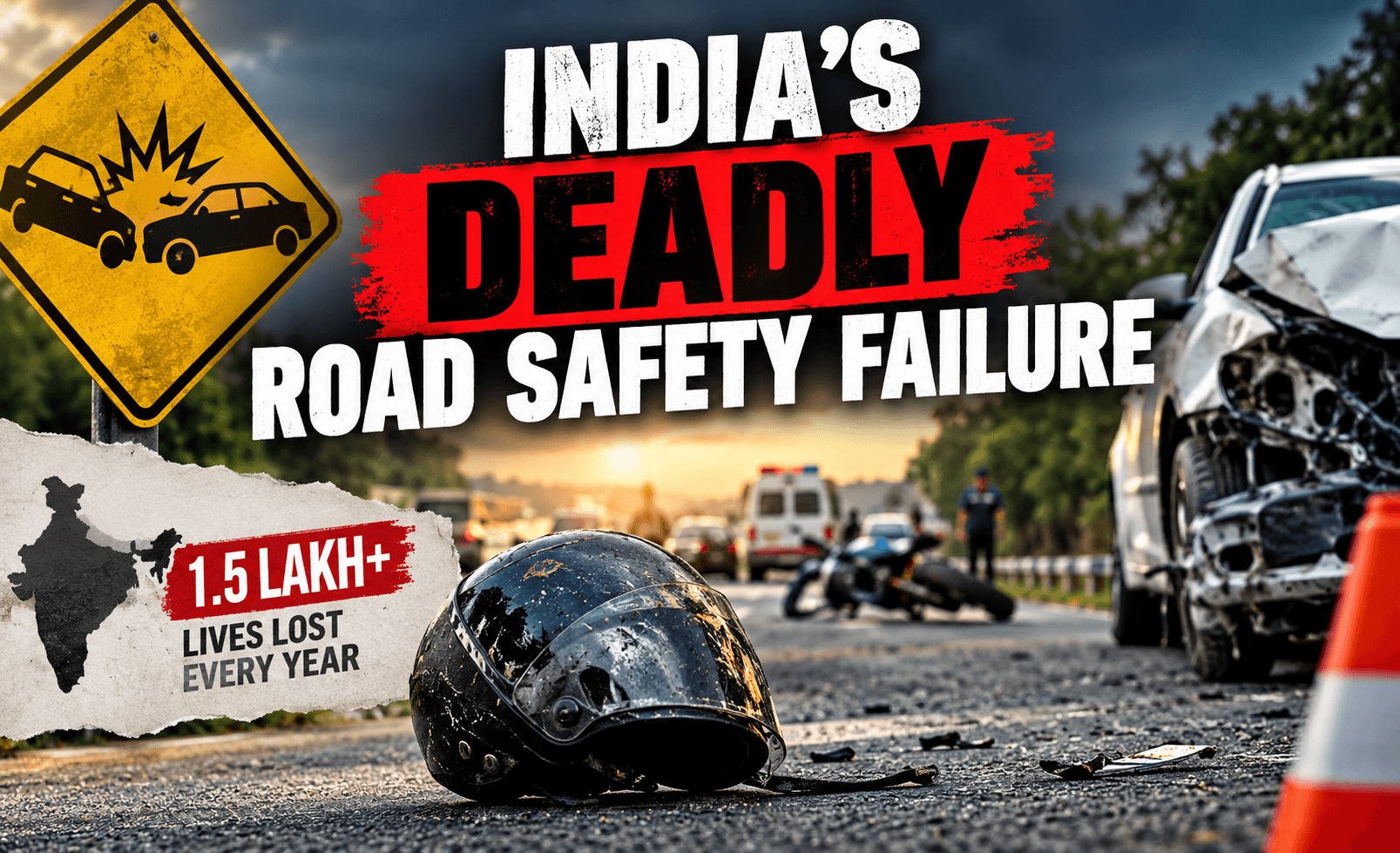
India is building expressways, expanding highways and improving connectivity at an unprecedented scale. Yet, the country continues to face a road-safety crisis that claims hundreds of lives every day. The contradiction is difficult to ignore: how can a nation investing heavily in modern infrastructure still struggle to keep its people safe on the roads?
The answer lies not in one failure, but in a combination of dangerous driving, inadequate road design, inconsistent enforcement and gaps in emergency response.
Also read: IPS Sandip Patil: From Managing Pune’s Most Sensitive Moments to Securing Maharashtra’s Industrial Future
The Numbers Are Getting Worse
According to a parliamentary disclosure by Union Road Transport and Highways Minister Nitin Gadkari in July 2026, India recorded 5,13,563 road accidents and 1,83,382 deaths in 2025. That amounts to approximately 502 deaths every day, or about 21 lives lost every hour.
The figures mark a worrying increase from 2024, when the Ministry of Road Transport and Highways recorded 4,87,707 accidents and 1,77,175 deaths in its Road Accidents in India 2024 report. The latest figures represent an increase of approximately 5.3% in accidents and 3.5% in fatalities over the previous year.
These are not merely statistics. Every number represents a life lost, a family affected and a preventable tragedy that deserves institutional scrutiny.
The Problem Goes Beyond Reckless Driving
Overspeeding remains a major concern. In a parliamentary reply reported in July 2026, the government identified 82,124 accidents in 2025 as involving overspeeding. Driving on the wrong side and lane indiscipline accounted for another 4,089 accidents.
The Ministry’s 2023 report offers a clearer picture of the risks. Overspeeding was associated with 3,28,727 accidents and 1,17,682 deaths. Driving on the wrong side or lane indiscipline accounted for 25,242 accidents and 9,432 deaths, while drunken driving or consumption of alcohol and drugs was linked to 9,143 accidents and 3,674 deaths. Mobile-phone use was associated with 7,122 accidents and 2,884 deaths. These figures show why road safety cannot rely on awareness campaigns alone: speeding, dangerous manoeuvres and impaired driving require consistent enforcement.
But blaming motorists alone would be an incomplete diagnosis.
Road design determines how safely vehicles, pedestrians and cyclists interact. Poorly planned junctions, unsafe highway crossings, inadequate lighting and insufficient pedestrian facilities can turn routine journeys into dangerous ones. Two-wheeler riders and pedestrians are particularly exposed because they have less physical protection in a collision.
Road safety must therefore be understood as a shared responsibility involving drivers, enforcement agencies, road designers, contractors and government authorities.
Stronger Laws Need Consistent Enforcement
The Motor Vehicles (Amendment) Act, 2019 strengthened penalties for several traffic violations and expanded provisions for electronic enforcement. These measures were intended to improve compliance and deter dangerous behaviour.
However, the existence of a law does not guarantee its effectiveness. Speed limits have little value when violations go undetected, and helmet and seat-belt requirements cannot protect lives if compliance is inconsistent.
Technology offers a practical way forward. Speed cameras, automated number-plate recognition and electronic monitoring can improve enforcement and reduce dependence on sporadic roadside checks. But these systems must be deployed strategically, maintained properly and supported by timely action.
Accountability must also extend to road-owning agencies. Where a defective junction, dangerous crossing or unresolved road hazard contributes to repeated crashes, identifying the problem must lead to corrective action within a defined timeframe.
Dangerous Roads Must Not Remain Dangerous
India has already recognised the need to identify accident-prone stretches, commonly known as black spots. The government has pursued engineering improvements, including better signage, road markings, crash barriers and junction modifications.
The risk is not confined to ordinary roads. According to a parliamentary reply dated 23 July 2026, India recorded 64,772 road deaths on National Highways, including expressways, in 2024. State Highways accounted for another 39,277 deaths, while other roads recorded 73,126. National Highways and expressways together therefore accounted for roughly 36.6% of all reported road fatalities that year. These figures do not isolate expressway deaths, but they underline the need for rigorous road-safety audits, effective speed management, safe entry and exit points, clear signage and rapid emergency response on high-speed corridors.
In an August 2026 parliamentary disclosure, the government also reported that 6,358 black-spot corridors had been identified using AI-based tools developed by IIT Kanpur, drawing on electronic accident data for 2023–2025.
Technology can help authorities identify dangerous locations more systematically. But detection is only the first step. The real test is whether these locations are made safer before more people die.
India needs transparent progress reports on identified hazards, completed repairs and pending interventions. Road-safety audits should lead to measurable improvements, not become paperwork that leaves known dangers untouched.
What Happens After a Crash?
Preventing accidents is essential, but survival also depends on what happens immediately afterwards. Delayed ambulance services, inadequate trauma-care facilities and poor coordination between police and hospitals can worsen the consequences of a collision.
The Motor Vehicles Act provides protections for Good Samaritans who assist accident victims. The government has also introduced cashless treatment provisions under Section 162, subsequently developed through the PM RAHAT scheme in 2026. Such measures recognise that financial uncertainty should not prevent victims from receiving urgent medical attention.
Their success depends on implementation: hospitals must be accessible, emergency services responsive and treatment procedures clear. Rural highways and remote stretches deserve particular attention, where reaching appropriate medical care can be difficult.
Infrastructure Must Be Measured in Lives Saved
India’s road-safety strategy needs a stronger focus on outcomes. The success of infrastructure development cannot be measured only through kilometres constructed, faster travel times or improved connectivity. It must also be measured through fewer fatalities and serious injuries.
This requires safer road engineering, consistent traffic enforcement, independent safety audits, protection for vulnerable road users and reliable emergency medical services. It also requires governments to publish clear, comparable data so that progress and failures can be assessed openly.
India does not lack road-safety legislation or policy initiatives. The challenge is translating them into consistent action across states, cities, highways and local roads.
A road accident may last seconds, but its consequences can reshape a family’s life forever. A nation aspiring to world-class infrastructure cannot treat such losses as an unavoidable price of development.
The real measure of India’s road progress is not simply how quickly people reach their destinations. It is how many of them reach home alive.
Also read: IRS Naresh Bundel: The Man Digitising Opium Testing and Taking the Fight Against Drugs to Young India