For generations, the global travel industry held a narrow view of Uttar Pradesh. India’s most populous state, the ancestral cradle of Vedic civilisation, birthplace of Lord Rama and Lord Krishna, home to the world’s oldest living city and guardian of the sacred confluence of its holy rivers, was viewed largely through one lens: a day-trip to the Taj Mahal in Agra. Travellers flew into New Delhi, took a morning train to Agra, photographed the white marble monument and departed before sundown. UP remained a sleeping cultural giant, constrained by logistics bottlenecks, safety concerns and an administrative approach that treated tourism as a byproduct of religious sentiment rather than a catalyst for economic growth.
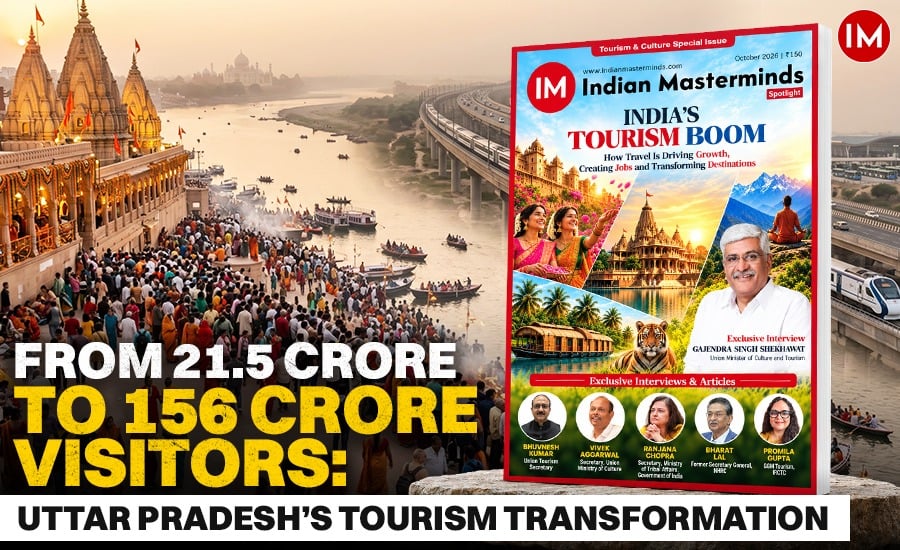
Fast forward to today, and that narrative has been shattered. Under Chief Minister Yogi Adityanath, Uttar Pradesh has undertaken a major infrastructure and socio-economic transformation. Tourist footfalls rose from 21.5 crore (215 million) in 2016 to 156.18 crore (1.56 billion) in 2025, making UP the number 1 state in domestic tourism.
The Decadal Growth
The growth between 2016 and 2025 represents a paradigm shift. The Adityanath administration declared tourism a core industry and positioned it as a key engine of the state’s march towards a $1 trillion economy.
Statewide tourist footfall increased sevenfold, while Ayodhya’s annual visitors rose from under 25 lakh in 2016 to over 16.4 crore following the consecration of the Shri Ram Janmabhoomi Temple. Kashi surged from around 60 lakh visitors before the corridor to over 9 crore annually following the opening of Shri Kashi Vishwanath Dham. Prayagraj rose from a non-Kumbh baseline of 1.5 crore to over 12.5 crore visitors, boosted by the Mahakumbh. The Braj region also recorded more than 5.1 crore visitors annually.
The Economic Ripple Effect
The tourism boom has reshaped UP’s economic fundamentals. Tourism and hospitality’s direct and indirect contribution to GSDP rose from under 3% in 2016 to over 7% by 2025–26.
The Shri Kashi Vishwanath Dham Corridor generated over ₹1.25 lakh crore in local economic activity, according to independent assessments. Average tourist spending per pilgrim increased from ₹800–₹1,200 to over ₹4,000–₹5,000, benefiting hotels, boatmen, artisans and transport providers.
Tourism development is estimated to have generated 45 lakh direct and indirect jobs between 2017 and 2026, complementing the One District One Product (ODOP) handicraft initiative.
Infrastructure
Such footfalls require a strong logistical backbone. UP has systematically dismantled connectivity bottlenecks through a multimodal infrastructure overhaul.
The state now operates over 40% of India’s operational expressways. The 341-km Purvanchal Expressway connects eastern UP to Lucknow, while the 296-km Bundelkhand Expressway has opened the region’s historic forts and destinations to high-speed connectivity. The 594-km Ganga Expressway is designed to link Meerut with Prayagraj, while the Gorakhpur Link Expressway integrates eastern industrial and heritage hubs.
Civil aviation has expanded dramatically. From just two functional commercial airports in 2016, UP now has 16-plus operational airports, including five international hubs. The Maharishi Valmiki International Airport in Ayodhya provides direct connectivity to major metros and international charter hubs, while Noida International Airport at Jewar is designed as one of Asia’s largest multi-runway airport ecosystems. Airports and expanded terminals in Kushinagar, Bareilly, Aligarh, Azamgarh, Chitrakoot and Shravasti have brought air connectivity closer to tier-2 and tier-3 destinations.
Pilgrimage to Mega-Events
The strategic shift has been to transform traditional religious transit into high-value, multi-day experiential tourism. Sacred towns have been upgraded with modern infrastructure, sanitation, crowd management and digital storytelling, turning them into year-round destinations.
Ayodhya underwent ₹32,000 crore of infrastructure redevelopment following the opening of the Ram Temple. Ram Path, Bhakti Path, Ram Janmabhoomi Path and Dharma Path have transformed congested lanes into broad, heritage-style boulevards. The annual Deepotsav, with more than 2.2 million lamps along the Saryu, has become a global tourism brand.
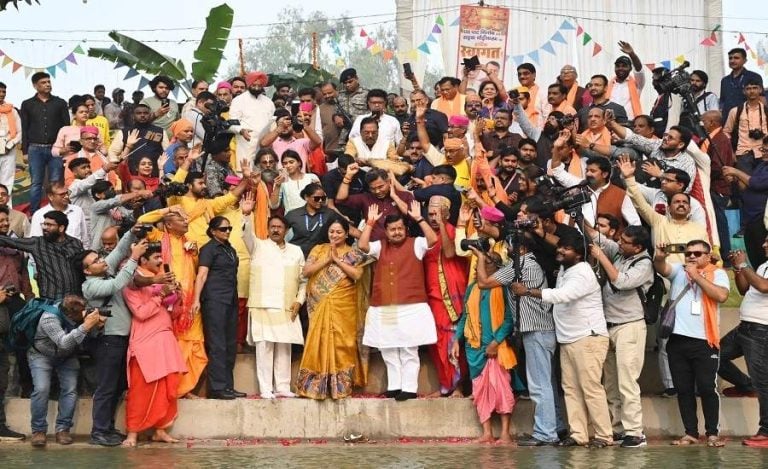
In Varanasi, the Shri Kashi Vishwanath Dham Corridor expanded the temple precinct from 3,000 to 500,000 square feet and provided direct access to the Ganga. Prayagraj has emerged as another showcase of mega-event management. Building on the 2019 Kumbh Mela, which drew 24 crore people and received UNESCO Intangible Cultural Heritage recognition, the state upgraded the city’s infrastructure.
Beyond Religious Tourism
The Uttar Pradesh Tourism Policy 2022 aims to diversify growth into eco-tourism, heritage and film tourism. At the Pilibhit Tiger Reserve, the state has developed eco-circuits combining wildlife safaris with Tharu tribal homestays after the reserve received the global TX2 Award for doubling its tiger population ahead of target. In Bundelkhand, more than 31 historic forts and palaces, including Kalinjar, Jhansi and Barua Sagar, have been opened for private heritage-hotel adaptive reuse.
Film tourism has also emerged as a growth sector. Single-window clearances and subsidies of up to 50% for local shoots have strengthened UP’s position as a filming destination, while the 1,000-acre Noida International Film City near Jewar Airport is attracting major entertainment investments.
The Road Ahead
The transformation has also been supported by governance and public-safety reforms. A strict approach towards organised crime, specialised Tourist Police and AI-linked CCTV cameras under the Safe City Project have strengthened perceptions of security for women, solo travellers and foreign tourists.
Granting tourism industry status has enabled hotels, resorts and homestays to access industrial land, power and tax tariffs, while capital subsidies of 15–20% have encouraged investment beyond metropolitan centres. More than 5,000 registered homestays across Ayodhya, Varanasi, Chitrakoot and Agra are helping channel tourism spending directly into local households.
Uttar Pradesh’s tourism transformation is ultimately a case study in heritage-led economic revitalisation. By combining cultural assets with expressways, airports, urban renewal, law-and-order reforms and private investment, the state has converted its ancient heritage into a modern economic engine.
As UP moves towards its $1 trillion economy goal, tourism is emerging as a key driver of infrastructure, employment and rural economic activity—demonstrating how India’s cultural capital can become a global tourism powerhouse.