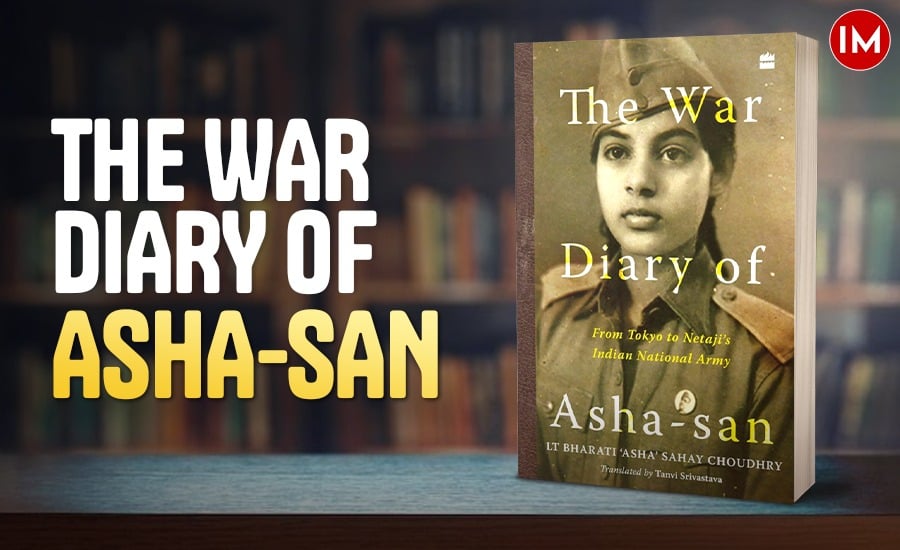
“Day and night, we speak only of Netaji, the worshipper of Ramachandika—an avatar of the Goddess Durga—and Mother India. What we know of him is only through Ma’s words. For us, he is like the heroes we read about in books,” writes 17-year-old Bharati ‘Asha’ Sahay in a journal entry from June 1943: “We cannot greet him with folded hands or bent heads. Neither is it possible to shy away our eyes because of his shimmering charm; he is a divine spectre who brings clarity and consciousness on sight.” A picture from the time at the Imperial Hotel in Tokyo, included in the book, shows Asha with her two braids looking intently at the camera, with an expression as serious and resolute as that of Netaji Subhash Chandra Bose standing next to her.
Also read: The Blue Potter: Ajeet Cour’s Portraits of the Icons Who Shaped Punjabiyat
Yet in the very next entry, when she and her sister Tulu pester their mother to speak to this redoubtable Netaji about them joining the Rani of Jhansi regiment (RJR) and he expresses doubt about whether their delicacy will allow them to survive military training, Asha feels as though someone has lit a fire within her. In a spirited mix of Hindi and Bangla, she retorts that they are strong enough to live — and die — for their country. “How can I stay silent when someone calls me weak and helpless, even if that person is Netaji himself?”
Asha knows that she has been born to parents who have chosen lives of service to the nation through dharma and karma as religion and duty. Her maternal grandmother Didima (sister of Deshbandhu Chittaranjan Das) had been arrested by the British and their Indian police officers when she was sixteen years old. When news of the arrest came through, Asha’s mother was one of the women walking in protest to Presidency Jail: “Girls in white sarees with red borders, walking barefoot, waving the tricolour. How many Ranis of Jhansi walked free that day! Suddenly, a whistle blew and the police surrounded them… The officers giving the orders were British, but those who rained the blows were Indian.”
Asha’s mother Sati Sen deliberately sang “God shave the King” when forced to follow the British national anthem in school, and would then blame the mispronunciation on her Bengali accent. Later an art student at Gurudev Rabindranath Tagore’s Visva-Bharati, she caught the attention of a young man named Anand Mohan Sahay while singing Bande Mataram on stage at a Congress gathering in 1922. That young man, restless to join the revolutionary Ghadar Party, was heading to Japan to proceed to the United States — but Japan was where he brought Sati after their wedding in 1927, and it was in Japan that the couple named their first child “Bharati” with hope “Asha” for their motherland.
By 1943, as Asha recorded her meeting with Netaji on scraps of paper in war-torn Tokyo, the Indian National Army was gaining support across East Asia from the Indian diaspora as well as those from Indonesia, Thailand, and Japan — Netaji was more revered in the hearts of the Japanese than other world leaders like Hitler and Mussolini, notes Asha — who had faith in historical currents of civilizational unity. Harakiri ritual self-sacrifice infuses Asha’s cultural understanding of rightful resistance as much as an Indian vocabulary of principles. In November, as the Sahay children and their mother wait for letters from Anand amidst a soundscape of American bombers, “Japan’s PM General Tojo declares Japan will hand over the Andaman and Nicobar Islands, currently under Japanese occupation, to the Azad Hind Government. Netaji has renamed the two islands ‘Shaheed’ (martyr) and ‘Swaraj’ (self-rule).”
Although the INA’s ascension is dented by defeat in Imphal in 1944, the family continues to sing quami geet of nationalism through increasing sparseness of rations. “Netaji will not accept defeat, regardless of the destination of the Japanese forces…The blood of Indians will colour the path to Delhi and we will garland the Red Fort with the tricolour.” To Asha-san, staring at a flaming sky of warring planes from the trenches of Tokyo in February 1945, bravehearts who fight and die for their country are the greatest ascetics. Her praise for them is fervent and deeply felt; to be a soldier is her dream. One evocative sentence — “The skies eventually calm and, as the earth smoulders, we return to our home” — brings to mind another diary entry by a young girl whose experience of that same world war would end with her death in a German concentration camp in March 1945: “…when I look up at the sky, I somehow feel that everything will change for the better, that this cruelty too will end, that peace and tranquility will return once more.”
Once her appeal to join the RJR training camp is accepted, Sati knows that her daughter must hold a gun in her hand instead of a flower, and Asha knows that her heart must become rocklike too. Soldiers cannot cry – and Asha is resolute about this even when she leaves her beloved Japanese home – but young soldiers sometimes stifle giggles at the quivering moustaches of senior officers, and occasionally sigh over the uphill task of comprehending Hindi. It is imperative to keep learning, however, if only to avoid errors over how a strictly vegetarian Vaishnava Punjabi family can paradoxically seem to enjoy “makkhi” roti made of flies!
There are moments of laughter in Asha-san’s journey — but flowers need to turn into stones in the cause of freedom. After the goal has been achieved and India has gained Independence, “if someone is to place a stone and a flower in front of me, I will always choose the flower,” she writes. Later, as history rusts around her, she muses: “How many flowers have withered in Manipur and Imphal, and we, the new buds, are once again getting ready to bloom.”
Officers must be wiser than soldiers, believes Lt Asha, and have the discernment to give clear and appropriate orders which can be obeyed instantly. She rarely talks back to those giving instructions, whether they are teaching her how to fire rifles or insisting that she change into a saree for dinner. But she greets everyone with a salute and a sharp “Jai Hind!” regardless of their familiarity with this address, deliberately ignores British and American civilities, and does her best to retain discernment as a world war of ammunition recalibrates into national wars of uncertainty.
Compiled and translated by the author into Hindustani with the help of her parents, Asha’s diary was serialized in Dharmyug in 1973 and later published as Asha-San ki Subhas Diary by Parijat Prakashan in Patna. This edition, brought to English for the first time with skill and affection by the author’s granddaughter-in-law, ensures that Bharati Asha’s song – the anthem of the Indian National Army – continues to bring clarity and consciousness on sight: Shubh sukh chain ki barkha barse… May rains of auspicious joy fall as India awakens to her destiny…
Also read: Project Cheetah’s Untold Story: The Negotiations, Challenges and Diplomacy Behind the Mission