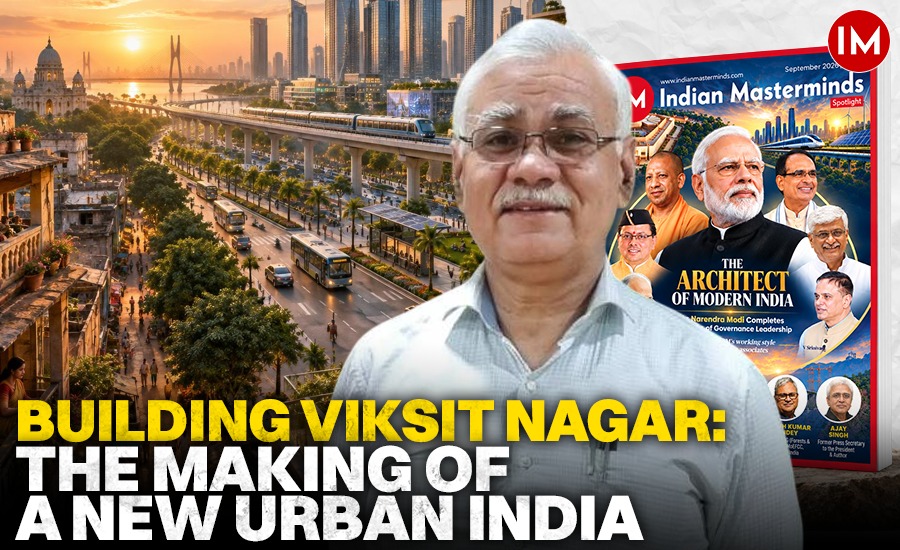
Today, cities contribute more than 65% of India’s GDP, and their share is expected to rise significantly as urbanisation accelerates. India’s journey towards Viksit Bharat @2047 will therefore depend, to a large extent, on whether its cities can become more productive, inclusive, resilient and liveable.
India’s urban story has not always received the attention it deserved. In the decades after Independence, development policy focused primarily on rural India. Although the Sixth Five-Year Plan introduced the Integrated Development of Small and Medium Towns (IDSMT) Scheme, urban development remained a relatively low priority for the government. Later, with the tenth five-year plan, the Jawaharlal Nehru National Urban Renewal Mission (JnNURM) attempted to bridge infrastructure gaps in the cities, but its impact was constrained by fragmented implementation, limited institutional capacity, and weaknesses in the programme design.
The turning point came in 2014. During the Lok Sabha election campaign, Mr Modi repeatedly emphasized the importance of building smart cities and modern urban infrastructure as drivers of national growth. Two years later, while marking the anniversary of three National Urban Missions in Pune, he described cities as places that “digest poverty”. People from rural areas migrate to urban spaces in search of better education, health, employment, services, and business opportunities to improve their quality of life. He added that it is our responsibility to make cities better places to live and work in, so that they can digest poverty faster. For the first time, an Indian political leader spoke so clearly in public about the potential of cities as engines of economic growth. This marked an important departure from how urban development was approached in the early decades after Independence.
Also Read – Vikas Bhi, Virasat Bhi : Narendra Modi’s Vision for a Modern and Rooted India
What followed was not simply an expansion of urban schemes but the beginning of a fundamentally different approach to urban transformation. It combined mission-mode implementation, measurable outcomes, technology, competition, citizen participation and new forms of financing and delivery. Over the last twelve years, this approach has produced five important shifts in the way India thinks about and builds its cities. These shifts contribute to India’s urban transformation not only through the scale of programmes launched, but also through a change in the development paradigm which recognises cities as engines of growth, innovation, and national transformation.
From Cities as Administrative Units to Engines of Growth
The first and perhaps most fundamental shift has been recognizing urbanisation as an economic opportunity rather than simply a demographic challenge.
India is experiencing rapid urbanisation. In the 2011 Census, 31.2% of our population lived in urban areas. This number is now estimated at 37%, or around 56 crores. Demography experts have projected the urban population to cross 50%, or over 90 crores, by 2051. This means that, we will be a majorly urban country in about two decades. At present, cities contribute over 65% of the national gross domestic product (GDP). Economists project this to cross 85% by 2051. Since cities provide space for superior quality of living, and opportunities for convergence of various kinds of resources- men/women, materials, money, and machines- and scope for innovations, they are hot-beds of economic activities.
From Schemes to Mission-Mode Transformation
The second shift is institutional. Instead of fragmented schemes, urban development has increasingly been pursued through integrated, mission-driven programmes.
As a great leader with a vision to transform India, which he later pronounced on 15 August 2022 as a commitment to Viksit Bharat @2047, Prime Minister Modi could foresee the future. A series of National Urban Missions was launched in 2014 and 2015 after he became the Prime Minister. First among these was the Swachchh Bharat Mission-Urban (SBM-U), a tribute to Mahatma Gandhi, on his birth anniversary, 02 October 2014; version 2.0 was launched in 2021. Prime Minister Modi emphasised that this should become a public movement, not merely a government scheme, adding that even a hundred Gandhis or a thousand Modis cannot make much difference, but the day 140 crore citizens decide to make their spaces clean and tidy, no force in the world can make it dirty again. This Mission has led to many innovations, startups, and entrepreneurship. His mantra of ‘waste to wealth’ and ‘dignity to the Swachchhakar’ has opened up new opportunities for technological interventions. The Annual Swachchha Sarvekshan, used as an effective tool to promote the Mission objectives, is the largest survey in the world .
Atal Mission for Urban Transformation & Rejuvenation (AMRUT), launched in June 2015, focused on creating necessary infrastructure like clean drinking water, sewage, drainage, and at least one public Park each in 500 cities with a population over one lakh (2011 Census) or other important cities. In its version 2.0, launched in 2021, it has been extended to all cities across the country (around 5,000), with a focus on making cities water-secure through various water conservation measures. It has emphasised technological innovations and work to realise Prime Minister Modi’s vision of 24×7 water supply and Drink from Tap. Various transformative urban reforms to strengthen municipal finance, administration, and service delivery are some of the by-products of this mission.
From Infrastructure Provision to Technology-Enabled Urban Systems
The third transformation involved embedding technology into the very fabric of city governance.
Smart Cities Mission (SCM) was a masterstroke for urban areas. Conceived at the instance of Prime Minister Modi for 100 cities, this Mission added a new dimension to the Indian Development Administrative System. For the first time, cities had to compete through a well-designed Challenge Mode to get selected and receive Central Assistance based on their performance. This marked a major departure from conventional resource allocation and encouraged innovation, accountability and performance. This Challenge Methodology has since been adapted to various government schemes/programmes.
This Mission allowed cities to take steps to improve the quality of living for citizens, enhance sustainability, and boost employment opportunities/ economic activities. Integrated Command and Control Centres (ICCCs) became the digital nerve centres of participating cities, improving planning, service delivery and emergency response. Prime Minister Modi’s Mantra to ‘Get More from Less’, i.e., use of a technology layer over infrastructure for ensuring smart & optimum usage of the capacity, has led to huge learning for municipal administration. All these need to be deployed effectively to build smart and sustainable urban areas for Viksit Bharat @2047. Today, digital platforms, data-driven governance and artificial intelligence increasingly support urban management across India.
From Welfare Delivery to Dignity, Inclusion and Opportunity
The fourth shift was on expanding urban transformation beyond infrastructure to improving quality of life with a broader focus on dignity, inclusion, choice, and economic opportunity. Prime Minister’s vision of ‘Housing for All’ was translated into Pradhan Mantri Awas Yojana-Urban (PMAY-U) and its subsequent version 2.0. It has delivered something unimaginable, which has not happened anywhere in the world in such a short span of time. This Mission, conceived and executed skillfully, has given over one crore poor families houses equipped with toilets, drinking water, cooking gas and electricity, giving them wings to realise their aspirations. Extensive use of space technology in monitoring and digital systems for follow-up has given credibility and confidence. Under the guidance of Prime Minister Modi, the Global Housing Technology Challenge was devised and executed, leading to the introduction of many promising new construction technologies in the country. This Mission has opened up scope for innovation in organising land, finance, technology and all other essentials to provide dignity and ease of living to men and women.
The Real Estate (Regulation and Development) Act (RERA), 2016, is the most transformative legislation introduced by the Central Government, giving much needed relief to home buyers and the confidence that s/he will be delivered what was promised. The Model Tenancy Act (MTA), approved by the Union Cabinet and shared with States to legislate, balances the rights and responsibilities of tenants and homeowners and opens new opportunities for different types of rental housing and income. Ease of Doing Business in Construction Permits and various other urban services, through digital technology and artificial intelligence, has boosted the Prime Minister’s focus on ease of living in urban areas.
Affordable Rental Housing, launched for the first time in the country after Independence in 2020 and now the fourth vertical of PMAY-U 2.0, holds great potential to provide accommodation for students, workers, support service providers, young professionals, etc. The Real Estate Investment Trust (REIT), introduced by the Central Government, has created an innovative financing model for creating real estate facilities. This holds huge promise for the real estate sector, just like the share market is for the industrial sector. The Special Window for Affordable and Middle-Income Housing (SWAMIH) and the National Urban Housing Fund (NUHF) have provided adequate support to boost housing construction.
Prime Minister Modi’s commitment to Antyodaya translated into support for street vendors, who lost their businesses during the COVID-19 pandemic. For the first time in Independent India, a financial assistance scheme named PM SVANidhi, intended to make urban street-vendors AatmNirbhar, was launched in 2020. Over one crore street vendors have received financial assistance of around Rs 20,000 crore so far. The system has been designed digitally to avoid physical contact between beneficiaries and service providers, curtailing any scope for corruption or harassment. ‘SVANidhi Se Samriddhi’ and various other support systems have been built on the guidance of Prime Minister Modi to make this Scheme achieve its planned results by 2030. The Scheme has been designed to incentivise timely repayment and use of the Unified Payments Interface (UPI), mainstreaming them in the formal economy.
Urban Transport, which affects the citizens’ lives most adversely, has received major attention under Prime Minister Modi. Metro Rails, which were operational in just five cities for less than 250 km in 2014, are now operating over 1,000 km in 24 cities, carrying more than one crore passengers daily. Work is in progress on another around 1,000 Kms expanding its reach to 31 cities. Over 90 kms of Rapid Regional Transport System (RRTS) named Namo Bharat from Delhi to Meerut has been made operational for the first time in the country. Bus Rapid Transit Systems (BRTS) and Electric Public Buses are operating in various cities. Kochi runs Water Metro, and Varanasi is getting the first Ropeway Urban Transport System in the country. The most important development in this field is our fast progress toward self-dependence in technology and products. We now have our own National Common Mobility Card (NCMC) and Automatic Fare Collection Gates and we now export Metro coaches and other items.
From Building Cities to Building Urban Economies
The fifth shift focuses on strengthening urban economies rather than simply expanding urban infrastructure. The Urban Challenge Fund and Regional Urban Economic Hubs signal this next phase of urban transformation. Together with competitive and cooperative federalism, they create opportunities for States and cities to leverage local strengths, attract investment, foster innovation and build stronger urban economies. The focus is moving from building cities to making cities productive engines of economic growth.
Central Vista Development/redevelopment projects, including the New Parliament Building, the Legislative/Executive/Defence Enclaves, Kartavya Path, and Kartavya Bhavans as the Common Central Secretariat, etc., are transforming the National Capital, worthy of its stature as an emerging Developed Country (Viksit Bharat). Such metamorphosis is being experienced across most cities in the country. Prime Minister Modi’s Mantra of ‘Reform, Perform and Transform’ has been motivating all States/ Union Territories to perform their best under the ‘Competitive Cooperative Federalism’ ecosystem. States/UTs realise the potential of cities to be strong engines of rapid economic growth. Accordingly, they have adopted Prime Minister Modi’s Mantra of ‘Skill, Speed and Scale’.
Across these shifts, the emphasis has remained on making urban development more inclusive. Expanding access to civic amenities, housing, mobility, and economic opportunity, while supporting street vendors, migrants, women, youth, and entrepreneurs, has continued to be a key ingredient in this transformation journey. The growing use of technology, competition and public-private partnerships has further strengthened the potential to deliver these outcomes at scale.
If Viksit Bharat @2047 is the destination, Viksit Nagar must be one of its most important building blocks. India’s development story will increasingly be written in its cities, and the quality of that story will depend on how effectively we convert urbanisation from a demographic reality into an economic, social and institutional advantage.
The foundation laid over the past twelve years under the visionary leadership of Prime Minister Modi, the real architect of new urban India, provides an important platform for the next phase of India’s urban development. The task now is to use the learnings from the past to fuel the development of stronger institutions, capable cities and productive urban economies with concrete outcomes for realising the vision of Viksit Bharat by 2047.
(The author has served as Secretary in the Ministry of Housing & Urban Affairs, Govt of India and Chief Secretary of Uttar Pradesh between 2014-2024)
Also Read – 25 Years of Transformative Governance: How Water Security Became Central to India’s Development Story