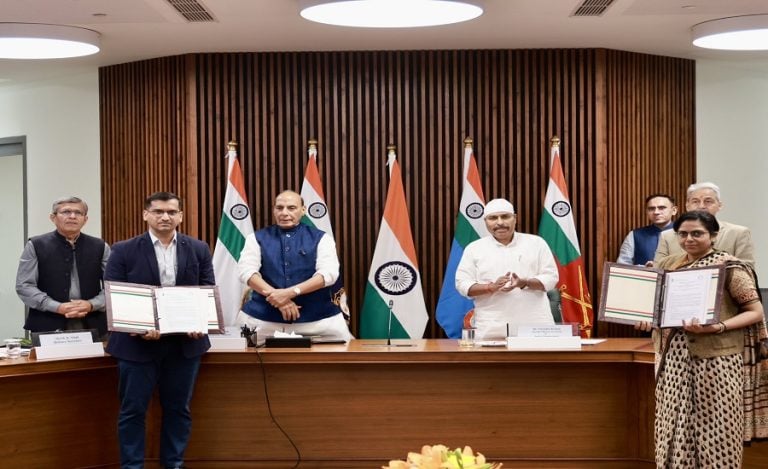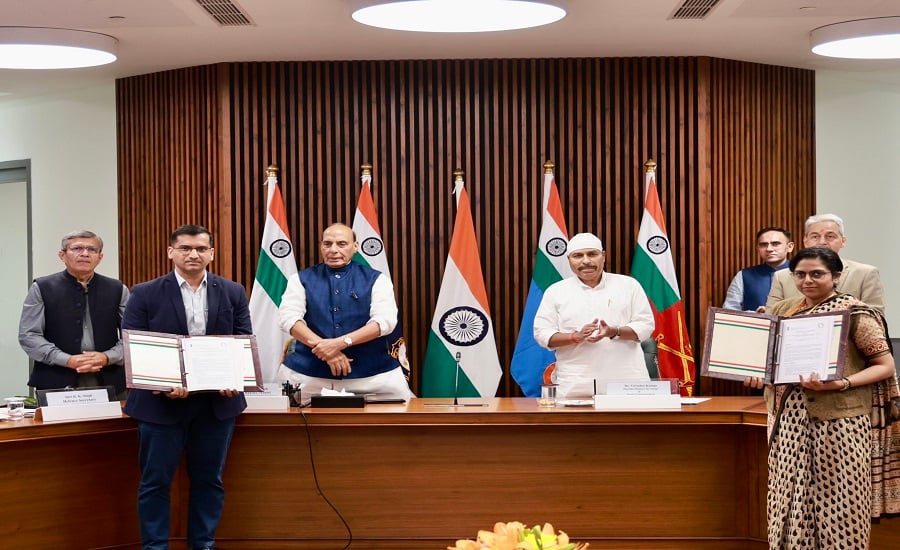
New Delhi: The Ministry of Defence (MoD), through the Directorate General of Defence Estates (DGDE), has signed a Memorandum of Understanding (MoU) with the Ministry of Social Justice and Empowerment (MoSJE) to strengthen the welfare of senior citizens living in Cantonment areas across the country.
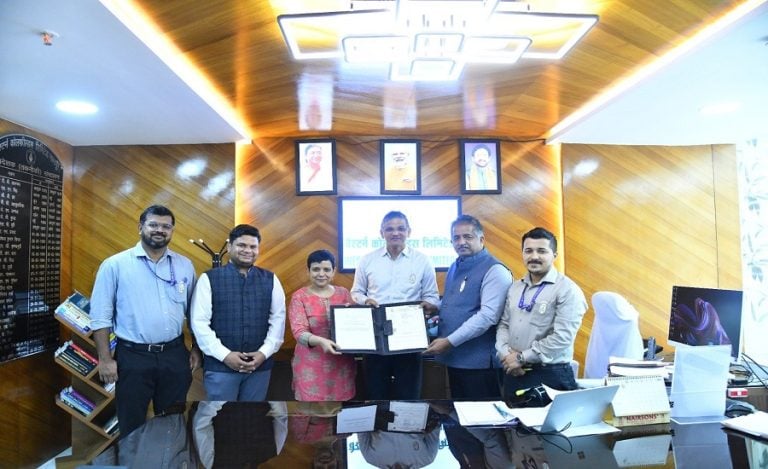
The MoU was signed in New Delhi in the presence of Defence Minister Rajnath Singh and Union Minister for Social Justice and Empowerment Dr Virendra Kumar. The agreement aims to improve elderly care facilities through the establishment of new Day Care Centres and Senior Citizen Homes, strengthening existing facilities and providing skill training to young Indians in geriatric caregiving.
Under the proposed arrangement, MoSJE will extend financial assistance under the Atal Vayo Abhyudaya Yojana (AVYAY) to support the operation and maintenance of existing facilities as well as the development of new centres in Cantonment areas.
Rajnath Singh Highlights Role of Senior Citizens in Nation-Building
Addressing the gathering, Defence Minister Rajnath Singh described senior citizens as important bearers of experience, traditions and social consciousness. He said their wisdom, guidance and contributions would remain invaluable in India’s journey towards achieving Viksit Bharat by 2047.
Highlighting the lifelong contributions of elderly people to families, society and the nation, he emphasised that ensuring their respect, security and sense of belonging is a social and moral responsibility.
Referring to India’s cultural values, he said, “Matru Devo Bhava, Pitru Devo Bhava”, adding that caring for the elderly is not merely a family responsibility but a collective social obligation.
While acknowledging the progress made in senior citizen welfare, Rajnath Singh stressed the need for continuous improvement in the delivery of services. He also called for social audits of Day Care Centres and Senior Citizen Homes to assess service quality and identify areas requiring improvement.
Virendra Kumar Reaffirms Government’s Commitment to Elderly Welfare
Speaking on the occasion, Union Minister for Social Justice and Empowerment Dr. Virendra Kumar reiterated the Government’s commitment to ensuring dignified, secure and active ageing for all senior citizens. He highlighted initiatives such as the Atal Vayo Abhyudaya Yojana (AVYAY), aimed at improving the quality of life of elderly people, and said the MoU would strengthen access to care facilities and welfare services in Cantonment areas.
The Minister also emphasised the need to establish at least one old-age home in every district, adding that more facilities could be developed according to requirements.He noted that India’s senior citizen population is estimated to reach 23 crore by 2036, making it important to expand elderly care infrastructure and support services across the country.
Eight New Day Care Centres to Be Established in Cantonments
Under the MoU, DGDE has identified eight Cantonments where new Day Care Centres can be established under the AVYAY scheme.
The proposed locations are:
- Barrackpore, West Bengal
- Belgaum, Karnataka
- Jhansi, Uttar Pradesh
- Khadki, Maharashtra
- Pune, Maharashtra
- Secunderabad, Telangana
- St. Thomas Mount, Tamil Nadu
- Delhi
In addition to establishing new centres, the agreement also provides for strengthening existing facilities, subject to the availability of funds and consultation with MoSJE.
Five existing Cantonments where Day Care Centres are proposed to be upgraded include:
- Ambala, Haryana
- Deolali, Maharashtra
- Jabalpur, Madhya Pradesh
- Ranikhet, Uttarakhand
- Lansdowne, Uttarakhand
Similarly, Senior Citizen Homes operating in Ayodhya and Lucknow in Uttar Pradesh are proposed to be strengthened.
Financial Assistance Under AVYAY Scheme
As part of the agreement, MoSJE will provide financial assistance under the Atal Vayo Abhyudaya Yojana (AVYAY), including support for the operation and maintenance of existing Day Care Centres and Senior Citizen Homes.
At present, Cantonment Boards in Ambala, Deolali, Jabalpur, Ranikhet and Lansdowne operate Day Care Centres using their own budgets. Similarly, Ayodhya and Lucknow Cantonments run Senior Citizen Homes.
These facilities are primarily dependent on grants from the Ministry of Defence. The new arrangement is expected to provide additional financial and operational support to improve their functioning.
DGDE and the respective Cantonment Boards will provide suitable premises and essential infrastructure, including electricity, water supply and sanitation facilities.
Meanwhile, MoSJE will extend financial assistance, technical guidance, training modules and operational support under the scheme.
Skill Training for Young Indians in Geriatric Caregiving
Another major component of the MoU is the skill development of young Indians in geriatric caregiving.
With India’s elderly population steadily increasing, the demand for trained caregivers and specialised elderly care services is expected to rise in the coming years. The initiative aims to create a pool of trained caregivers in and around 12 identified Cantonments.
These include:
- Barrackpore, West Bengal
- Belgaum, Karnataka
- Jhansi, Uttar Pradesh
- Deolali, Maharashtra
- Khadki, Maharashtra
- Pune, Maharashtra
- Secunderabad, Telangana
- St. Thomas Mount, Tamil Nadu
- Ambala, Haryana
- Delhi
- Ferozepur, Punjab
- Jalandhar, Punjab
The initiative is expected to strengthen the availability of trained personnel for elderly care while creating skill development and employment opportunities for young Indians.
Joint Working Group to Monitor Implementation
To ensure effective coordination and implementation of the initiative, a Joint Working Group comprising representatives from both Ministries will be constituted.
The group will facilitate coordination, monitor progress and oversee the implementation of activities under the MoU.
The partnership brings together the institutional network and civic infrastructure of Cantonment Boards with the policy framework, technical expertise and financial support of MoSJE. It reflects the Government’s Whole of Government approach to improving public welfare through better utilisation of existing resources.