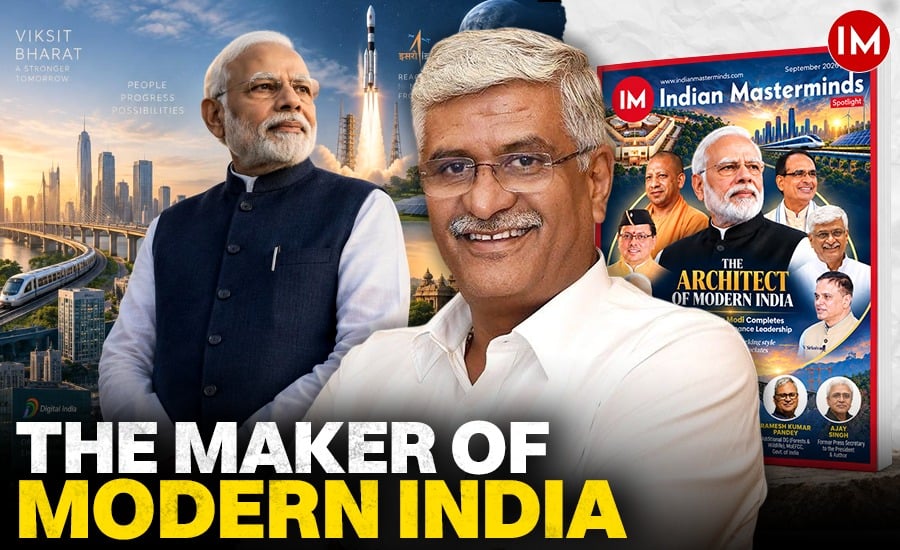
Some leaders administer their time; a rare few alter the way a nation understands itself and imagines its future. Having spent years in public life and served in a government led by Prime Minister Shri Narendra Modi ji, I believe his enduring contribution lies not only in the scale of India’s transformation, but in the confidence with which India now defines it in its own voice.
India has never lacked talent, enterprise, courage or civilisational depth. What it needed was a framework in which aspiration was not apologetic, development was not divorced from identity, and governance was judged by outcomes in the life of the last citizen.
Prime Minister Modi has given contemporary India that framework. His idea of modern India is neither an imitation of the West nor a retreat into the past. It is a confident synthesis of technology and tradition, reform and rootedness, enterprise and empathy, national ambition and people’s participation.
For decades, modernity was often presented to India as a choice: either look forward or remain rooted; either embrace technology or preserve tradition; either compete globally or speak proudly of our civilisational inheritance. Prime Minister Modi has decisively rejected this false binary.
World-class Infrastructure
His message is clear: India need not become less Indian in order to become more modern. We can build world-class infrastructure and restore ancient centres of faith; lead in digital public infrastructure and bring home stolen antiquities; send missions into space and safeguard centuries-old manuscripts. We can participate in the global economy without surrendering the cultural grammar through which Bharat has understood life and the world.
Also Read – Operation Clawing Back: How IFS N Ravisankar Sarma Cracked a Leopard Claw Trafficking Network in Himachal
This is not nostalgia; it is civilisational self-confidence. A nation uncertain of its identity borrows both its language of progress and its measures of success. A nation that knows itself can learn from the world, contribute to it and still choose a path suited to its own genius.
The renewal of Kashi Vishwanath Dham, transformation of Ayodhya, reconstruction at Kedarnath, Mahakal Lok and recovery of India’s cultural treasures are not isolated projects. Together, they affirm that India’s future will draw strength from its memory.
Vision Becomes Delivery
Prime Minister Modi’s leadership is equally distinguished by his insistence that vision must become delivery. In public administration, the distance between a policy decision and a citizen’s lived experience is the true measure of governance. A scheme, budget or target acquires moral meaning only when the intended benefit reaches the person for whom it was created.
This focus on the last mile has reshaped the culture of governance. Financial inclusion, direct benefit transfers, sanitation, drinking water, housing, electricity, health coverage and digital services are not separate compartments. Together, they restore dignity, expand opportunity and give citizens the confidence to participate in national progress.
Technology Improving Life
The transformation is also institutional. Technology has been used not as a symbol, but as an instrument of transparency, scale and inclusion. Digital India, the Jan Dhan-Aadhaar-Mobile architecture, UPI and digital public services demonstrate that innovation can be sophisticated and democratic. The strongest technology is not the one admired in a presentation; it is the one that quietly removes a barrier from an ordinary citizen’s life.
For administrators, the lesson is important. Governance cannot remain satisfied with sanctioning a project or publishing a dashboard. It must ask: Has the citizen received the benefit? Has the process become simpler? Has opportunity expanded and public trust increased? Prime Minister Modi’s emphasis on monitoring, accountability and time-bound implementation has made these questions central to government.
Policy Into People’s Movement
A defining feature of his leadership is the ability to turn public policy into public participation. Swachh Bharat could never have succeeded as a departmental exercise alone. Nor can water conservation, environmental responsibility, fitness, support for local products, heritage preservation or tourism promotion. Each requires citizens to move from being beneficiaries to becoming partners.
Prime Minister Modi invokes Jan Bhagidari because durable transformation cannot be outsourced to government. The State can create infrastructure and institutions, but habits change through social commitment. Experts may conserve a monument, but culture survives because families teach it, communities practise it and young people find contemporary meaning in it. Government may develop a destination, but its reputation is shaped by the cleanliness, hospitality and conduct experienced by every visitor.
This conversion of policy into a people’s movement respects the citizen as a stakeholder in the Republic. It recognises that the energy transforming India lies in its people – in villages and cities, farms and factories, laboratories and classrooms, workshops and start-ups.
Development With Heritage
No formulation captures Prime Minister Modi’s approach more powerfully than ‘Vikas Bhi, Virasat Bhi’ – development along with heritage. For those of us entrusted with culture and tourism, these words are not a slogan; they are a governing principle.
India’s heritage is not confined to protected monuments. It lives in languages, manuscripts, oral traditions, music, dance, crafts, architecture, food, festivals, sacred geographies and indigenous knowledge systems. Much of it survives because generations of families, gurus, artisans, performers, scholars and communities protected it without seeking recognition.
Our responsibility is twofold: to conserve the tangible and sustain the living. A temple, fort, stepwell or historic precinct must be preserved with integrity; the knowledge, skills and livelihoods associated with it must also find space in the contemporary economy. Conservation cannot mean freezing heritage in time. It must enable continuity, creativity and transmission.
Development and heritage can therefore reinforce each other. Better connectivity can revive a pilgrimage centre. Thoughtful destination planning can support guides, artisans, performers, homestays and small businesses. Digitisation can widen access to manuscripts and museum collections; design and e-commerce can take traditional crafts to new markets. When local communities become partners and beneficiaries, heritage protection gains economic strength and social legitimacy.
The essential condition is sensitivity. Heritage cannot be treated merely as real estate, nor living cultures reduced to spectacle. Development must respect the ecology, memory and distinctive character of a place. The objective is not to make every destination look alike, but to help each express what makes it unique.
Culture into Development’s Heart
Prime Minister Modi’s vision has repositioned culture from the margins of development to its heart. Culture is a source of identity, knowledge, creativity, employment and soft power. Tourism is the bridge connecting these dimensions with local prosperity.
Tourism is among the most human forms of economic activity. It creates opportunities for drivers and guides, hotels and homestays, artisans and chefs, performers, farmers and entrepreneurs. Its benefits can reach remote regions and small towns where large industries may never be established. Properly planned, it creates livelihoods while giving communities a direct stake in conserving their environment and heritage.
Yet the future of Indian tourism cannot be measured only by footfall. The new traveller seeks meaning, authenticity and experience. India can offer journeys of spirituality, wellness, nature, cuisine, craft, music, history and living traditions. Our task is to combine this civilisational abundance with contemporary standards of connectivity, hygiene, safety, interpretation, hospitality and digital convenience – world-class facilities with an unmistakably Indian soul.
Viksit Bharat
The vision of Viksit Bharat by 2047 gives these efforts a shared horizon. It is not simply a target of economic expansion. A developed India must be prosperous and innovative, but also inclusive, culturally confident, environmentally responsible and capable of giving every citizen the opportunity to realise his or her potential.
This journey demands sustained reform, strong institutions and the participation of successive generations. It requires us to combine scale with quality, speed with sensitivity and ambition with responsibility. Above all, it requires the confidence to solve Indian problems in ways rooted in Indian realities while drawing upon the best knowledge available anywhere.
When I reflect upon Prime Minister Narendra Modi ji’s leadership, I think of his clarity of purpose, extraordinary capacity for sustained work, attention to implementation and ability to convert national objectives into shared public resolve. But from the perspective of my responsibilities, one conviction stands out: India can move forward without losing its sense of self.
Upbeat National Mood
That conviction has changed the national mood. It encourages us to see heritage not as a burden from the past, but as strength for the future; citizens not merely as recipients, but as partners; and development not as a collection of projects, but as a national renaissance grounded in dignity and confidence.
The modern India taking shape is neither trapped by history nor persuaded that progress requires forgetting it. It is an India that innovates without imitation, modernises without deracination and engages with the world without hesitation.
Prime Minister Modi’s contribution to the making of modern India lies precisely here: he has helped a civilisation of immense antiquity recover the confidence to imagine an audacious future – and to build that future in its own voice.
(The article is written by Gajendra Singh Shekhawat, Union Minister of Culture and Tourism of India which was published in the September edition of Indian Masterminds Spotlight)
Also read – How Prime Minister Narendra Modi’s vision and guidance are transforming Uttarakhand’s development journey