Examinations are meant to test a student’s knowledge, aptitude and understanding. But increasingly, students are also being tested on something they never signed up for — the ability to deal with technical glitches, power cuts, poor network connectivity, overcrowded centres and, most seriously, the fear of question-paper leaks.
An examination system should create a level playing field. Instead, when a student reaches a centre and finds that the computer is not working, the server is down or the electricity has failed, the test can become as much about infrastructure as it is about ability.
Perhaps, therefore, India needs to ask a simple question: Are we testing students, or are we testing our examination centres?
THE EXAMINATION CENTRE NEEDS A NEW MODEL
Government schools and colleges have traditionally been used as examination centres. They are accessible and relatively economical. But with the growing dependence on technology and the increasing scale of competitive examinations, the traditional model deserves a rethink.
One possible solution is to create a decentralised network of smaller examination centres in public institutions that already have basic infrastructure and security arrangements.
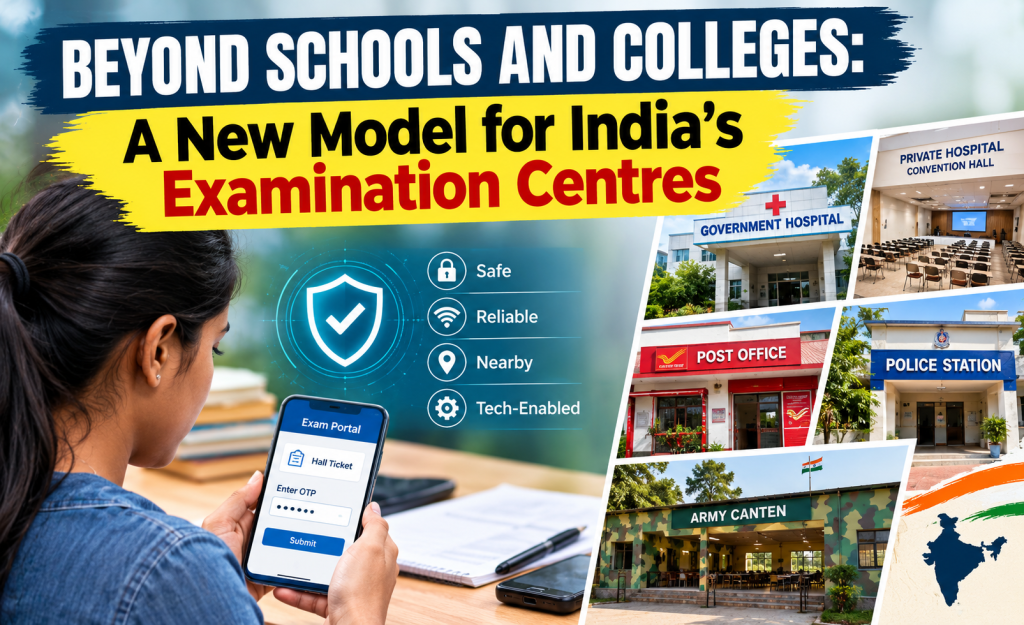
Depending on the location, centres could be created in:
- Government hospitals – using an available room or designated hall
- Private hospitals – using convention or seminar halls
- Government offices and post offices – using suitable rooms
- Local police stations – using waiting or community rooms
- Army cantonments – using suitable halls such as canteen or community spaces
The idea is not to turn every such institution into a permanent examination centre. Instead, these spaces could be temporarily designated as examination stations on selected Sundays.
Also Read – Rainwater Conservation: A Decision That Can Alter a Destined Disaster
BRING THE EXAM CENTRE CLOSER TO THE STUDENT
One of the biggest advantages of such a model would be proximity. A student from a village should ideally not have to travel several hours to another town simply to appear for an examination. Wherever practical, the centre should be allotted close to the student’s residence.
A decentralised system could divide candidates into smaller groups, with perhaps 50 to 100 students at each centre. A common examination window, such as 8 a.m. to 12 noon on a Sunday, could allow authorities to conduct examinations across hundreds or thousands of small centres simultaneously.
This could also reduce crowding and the logistical burden on a few large examination centres.
THE PROCESS SHOULD BEGIN BEFORE EXAM DAY
Technology can make this system more organised. Students could apply online, much like they do for other government services. Once their application is accepted, they could receive a digital hall ticket along with a unique OTP or authentication code.
Around 15 days before the examination, candidates could be given an opportunity to verify their allotted centre. A designated team at each centre could record the details of candidates who visit for verification. This simple step could prevent confusion on examination day and ensure that students know exactly where they have to report. It would also provide authorities with an opportunity to identify infrastructure problems before the actual examination.
A PAPERLESS EXAMINATION SYSTEM
The next major change could be the examination itself. Instead of installing hundreds of computers at every centre, the question paper could be delivered securely to the candidate’s own smartphone or another approved device.
After entering the centre, the student could open the examination link through an official message, email or designated examination platform. The first screen could display the student’s hall ticket and identity verification.
Only after entering the unique OTP would the question paper become accessible. At the end of the examination, the student would click SUBMIT. The answer sheet would then be digitally locked. Any attempt to reopen the examination link could result in a blocked screen.
Such a system could potentially reduce dependence on computer laboratories, rented equipment and large numbers of technical personnel. However, this would require strong cybersecurity, device authentication, encrypted question delivery and strict monitoring. A smartphone-based examination cannot simply be implemented without addressing the risks of cheating, impersonation, hacking and device malfunction.
FROM MEMORY TESTS TO APTITUDE TESTS
There is another issue that deserves equal attention: what exactly are examinations trying to measure? Many examinations reward the ability to remember large amounts of information. But memorisation alone does not necessarily indicate whether a student will become a good doctor, engineer, administrator, researcher, teacher or other professional.
Questions should increasingly test understanding, reasoning, application and aptitude.
Objective formats such as true-or-false questions and multiple-choice questions can be useful, provided they are designed intelligently. The purpose should not be to make examinations easier. It should be to make them more meaningful.
A student who genuinely understands a subject should be able to demonstrate that understanding without depending entirely on rote learning.
THE REAL SCORE SHOULD GO BEYOND MARKS
India needs professionals who have genuine interest and aptitude in their chosen fields. An examination system therefore needs to recognise more than a student’s capacity to memorise a textbook. It should attempt to identify genuine interest, deeper understanding, reasoning ability and aptitude.
This does not mean abandoning standardised examinations. Competitive exams provide an important common benchmark, particularly in a country as large and diverse as India. But the benchmark itself can evolve.
CAN THIS REDUCE LEAKS AND LOGISTICAL COSTS?
A decentralised examination model could potentially reduce several costs associated with conventional examinations — including large-scale police deployment, extensive centre bookings, computer installations and the appointment of large numbers of invigilators.
It could also reduce the concentration of thousands of candidates at a small number of examination centres.
But the idea that smaller centres automatically eliminate paper leaks or technical problems would be too simplistic. Security risks can shift from physical paper handling to digital systems. Therefore, cybersecurity and independent auditing would have to become central components of the model.
INDIA NEEDS AN EXAMINATION UPGRADE, NOT JUST ANOTHER EXAMINATION
The examination system cannot simply be eliminated. In a country of India’s size, some form of standardised assessment will remain necessary. But a standardised system does not have to remain a rigid system.
India can learn from international examination models, including those followed in countries such as South Korea and China. Yet directly replicating those systems may be expensive and difficult because India’s scale, infrastructure and socio-economic conditions are very different.
The answer may lie in an Indian model — decentralised, technology-enabled, secure and student-friendly.
The objective should be simple: a student should enter an examination centre worried only about the questions.Not about whether the electricity will remain on. Not about whether the network will work. Not about whether the examination will be delayed. And certainly not about whether the question paper will leak.
The real test should be the student’s ability. It is time we stopped making the examination centre another examination.
About The Author – (Malviekaa S Babbar holds degrees in B.Com., M.A. in English Literature, and M.B.F., along with a Creative Writing Certificate from the Writers Bureau, Manchester, UK. She is a skilled bilingual writer with extensive experience in English and Hindi, including scripting and writing Hindi dialogues.)
Disclaimer – (The views and opinions expressed in this article are solely those of the author and do not necessarily reflect the views of Indian Masterminds. For feedback or queries, please write to [email protected].)
Also Read – Accountability: The Forsaken Word We Must Bring Back