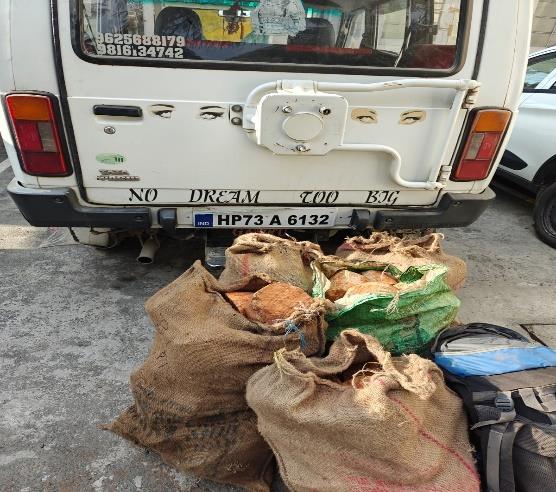
On 26 February 2024, a Tata Spacio approaching the Ludera forest check post in Chamba looked like any other vehicle passing through the hills.
Then the forest officials opened it.
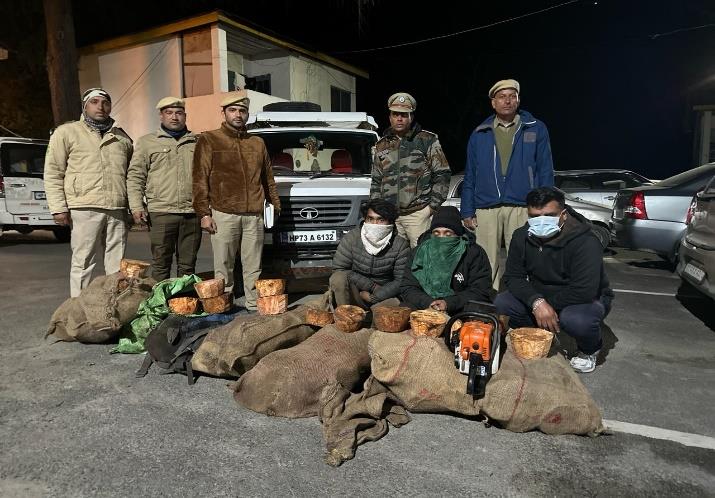
Inside were 160 freshly extracted maple knots, a power chainsaw and equipment that told a much more troubling story. Three people, including the driver Sanjay Kumar, were arrested.
At first, it could have been treated as another case of illegal forest produce extraction. But for IFS officer Kritagya Kumar, a 2020-batch Himachal Pradesh cadre officer serving as Deputy Conservator of Forests (Territorial), Chamba, the seizure raised too many questions.
Where had the maple been cut? Who had ordered it? And, more importantly, where was it supposed to go?
“It looked like another small-scale smuggling attempt, but the more we questioned them, the more we realized we had stumbled onto something far bigger,” Kumar recalls.
The answers would eventually take the Chamba Forest Division far beyond the forests of Himachal Pradesh.
Following the Maple Trail
Under the guidance of Chief Conservator of Forests, Chamba, Abhilash Damodran, the investigation began moving in several directions at once.
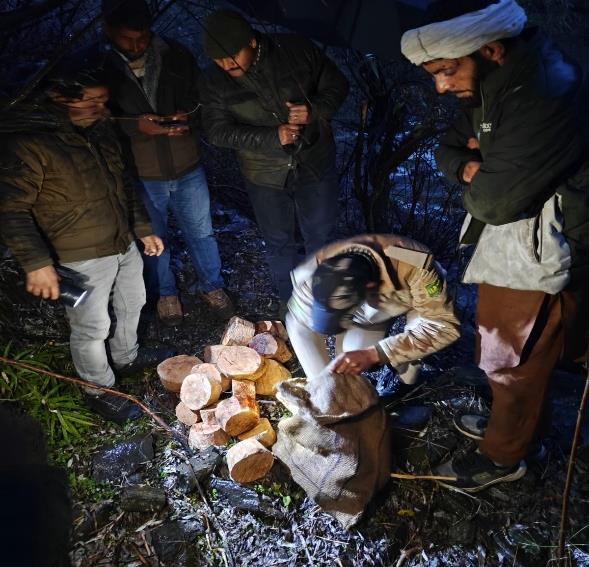
Interrogation revealed the name of Preethi Rawal, described as a seasoned maple smuggler operating across Himachal Pradesh, Jammu & Kashmir and Uttarakhand. Along with associates Tek Bahadur and Sanjay Kumar, Rawal had allegedly established hidden camps in the Sillagharat beat, where trees could be felled and processed over several days without immediately attracting attention.
The investigation also uncovered financial links.
More than ₹3 lakh had been transferred into Sanjay Kumar’s bank account from contacts in Nepal, providing investigators with an important clue that the operation extended well beyond the local level.
By 28 February, another 22 maple knots had been traced from hidden locations. Rawal’s son Paras was arrested, followed by local facilitators Musa and Bashir. Their questioning led forest officials to concealed caches in Kurtha village.
With every seizure, the case was becoming less about individual smugglers and more about a supply chain.

Every Interrogation Revealed Another Layer
The team began working against time. The longer the investigation continued, the greater the possibility that information would reach the people still outside the net.
“Every night someone new emerged: a supplier here, a transporter there. We were racing the clock before word spread,” says Kumar.
Then came another breakthrough.
On the night of 4 March, forest officials raided Hotel Thakur Dhaba in Chamba and found eight Nepali nationals. Five of them admitted that they were waiting for clear weather before entering the forest again to extract more maple knots.
Their statements pointed investigators towards a much larger player in Saharanpur, Uttar Pradesh — Funjok Lama.
According to the investigation, Lama was financing the operation, providing shelter and helping move the illegally sourced material towards Nepal, with the network’s international trail extending from Nepal to Tibet.
The forest department now had a map of a sophisticated inter-state network stretching across Himachal Pradesh, Uttarakhand, Uttar Pradesh and Jammu & Kashmir, with links beyond India’s borders.
Operation ‘King in the North’
The next step required the Chamba team to take the investigation out of the mountains. From 6 to 9 March, Kumar coordinated Operation “King in the North” with CCF Abhilash Damodran, the Range Officer, Lower Chamba, and local police forces in Saharanpur.
A reconnaissance team first verified the suspected addresses. Legal clearances and court permissions were secured before the operation moved into its decisive phase.
The concern was simple: one warning could scatter the entire network.
“Speed was everything. If even one accused got a tip-off, the network would vanish,” Kumar says.
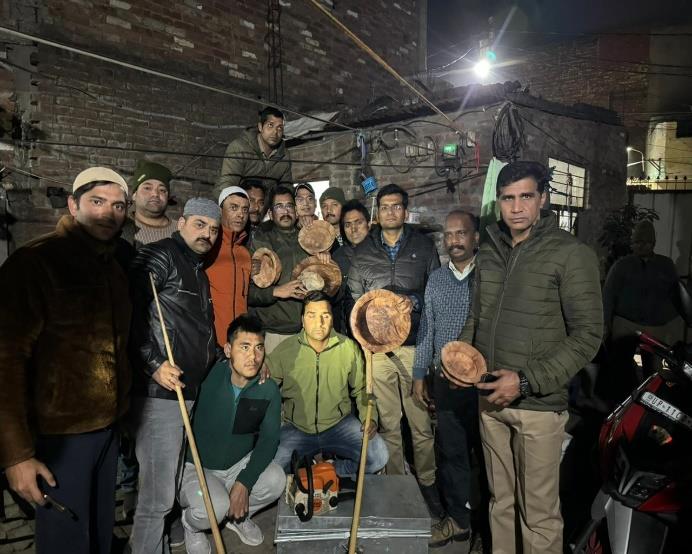
So, before dawn on 8 March, a 16-member strike team moved simultaneously against three locations in Saharanpur. What they found transformed the case.
The Saharanpur Haul
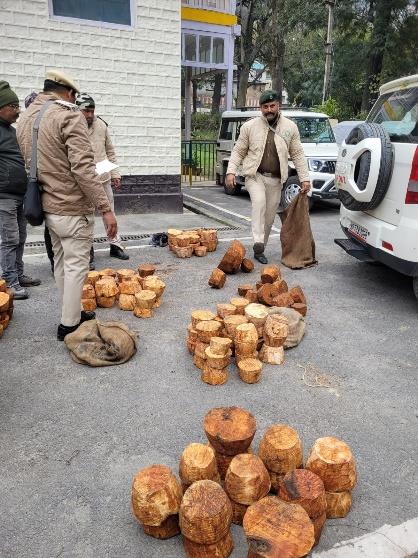
The raids resulted in the seizure of 1,330 illegally stored maple knots, taking the total recovery in the operation to 1,490 knots.
But the timber was only part of the story.
The team recovered processing equipment, raw carving material and finished handicraft products, suggesting that the illegally extracted maple was not simply being stored but was moving through different stages of a commercial supply chain.
The financial trail was there too: ₹7.22 lakh in Indian currency, 5,665 Nepali currency notes and 373 Chinese Yuanwere seized along with six mobile phones containing potentially crucial transaction and communication records.
Across the operation, 15 people were arrested at multiple locations.
What had begun with 160 maple knots inside a vehicle at a Chamba forest check post had grown into one of the region’s largest organised forest produce smuggling investigations.
More Than a Timber Seizure
The case continues under provisions of the Indian Forest Act, including Sections 41, 42 and 69, the Himachal Pradesh Forest Produce Transit Rules and the Biological Diversity Act. Damage assessment reports are being prepared, while further legal action in the case remains part of the ongoing investigation.
For Kumar, however, the significance of the operation lies beyond the quantity of maple recovered.
“This wasn’t just about seizing wood. It was about sending a message that Himachal’s forests are not for the taking,” he says.
The operation demonstrated what can happen when forest crime is approached not merely as a series of isolated seizures, but as an organised network that has to be mapped, followed and dismantled.
The trail began with a vehicle at a forest check post in Chamba. It led through hidden camps, local facilitators, financial transactions, secret storage points and interstate transport routes before reaching Saharanpur — and ultimately revealing links extending towards Nepal and Tibet.
For the Chamba Forest Division, the maple knot crackdown became a striking example of intelligence-led forest enforcement, rapid coordination and interstate cooperation.
And for IFS Kritagya Kumar and his team, it was a reminder that sometimes the smallest-looking seizure can conceal the biggest story.
Also read: How IFS Diganth Nayak Turned a Human-Dominated Landscape Into a Tiger Habitat