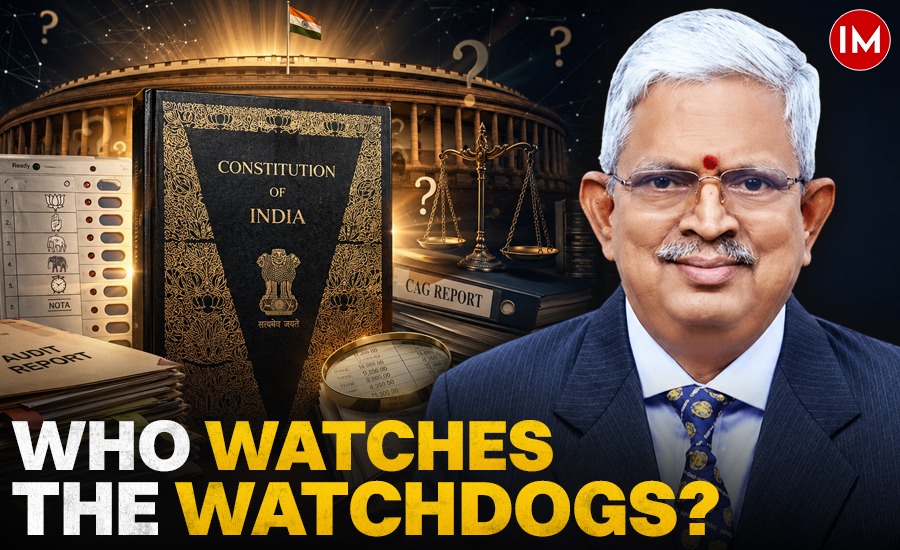
By P. Sesh Kumar, IAAS (Retd.), Former Director General, CAG of India
There is a curious paradox at the heart of India’s accountability architecture.
Whenever a major scam breaks into public consciousness, citizens instinctively look towards one institution. They wait for the Comptroller and Auditor General of India to investigate the financial trail, quantify losses, identify procedural violations and explain where governance went wrong. Decades of constitutional practice have made the CAG synonymous with accountability. The office carries an aura of neutrality that political parties often borrow when it suits them and question when it does not. Governments celebrate favourable audit reports and dismiss uncomfortable ones. Opposition parties do exactly the opposite. Yet through these political swings, one assumption remains remarkably constant: if the CAG speaks, the nation should pay attention.
But should speaking be enough?
This question lies at the heart of the second half of the story. For much of the public debate surrounding constitutional watchdogs concentrates on their appointment, their independence or their willingness to expose wrongdoing. Far less attention is paid to something equally important—what happens after the watchdog has spoken.
Does Parliament examine every major audit with the seriousness the Constitution intended? Do governments correct the weaknesses identified? Are systemic failures addressed before they recur? Or do audit reports merely become political ammunition for the news cycle before quietly disappearing into the archives?
The answers to these questions reveal that India’s accountability deficit may not lie primarily in its auditors. It may lie in the institutions expected to act upon what auditors discover.
Also read: Possible Solutions To Paper Leaks (Part 2)
VINOD RAI AND THE NEW FACE OF PUBLIC ACCOUNTABILITY
No modern Indian illustrates this paradox better than Vinod Rai.
Long before his name became synonymous with public accountability, the office of the Comptroller and Auditor General had largely remained outside everyday political conversation. Audit reports certainly attracted attention within ministries, parliamentary committees and specialist circles, but few citizens could identify the individual heading the institution. The office functioned with quiet efficiency, respected by experts but rarely discussed beyond policy circles.
That changed dramatically after 2010.
A series of audit reports examining the allocation of natural resources transformed both the office and its occupant into household names. Reports relating to the allocation of telecommunications spectrum and coal blocks suggested enormous financial implications for the exchequer and raised uncomfortable questions about decision-making within the executive. Headlines were dominated by expressions such as “presumptive loss,” “public resources,” and “accountability.” Political debate intensified. Parliamentary proceedings were repeatedly disrupted. Public protests drew energy from findings that appeared to demonstrate not merely procedural irregularities but systemic weaknesses in governance.
For the first time in independent India, the Comptroller and Auditor General became one of the most recognisable constitutional authorities in the country.
The transformation was extraordinary.
Ironically, however, the circumstances of Vinod Rai’s own appointment received very little attention at the time. He had not emerged through a transparent selection committee. Parliament had not conducted public hearings. Civil society had not evaluated competing candidates. His appointment followed precisely the same executive process that critics today argue lacks transparency and institutional safeguards.
Yet once in office, Rai fundamentally altered public expectations of what an independent auditor could accomplish.
His tenure therefore complicates one of the central assumptions in today’s debate.
If appointment procedures alone determine institutional behaviour, how did an officer selected through the traditional executive process become the most assertive Comptroller and Auditor General in recent memory?
The answer once again suggests that constitutional design is only one part of institutional independence. Personal conviction, professional culture and leadership also matter enormously.
But the Rai years reveal another truth that receives far less attention.
AUDIT IS ONLY THE FIRST STEP
Even the most independent auditor cannot ensure accountability alone.
The Constitution gives the Comptroller and Auditor General the authority to audit. It does not give the office the power to prosecute. It cannot impose penalties. It cannot cancel contracts. It cannot compel governments to accept its findings. Nor can it force Parliament to debate its reports.
The CAG’s constitutional responsibility ends the moment an audit report is submitted to the President or the Governor and subsequently laid before Parliament or the State Legislature.
From that point onward, responsibility shifts to elected representatives.
This distinction is often overlooked because public debate tends to treat the publication of an audit report as the conclusion of the accountability process. In constitutional theory, however, it is only the beginning.
THE MISSING LINK: PARLIAMENT’S ROLE IN ACCOUNTABILITY
The framers of the Constitution never intended the CAG to function as a solitary anti-corruption institution. They envisioned a chain of accountability. The auditor would identify financial irregularities. Parliament, acting through committees such as the Public Accounts Committee, would examine those findings in detail. Government departments would be required to explain their actions. Corrective measures would follow. Administrative reforms would emerge from institutional learning rather than political controversy.
The strength of the system therefore depended upon every link functioning effectively.
An auditor without parliamentary follow-up would remain incomplete.
Parliament without independent audit would remain uninformed.
The constitutional architecture required both institutions to reinforce one another.
In practice, however, this ideal has often proved elusive.
THE AGUSTAWESTLAND LESSON: WHEN AUDITS LEAD NOWHERE
One of the most revealing illustrations emerged from the controversy surrounding the procurement of VVIP helicopters from AgustaWestland.
The issue had already attracted widespread public attention because of allegations of corruption and irregularities in the procurement process. Questions regarding technical specifications, evaluation criteria and contractual decisions had dominated public debate for years.
When Shashi Kant Sharma was appointed Comptroller and Auditor General in 2013, the controversy acquired an additional institutional dimension.
Before assuming office as the nation’s constitutional auditor, Sharma had served as Defence Secretary and had occupied other senior positions within the Government of India during periods relevant to the helicopter procurement process. Critics therefore questioned whether someone who had earlier occupied executive positions connected with defence administration could impartially oversee an audit examining decisions taken during that period.
The concern was not directed at his personal integrity.
Rather, it reflected a broader institutional question that has become increasingly significant in recent years.
Should constitutional auditors immediately audit systems they themselves recently helped administer?
Reasonable people offered different answers.
Supporters argued that experience within government equipped senior civil servants with precisely the administrative knowledge required to conduct effective audits. Critics countered that public confidence in institutional neutrality depended not merely upon actual impartiality but also upon the appearance of impartiality.
The distinction may appear subtle.
In constitutional governance, it is fundamental.
Public trust depends as much upon perception as upon legal correctness.
Interestingly, the audit report that eventually emerged under Sharma’s leadership hardly resembled the work of an institution attempting to shield the executive.
The report identified significant deviations from established procurement procedures. It questioned changes made to technical requirements, highlighted shortcomings in evaluation processes and pointed towards weaknesses in the manner the contract had been concluded. In several respects, the audit attracted precisely the kind of public attention expected from an independent constitutional authority.
From the standpoint of audit, the institution had performed its constitutional duty.
Yet what followed proved even more revealing.
Or perhaps more accurately, what did not follow.
WHEN THE SYSTEM FAILS TO RESPOND
Despite the seriousness of the findings, the report never received the sustained parliamentary examination that one might expect from a document involving expenditure of enormous public importance. The Public Accounts Committee did not undertake a comprehensive analysis leading to definitive institutional conclusions. Political debate moved elsewhere. Media attention gradually faded. The audit entered the official record—but much of its potential impact remained unrealised.
This episode exposes one of the least discussed weaknesses in India’s accountability framework.
The problem was no longer the auditor.
The problem lay in the response—or the absence of one.
Audit reports are often described as instruments of accountability.
That description is only partially accurate.
An audit report is better understood as an invitation to accountability.
Whether accountability actually follows depends upon institutions beyond the auditor’s control.
Parliament must examine.
Governments must respond.
Departments must implement reforms.
If these subsequent stages fail, even the most rigorous audit risks becoming little more than an archival document.
The AgustaWestland episode therefore reinforces an argument running through this entire discussion.
Institutional independence cannot be measured merely by the courage with which watchdogs speak.
It must also be measured by the seriousness with which the constitutional system listens.
The same constitutional philosophy that requires fearless auditors also requires attentive legislatures.
Without the second, the first can achieve only limited success.
Perhaps this explains why debates over accountability sometimes appear strangely incomplete. Public attention focuses intensely on the publication of audit findings, yet comparatively little interest is shown in whether Parliament actually examines those findings, whether Action Taken Reports are submitted on time, whether recommendations are implemented, or whether similar irregularities recur in later years.
The Constitution expected audit to improve governance.
Too often, governance simply moves on.
It is against this background that another major controversy—the Rafale fighter aircraft procurement—would once again place the office of the Comptroller and Auditor General at the centre of national debate, raising difficult questions not only about audit methodology but also about transparency, confidentiality and the limits of public accountability.
RAFale AND THE POLITICS OF TRANSPARENCY
The Rafale controversy demonstrated that constitutional accountability in India has entered an era where even independent institutions are expected to operate under intense political scrutiny. Unlike earlier audit controversies that centred primarily on financial irregularities, Rafale became a debate over transparency itself—how much should citizens know, and how much can legitimately remain confidential in matters involving national security?
When Rajiv Mehrishi assumed office as Comptroller and Auditor General in 2017, questions surfaced almost immediately. Before becoming the constitutional auditor, he had served as Finance Secretary and later as Union Home Secretary. Since parts of the Rafale procurement process had unfolded during his tenure in government, critics argued that his appointment created the appearance of a conflict of interest. They questioned whether someone who had recently occupied the highest levels of the executive could independently audit decisions in which the executive itself was deeply invested.
The issue, however, was never about personal integrity. Throughout India’s administrative history, senior civil servants have built reputations based on professionalism and public service. The larger concern was institutional. Constitutional offices do not merely require independence; they must also be seen to be independent. Public confidence depends not only upon the correctness of an institution’s decisions but also upon the perception that those decisions were reached without prior association or institutional proximity.
When the CAG’s report on the Rafale procurement was finally tabled, it concluded that the negotiated deal offered pricing advantages compared with the earlier proposal. Yet significant portions of the underlying financial details remained confidential because of national security considerations. Consequently, the report produced sharply divergent political interpretations. Supporters claimed it vindicated the government’s position. Critics argued that conclusions unsupported by publicly verifiable data inevitably left room for doubt.
Neither side was entirely satisfied.
The episode highlighted a recurring challenge confronting constitutional watchdogs in modern democracies. An auditor must balance transparency with legitimate claims of confidentiality. Excessive secrecy weakens public confidence, but indiscriminate disclosure may compromise national interests. Navigating that balance is never easy, particularly when every conclusion is instantly filtered through partisan politics.
Yet once again, the more fundamental issue lay elsewhere.
Regardless of whether one agreed or disagreed with the report’s conclusions, the constitutional process after the report’s submission remained remarkably familiar. Public debate raged for weeks. Television studios hosted endless discussions. Political parties issued competing statements. Eventually, attention shifted to newer controversies.
The audit entered the archives.
The larger institutional conversation faded.
This pattern has repeated itself with surprising consistency over the years.
Audit reports often generate enormous political attention immediately after publication. They become headlines, parliamentary slogans and election speeches. But sustained institutional engagement—precisely what the Constitution envisioned—frequently remains elusive. Parliamentary committees tasked with examining audit findings often work under enormous backlogs. Some reports receive detailed scrutiny years after the events they describe. Others never receive comprehensive examination at all.
The consequence is subtle but profound.
Audit becomes retrospective commentary rather than an instrument for administrative reform.
The framers of the Constitution intended something very different.
The Comptroller and Auditor General was never conceived merely as a chronicler of governmental mistakes. The office exists to strengthen governance by identifying systemic weaknesses before they become recurring patterns. Every audit report represents an opportunity to improve administrative processes, tighten financial controls and prevent future waste of public resources.
That opportunity diminishes dramatically when reports are treated primarily as political documents rather than administrative roadmaps.
Parliament occupies a pivotal place in this constitutional chain. Through the Public Accounts Committee and the Committee on Public Undertakings, legislators are expected to subject audit findings to rigorous examination. Secretaries to the Government of India appear before these committees. Departments explain the reasoning behind their decisions. Corrective measures are recommended. Governments subsequently submit Action Taken Notes indicating how recommendations have been implemented.
This process rarely attracts public attention, yet it is arguably the most important stage in the entire accountability cycle.
Without effective parliamentary follow-up, audits cannot fulfil their constitutional purpose.
This institutional weakness deserves far greater public discussion than it currently receives. India does not necessarily suffer from a shortage of audits. It suffers from an inconsistent culture of acting upon them.
WHY PERFORMANCE AUDITS MATTER MORE THAN EVER
Another issue concerns the gradual decline in the visibility of large performance audits.
Performance auditing represents one of the most significant innovations in public accountability. Unlike traditional financial audits that examine whether expenditure complied with rules, performance audits ask more searching questions. Did the programme achieve its objectives? Were public resources used economically? Could better outcomes have been achieved through different administrative choices?
Such audits move beyond bookkeeping into governance itself.
Historically, performance audits have helped expose weaknesses in sectors ranging from health and education to defence, infrastructure and environmental protection. They often reveal systemic shortcomings that remain invisible in conventional financial statements.
In recent years, however, observers have noted fewer nationally prominent performance audits dominating public debate. There may be multiple explanations. Government programmes have become increasingly technology-driven and data-intensive. Audit methodologies themselves have evolved. The COVID-19 pandemic disrupted institutional functioning across government. Resource constraints have also affected audit priorities.
Each of these factors deserves consideration.
Yet another possibility cannot be ignored.
Performance audits often examine policy implementation in ways that naturally invite political sensitivity. They ask whether outcomes justified expenditure. They evaluate whether objectives were achieved. They analyse efficiency rather than merely legality.
Such scrutiny inevitably places constitutional auditors closer to questions of governance than governments may always find comfortable.
A healthy democracy should welcome such examination.
Public money is not judged merely by whether it was spent lawfully. Citizens also deserve to know whether it was spent wisely.
THE POST-RETIREMENT DILEMMA
India’s constitutional authorities often continue contributing to public life after retirement. Some become Governors. Others head commissions, tribunals or advisory bodies. Some accept positions in international organisations. Others join universities, think tanks or public institutions.
There is nothing inherently improper about experienced public servants continuing to serve society.
Indeed, many continue making valuable contributions long after formal retirement.
The concern arises not from actual misconduct but from institutional incentives.
Suppose a constitutional authority knows that several prestigious public appointments remain available after retirement. No explicit promise need ever be made. No conversation need ever occur. Yet the existence of such possibilities inevitably becomes part of the broader institutional environment within which decisions are made.
Constitutional design seeks, wherever possible, to eliminate even the appearance of such influences.
That is why judges follow carefully structured post-retirement conventions. That is why independent regulators are often subject to cooling-off periods before joining industries they once regulated.
The same logic applies to constitutional watchdogs.
The issue is not whether any individual acted improperly.
It is whether institutions should depend upon individual restraint when structural safeguards can remove unnecessary doubts altogether.
BUILDING STRONGER WATCHDOGS
This is where comparative constitutional practice offers useful lessons.
Several mature democracies have adopted appointment processes that deliberately diffuse executive influence. Independent selection committees, parliamentary confirmation hearings, transparent eligibility criteria and fixed cooling-off periods all seek to reinforce public confidence.
None of these mechanisms guarantees perfect independence.
No constitutional design can completely eliminate human ambition, political pressure or institutional caution.
But good institutional design reduces the likelihood that such factors will shape public decision-making.
India’s constitutional framework has reached a stage where similar reflection is both timely and necessary.
Reform, however, must avoid simplistic solutions.
Changing appointment procedures alone will not transform constitutional institutions overnight. A larger selection committee cannot manufacture courage. Publishing eligibility criteria cannot automatically produce fearless auditors or uncompromising election commissioners.
Institutional independence rests upon multiple foundations.
Appointments matter.
Internal decision-making processes matter.
Transparency matters.
The publication of dissenting opinions matters.
Parliamentary oversight matters.
Professional culture matters.
Protection against post-retirement incentives matters.
Above all, public expectations matter.
Institutions become stronger when citizens expect them to act independently and refuse to normalise silence.
Perhaps that is the most important lesson running through the histories of both the Election Commission and the Comptroller and Auditor General.
India has repeatedly demonstrated that constitutional offices possess extraordinary potential. T.N. Seshan reminded the nation that electoral rules could actually be enforced. Vinod Rai reminded governments that audit reports could shape national debate. Ashok Lavasa illustrated the importance of institutional dissent. Even controversial episodes such as AgustaWestland and Rafale reveal the continuing relevance of constitutional scrutiny in democratic governance.
These individuals mattered enormously.
But constitutions cannot depend forever upon exceptional personalities.
Institutions must become strong enough to produce independence routinely rather than occasionally.
The framers of the Constitution understood that democracy required checks upon executive authority. They built those checks carefully. They protected them generously. They insulated them from arbitrary removal. They assumed that security of tenure would encourage constitutional courage.
Experience has shown that courage, though essential, is only one part of the equation.
Independent institutions also require transparent appointments, professional cultures that encourage dissent, legislatures willing to examine uncomfortable findings and governments prepared to treat criticism as an opportunity for improvement rather than political confrontation.
THE UNFINISHED CONSTITUTIONAL PROJECT
The current debate before the Supreme Court over appointments is therefore important.
But it is not the final destination.
Whether the Court ultimately reshapes appointment procedures or leaves the existing framework largely intact, India’s constitutional conversation cannot end there.
For the larger question remains unanswered.
Who audits the auditors?
Who strengthens the watchdogs?
And perhaps most importantly, when they finally bark, who ensures that the nation actually listens?
That, ultimately, is the unfinished constitutional project before the Republic.
About The Author– Mr. P Sesh Kumar is a retired 1982-batch officer of the Indian Audit and Accounts Service (IA&AS) who served as Director General of Audit at the Comptroller & Auditor General of India.
Disclaimer—(The views and opinions expressed in this article are solely those of the author and do not necessarily reflect the views of Indian Masterminds. For feedback or queries, please write to [email protected].)
Also read: Why NEET Leaks Perpetually, But IIT-JEE & CA Tests Don’t (Part 1)