There is a moment that Gujaratis like to recall — the year 2000, when Narendra Modi became Chief Minister of a state battered by drought, economic slowdown and, just months later, a catastrophic earthquake. It was, by any measure, a difficult inheritance. Yet what followed over the next two-and-a-half decades is one of the most dramatic economic transformations in post-independence India.
Today, Gujarat accounts for roughly 8 per cent of India’s GDP while being home to barely 5 per cent of its population. It contributes nearly 18 per cent of the country’s total industrial output, handles over 40 per cent of India’s total exports, and runs one of the most extensive port and pipeline networks in Asia. Its per capita income is nearly double the national average.
How did this happen? And what role did the now-famous Vibrant Gujarat Global Investors’ Summit play in accelerating this growth? The story is worth telling in full.
Also read: Why India’s Constitutional Guardians Often Lose Their Bite
A Tradition of Enterprise
Gujarat did not begin its industrial journey in 2000. The state has always had a culture of commerce and enterprise going back centuries, when Gujarati merchants sailed to East Africa, Southeast Asia, and the Middle East. Cities like Surat were among the busiest trading ports in the world before colonial rule upended old trade routes.
After independence, this entrepreneurial DNA found a new outlet. Ahmedabad became one of India’s great textile cities. The Anand district gave birth to Amul, the cooperative milk model that the world still studies. Vadodara emerged as a chemical and petrochemical hub. By the 1990s, Gujarat already had a strong industrial base, good roads by Indian standards, and a government that broadly understood that industry needed space and support to grow.
But potential and performance are not always the same thing. When Modi took charge in 2001, Gujarat’s industrial growth had plateaued. Investor confidence was shaky. The earthquake of January 2001 had caused enormous damage to western parts of the state. The government needed to send a clear signal — that Gujarat was open for business, and was serious about it.
The Birth of Vibrant Gujarat
In September 2003, the first Vibrant Gujarat Global Investors’ Summit was held in Ahmedabad. It was, in scale, modest compared to what it would later become. But its purpose was unmistakable — to position Gujarat as a destination of choice for domestic and international investment, and to use the weight of public commitments to hold both government and investors accountable.
The idea itself was simple but powerful. Bring investors, industrialists, diplomats, and policymakers to one place. Sign memoranda of understanding on stage, in public, with media watching. Create a festival of investment rather than a quiet bureaucratic exercise. And then, follow up.
The first summit attracted investments worth around Rs 66,000 crore in MoUs. Critics then — as they would in later editions — questioned how many of these promises would actually materialise. But the state government developed a rigorous follow-up system to track implementation, and the conversion rate steadily improved over successive editions.
By the time the summit became biennial — held every two years — it had turned into one of Asia’s most anticipated investment conclaves. The 2024 edition, the 10th in the series, saw participation from over 140 countries and MoUs worth more than Rs 24 lakh crore. That single number tells you how far Gujarat had come since 2003.
What the Summit Actually Did
It would be a mistake to see the Vibrant Gujarat Summit as merely a PR exercise. Its real impact was structural, and it worked at three levels.
First, it forced the government to put its own house in order before every edition. In the months leading up to each summit, there would be an intense internal review — which clearances were pending, which land parcels were ready for allotment, which infrastructure bottlenecks needed resolution. The summit became an external deadline that drove internal reform. Bureaucracies, which otherwise move slowly, found that every two years they had to present results on a public stage.
Second, it built Gujarat’s global brand. Before 2003, international investors rarely had Gujarat high on their India investment radar. Mumbai was the financial capital, Delhi the political one, Bangalore the technology hub. Gujarat was known but not top-of-mind. The successive summits changed this. By the time the 2007 and 2009 editions rolled around — when global leaders from Japan, the US, and Europe were attending — Gujarat had become a serious address.
Third, and perhaps most importantly, the summits created a culture of partnership between industry and government. Companies that came to Gujarat found a responsive administration. The Chief Minister’s Office was known to directly intervene to resolve investor grievances. Single-window clearances were strengthened. The message that Gujarat sent, consistently, was that if you came here and invested, the government would be your ally — not your obstacle.
The Sectors That Drove Growth
Gujarat’s industrial rise has not been about one sector alone. It has been a broad-based growth story, though some areas stand out.
Petrochemicals and chemicals have long been Gujarat’s backbone. The state accounts for nearly 62 per cent of India’s total petrochemical capacity. The Dahej Special Economic Zone is one of Asia’s largest, housing hundreds of chemical and pharmaceutical units. Reliance Industries’ giant integrated refinery and petrochemical complex at Jamnagar — the world’s largest single-location refinery — is located in Gujarat. It alone has transformed the state’s industrial landscape.
Automobiles became a surprise success story after Ratan Tata, frustrated with delays in West Bengal, moved the Nano project to Sanand in 2008. The Gujarat government moved swiftly — land was allotted, clearances given, infrastructure laid out — all within weeks. This episode became a landmark in Indian industrial history. It demonstrated that Gujarat could execute at speed. Sanand quickly became an automotive cluster, attracting Ford, Honda Motorcycles, and dozens of ancillary manufacturers.
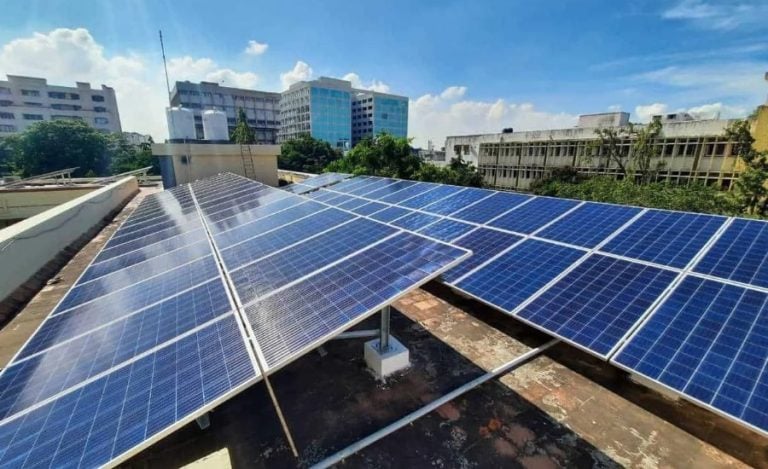
Renewable energy is the newest chapter. Gujarat was among the first Indian states to introduce a solar power policy and build utility-scale solar parks. The massive hybrid renewable energy park proposed at Khavda in the Rann of Kutch — with a planned capacity of 30 GW — will, when complete, be the world’s largest renewable energy project. Gujarat also accounts for a significant share of India’s wind energy capacity.
Ports and logistics have been another defining feature. Gujarat has the longest coastline of any Indian state — over 1,600 kilometres — and it has used this geography wisely. Mundra Port, built by Adani Enterprises from scratch, is now India’s largest commercial port by cargo handled. Together with Kandla (now renamed Deendayal Port), Hazira, and Dahej, Gujarat runs the most formidable port system in the country.
Infrastructure: The Invisible Engine
No industrial growth story survives without infrastructure. Gujarat understood this early. The state built an extensive network of expressways and state highways. Power availability — chronic in other Indian states — became a relative strength. The 24×7 uninterrupted power supply to industry, at a time when load-shedding plagued most of India, was a major competitive advantage.
The GIFT City project — Gujarat International Finance Tec-City — near Gandhinagar represents the most ambitious piece of new infrastructure. Conceived as India’s first operational smart city and a global financial hub, GIFT City has attracted major banks, insurance companies, and financial institutions. It houses an International Financial Services Centre (IFSC) that operates on par with Singapore and Dubai in terms of regulations and tax treatment. This is Gujarat’s bet on the future, beyond manufacturing.
The state also developed a gas grid that supplies piped natural gas to homes and industries across dozens of cities — a model that has since been replicated in other states. Irrigation networks were revived under the Narmada project, ensuring that agriculture remained a stable foundation even as industry surged ahead.
The Policy Continuity Factor
One thing that often gets overlooked in discussions about Gujarat’s growth is the role of policy continuity. The BJP has governed Gujarat without interruption since 1995. Whether one agrees with the party’s politics or not, there is no question that this continuity gave industry something it values deeply: predictability.
Investors who put money into long-term assets — factories, ports, power plants — need to know that the policy environment will not change with every election. In Gujarat, over two decades, industrial policies have been revised and updated, but the fundamental direction — welcoming to industry, responsive to investor needs, and willing to move fast on land and clearances — has remained consistent.
The Vibrant Gujarat summits themselves became a symbol of this continuity. Even as Chief Ministers changed — from Modi to Anandiben Patel to Vijay Rupani to Bhupendra Patel — the summits continued. Each government built on the work of the previous one. This institutional memory and policy continuity is rare in Indian politics and has been central to Gujarat’s industrial success.
Challenges That Remain
Gujarat’s industrial success has not come without costs or criticisms. Environmental concerns have been raised about the chemical and petrochemical belt around Ankleshwar and Vapi, where pollution of water bodies and air quality has been a recurring issue. Labour rights advocates have pointed to the relatively weak unionisation in Gujarat’s industries and questioned whether workers are fully sharing in the prosperity that their factories generate.
The concentration of industrial growth in a few large industrial corridors has left some districts — particularly in the tribal belt of eastern Gujarat — relatively behind. The question of whether growth has been inclusive enough remains live. Gujarat’s human development indicators, while improving, have not always kept pace with its economic metrics.
And even the Vibrant Gujarat summits have faced scrutiny over MoU-to-investment conversion rates. While the state has improved its tracking systems, there is always a gap between intentions signed at a glittering summit and factories actually running on the ground. The government would do well to publish regular, transparent progress reports on past commitments.
Twenty-Five Years On
In the broader sweep of Indian economic history, Gujarat’s last 25 years will likely be studied as a case study in how a state government can consciously shape its industrial destiny. The combination of a business-friendly administration, smart use of geography, investment in infrastructure, and the globally visible platform of the Vibrant Gujarat Summit created an ecosystem where industry could thrive.
The summits themselves deserve credit for more than just the investment numbers they generated. They changed the culture of how government interacted with industry. They made Gujarat visible on the world map of investment destinations. And they created a rhythm — every two years, the state had to take stock, show results, and make new commitments.
From the rubble of the 2001 earthquake to the gleaming towers of GIFT City, from battered drought-hit farms to the world’s largest renewable energy park, Gujarat’s journey is proof that economic transformation is possible when vision, policy, and execution align.
The state still has miles to go — in equity, in environment, in ensuring that growth reaches every corner and every community. But as a story of industrial ambition turned into reality, Gujarat’s last quarter century stands in a class of its own.
Also read: IAS Gargi Jain’s ‘Collector in Classroom’ Is Transforming Tribal Girls’ Education in Gujarat