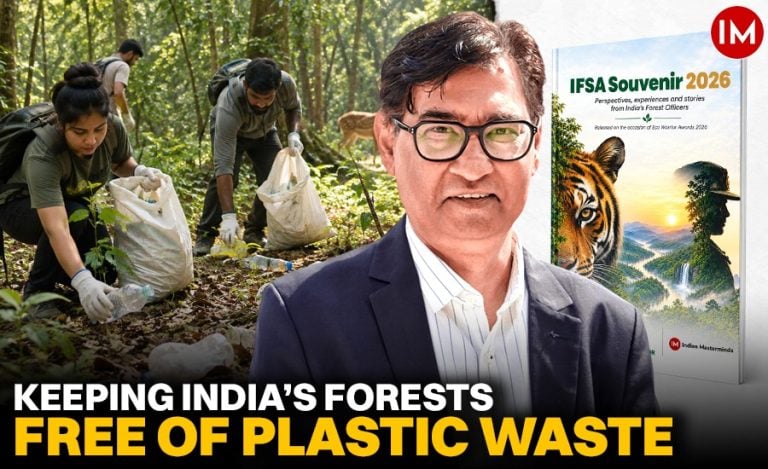
Forests cannot be protected by governments alone. In an era of accelerating climate challenges, biodiversity loss and increasing pressure on natural resources, conservation is steadily becoming a shared responsibility – one that calls for the resources of corporates, the knowledge of experts, the authority of government agencies and, most importantly, the participation of local communities.
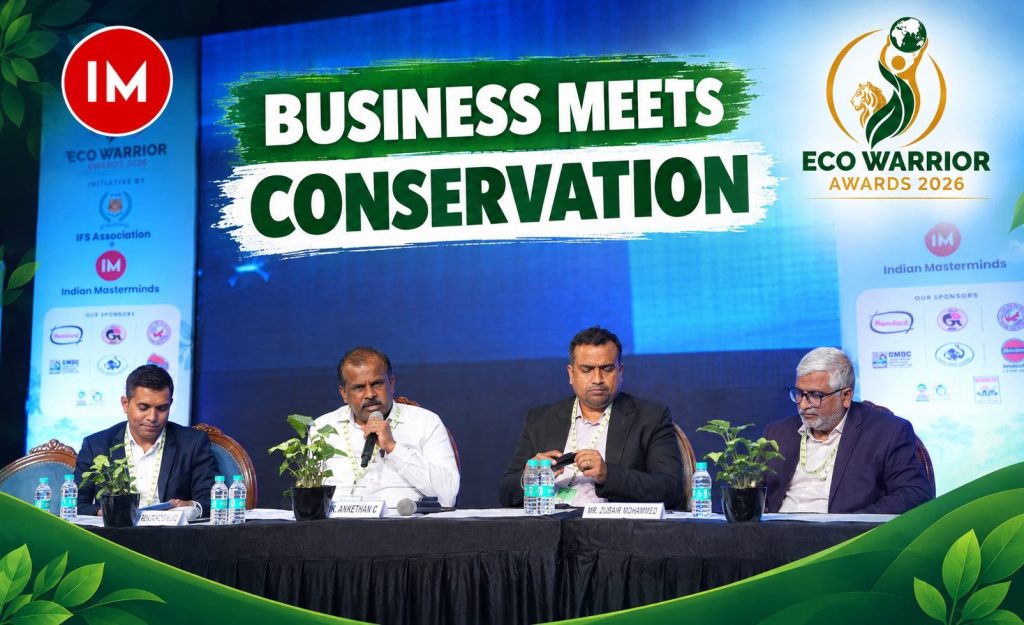
At the Eco Warrior Awards 2026 Conclave, this larger idea came into focus during the second panel discussion, “Role of Corporates in Forest Management.” The session explored how corporate participation can move beyond one-time CSR interventions and evolve into sustained partnerships capable of delivering measurable outcomes for forests, wildlife and communities.
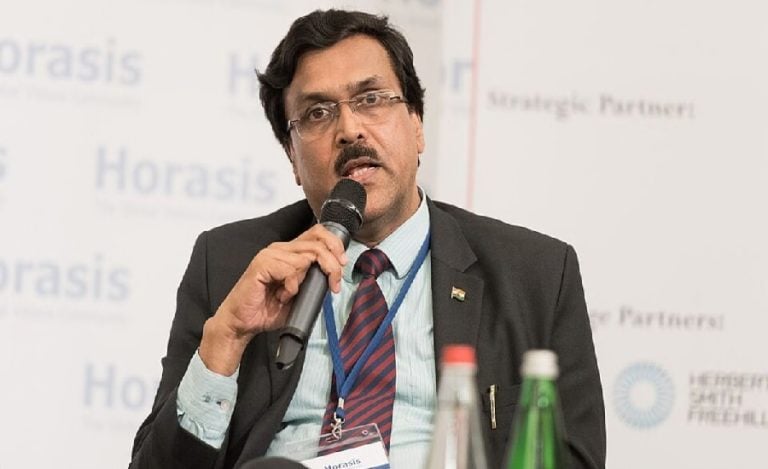
Moderated by senior journalist Manoj Singh of Indian Masterminds, the discussion brought together K. Ravi Chandran, 1996 batch IFS officer of AGMUT cadre and Director, Indian Institute of Forest Management; Zubair Mohammed, Head of Sales & Marketing, Hamdard Laboratories; and Anikethan C, Chief Naturalist, Jungle Lodges & Resorts, Karnataka.
The panel examined a crucial question: How can corporates become long-term partners in conservation rather than merely funding isolated CSR activities?
From CSR Donations to Long-Term Conservation Partnerships
Opening the discussion, K. Ravi Chandran, IFS, placed corporate participation in the broader historical context of forest management, pointing out that public and private participation in conservation is not a new concept.
However, he underlined the need to make such engagement more strategic and outcome-oriented.
According to him, corporates can contribute across several critical areas—from quality planting material and nursery management to restoration, afforestation and reforestation.
Read Also: Eco Warrior Awards 2026 Conclave: Can AI Change the Way We Protect Forests and Wildlife?
The possibilities are expanding further with technology.
He highlighted emerging opportunities in forest technology, carbon markets, remote sensing, GIS and digital public goods, suggesting that companies with technological expertise can play a much larger role in strengthening the capacity of forest management institutions.
The objective, however, should not be to create parallel systems.
Corporate support, he stressed, should complement the work being carried out by government agencies and local communities.
Technology and AI Can Transform Forest Management
One of the important dimensions of the discussion was the potential of technology to improve forest governance.
Ravi Chandran pointed towards the growing possibilities of Artificial Intelligence and Machine Learning in forestry. While AI is already transforming several sectors, specialised applications for forests could help improve decision-making, monitoring and management.
He also highlighted the possibility of industries contributing to the development of forestry-specific language models, which could eventually help forest managers access and interpret large volumes of information more effectively.
Such technological interventions could become particularly valuable when combined with remote sensing and GIS-based systems, enabling better monitoring of landscapes and conservation outcomes.
The underlying message was clear: corporate expertise should not be limited to financial contributions. Technology, innovation, research and specialised knowledge can be equally valuable assets for conservation.
Hamdard: Conservation as Part of the Business Philosophy
Offering the corporate perspective, Zubair Mohammed explained how Hamdard Laboratories approaches conservation not simply as a CSR responsibility but as something integrated into its broader philosophy and value chain.
He spoke about the company’s focus on responsible sourcing and cultivation, sustainable manufacturing, renewable energy, rainwater harvesting and responsible effluent disposal.
This approach connects environmental responsibility directly with business operations.
Hamdard’s agricultural activities include farms spread across more than 200 acres, where over 50 medicinal plants are cultivated. The model demonstrates how companies whose businesses depend on natural resources can incorporate sustainability into their core operations rather than treating conservation as an external activity.
Zubair also highlighted Hamdard Excellence Tours, through which policymakers, researchers, AYUSH practitioners, employees and other stakeholders can directly experience the company’s practices.
Such exposure, he suggested, can help make sustainability more tangible and encourage wider participation.
Responsible Tourism Can Connect Corporates with Communities
Another important perspective came from Anikethan C, Chief Naturalist at Jungle Lodges & Resorts, Karnataka.
Speaking from the field perspective, Anikethan emphasised the potential of responsible tourism to connect corporate resources with genuine conservation and community requirements.
Naturalists, he explained, can act as a bridge between different stakeholders—including the scientific community, Forest Department, local communities and visitors—and help identify areas where corporate support can create meaningful impact.
He cautioned, however, against approaches that focus only on distributing goods to communities.
For instance, when interventions involve sensitive issues such as tribal village relocation, the process requires proper planning, consultation and appropriate compensation. Simply providing items such as bags, shoes or uniforms may offer short-term assistance but does not necessarily address the deeper social and economic challenges faced by communities.
This highlighted an important principle emerging from the discussion: conservation interventions must be based on actual needs rather than assumptions about what communities require.
A Role for Corporates Beyond the Nature Sector
The panel also broadened the conversation beyond companies directly associated with forests, tourism, agriculture or natural resources.
Zubair pointed out that even companies from the service sector can contribute to conservation through resources, technology, innovation and market linkages.
This opens up a much wider ecosystem for environmental partnerships.
Technology companies, financial institutions, consulting firms, media organisations and other service-sector businesses may not directly work with forests, but their capabilities can potentially be channelled towards conservation programmes.
The panel also stressed the importance of making conservation more visible and relatable to younger generations, ensuring that environmental responsibility becomes part of everyday social and corporate culture.
Building a Shared Ecosystem for Conservation
The discussion at the Eco Warrior Awards 2026 Conclave ultimately moved beyond the conventional idea of CSR as financial assistance.
The panellists emphasised that meaningful corporate participation should be sustained, needs-based, collaborative and measurable.
Corporates can bring financial resources, technology, innovation, managerial expertise and market connections. Government agencies bring institutional authority and field experience, while communities contribute local knowledge and remain central to the long-term success of conservation initiatives.
When these strengths come together, corporate participation can evolve from isolated projects into long-term conservation partnerships.
The message emerging from the conclave was therefore both practical and inspiring: the future of forest conservation will depend not only on how much is invested, but on how intelligently, collaboratively and sustainably that investment is transformed into lasting impact.