By P Sesh Kumar
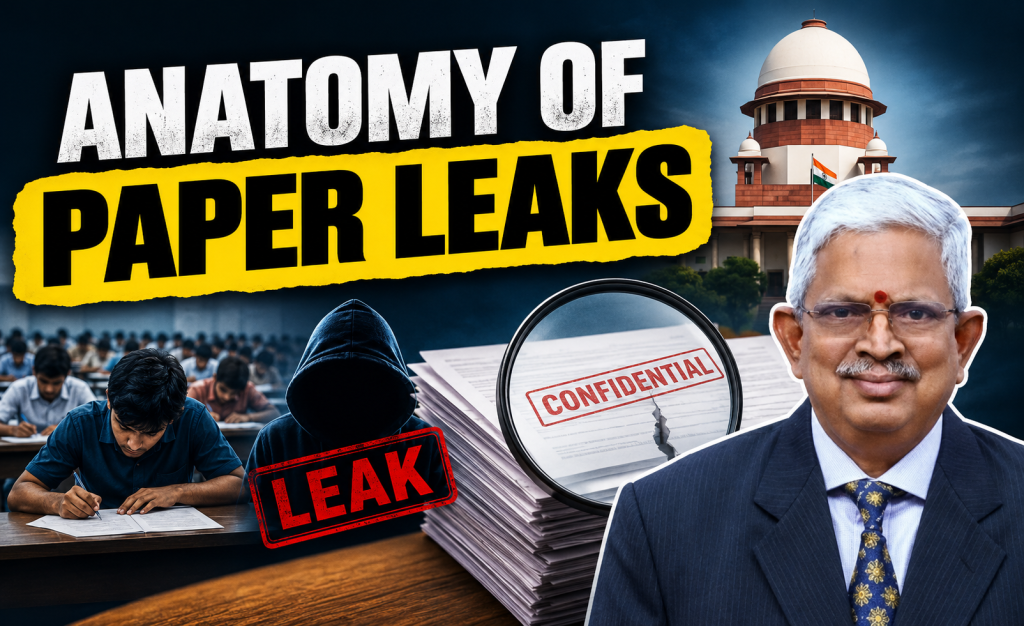
The resignation of Union Education Minister Dharmendra Pradhan has brought one of the largest student-led agitations in recent years to a close. For weeks, thousands of young aspirants occupied Delhi’s streets, demanding accountability after the NEET-UG 2026 paper leak shattered the faith of millions in India’s examination system. Their persistence forced the government to concede on its most politically sensitive demand, bringing an end to a protest that had steadily grown into a national movement.
But resignations make for powerful political symbolism, not lasting institutional reform. If the public conversation now ends with a minister stepping down and a promise of tougher punishments, India risks repeating the very cycle that produced this crisis. The NEET scandal was not simply the consequence of one administrative failure; it exposed deep structural weaknesses in the way examinations are designed, secured, investigated and prosecuted. Unless those deeper failures are addressed, another leak is only a matter of time.
This is not, therefore, the story of a protest that ended. It is the story of an examination system that remains dangerously vulnerable despite new laws, repeated assurances and increasingly harsher penalties. The larger question is not who resigned, but why a country that already possessed one of the toughest anti-paper leak laws still witnessed its biggest examination being compromised from within.
I. A SELFIE, A CABINET NOTE AND A BILL IN A HURRY
Late on the night of 23 July 2026, after roughly two and a half months of official reticence, the Prime Minister addressed the country not from the floor of a Parliament sitting a few hundred metres away but from a phone camera. The message was brief and its arithmetic was political: fast-track courts had already been directed into existence, a draft carrying stiffer punishments would go to the Cabinet the following morning, and a Bill would be introduced when the second week of the Monsoon session opened on Monday. By the morning of 24 July the contours had reached the wires in the customary manner, attributed to unnamed sources, and the headlines converged on a familiar pair of figures: imprisonment of five to ten years and fines running to a crore of rupees.
It is worth pausing on those figures, because they are not new. They are, almost precisely, what the Public Examinations (Prevention of Unfair Means) Act, 2024 already prescribes for organised paper-leak crime, and has prescribed since the statute came into force in June 2024. What is actually on the table is an uplift of the individual offender’s exposure from the present three-to-five years and Rs 10 lakh, together with the statutory blessing of fast-track courts that the executive has, characteristically, already set up ahead of the law. A statute twenty-three months old, in full force on 3 May 2026 when the NEET-UG question paper walked out of the National Testing Agency’s own ecosystem, is to be answered with a larger dose of itself. One would need to note that the specific contents of the amendment remain, as of this writing, sourced entirely to anonymous briefings; the Cabinet note itself is not in the public domain, and every number attributed to it in the press carries that health warning.
That is the intellectual event of this week, and it deserves a harder look than a news cycle will give it.
II. SIKAR, LATUR, PUNE: THE ANATOMY OF AN INSIDE JOB
The NEET-UG 2026 was written on 3 May by an army of about 22.79 lakh registered candidates across 551 Indian cities, fourteen foreign ones and upward of 5,400 centres, which makes it, by candidate count, the largest single-day examination on the planet, China’s Gaokao nothwithstanding.
Within days a chemistry teacher in Sikar, Rajasthan, compared a so-called guess paper that had been circulating in a paid messaging group against the actual question paper and found that the overlap was not the sort of thing that happens to lucky tutors. The reported extent of the match varies by outlet, and the variation is itself instructive: One outlet put it at 120 of 180 questions, others at around 140. Either figure is fatal. The Rajasthan Special Operations Group moved first; on 12 May the Central Bureau of Investigation took the case and the National Testing Agency cancelled the examination outright, promising a retest, a refund and no fresh registration. The retest was fixed for 21 June.
What the investigation then turned up is the part that should have ended the conversation about penalties. This was not a strongroom burgled by a gang from outside. The Central Bureau of Investigation arrested a retired Pune chemistry lecturer associated with the Agency’s own paper-setting panel, and then a subject expert in biology; a Latur coaching proprietor followed as the tenth arrest, and a school headmistress after him. The modus operandi, as reconstructed, was almost quaint in its analogue simplicity: questions dictated in special classes, handwritten notes scanned and passed on, candidates paying in lakhs. The Union Education Minister conceded, in the most revealing three words of the entire affair, that there had been a breach in the command chain.
There is worse. Investigators reported evidence that the same network had also obtained the NEET-UG 2025 paper. If that holds up, then a cohort admitted to medical colleges in 2025 sits on a merit list that nobody proposes to disturb, and the 2026 cancellation was not the discovery of a crime but the discovery of a habit. It is also the single most consequential fact in this file, and it has been reported thinly enough that it deserves an explicit flag: as of now it rests largely on agency sourcing carried by a limited number of outlets, not on any charge framed in court.
The human ledger has been settled less tidily. At least three aspirants are reported to have taken their own lives in the weeks after the cancellation, and the wider reportage on the despair in coaching towns makes uncomfortable reading. The Supreme Court, hearing petitions from medical associations, put the institutional question with unusual precision: the real problem will not stop, the Bench observed, until actual accountability arises, because unless duty holders are identified the obligation remains diffused. That sentence is worth more than the entire proposed amendment.
III. THE COMFORTABLE FICTION OF A CLOSED CASE
It is now possible, and in certain quarters fashionable, to argue that the NEET leak has become a non-issue. The steel-manned version of that argument runs as follows. The compromised examination was cancelled within nine days, which is faster than any comparable administrative response in Indian memory. A retest was conducted on 21 June across the full national footprint. Results were declared in the middle of July; roughly 11.21 lakh of about twenty lakh candidates qualified, and the National Medical Commission had already released a seat matrix of 1,36,939 places across 823 colleges, nearly ten thousand more than the previous year. Counselling by the Medical Counselling Committee is imminent. Arrests have been made and a chargesheet is in preparation. The examination is to migrate to a computer-based format from 2027. The law is being tightened this very week. On this reading, the system absorbed a severe shock, corrected itself within a single admission cycle, and is now legislating so that it does not happen again. Prolonging the agitation, the argument concludes, serves politics rather than students.
That case is not frivolous, and anyone who dismisses it is not arguing in good faith. It is nonetheless wrong, for four reasons.
First, a retest is not restitution. It is a second draw of the same lottery imposed on people who had already paid for the first. The candidate who peaked on 3 May and could not peak again on 21 June has lost something the State cannot restore; so has the repeater whose gap year burned, the aspirant whose family could not fund a second journey to a distant centre, and the three who are not here to file a petition. Educationists in coastal Karnataka said as much within hours of the cancellation, and they were right: a retest is a cost transferred from the guilty to the innocent.
Second, closure by counselling is a category error dressed as pragmatism. Once seats are allotted, admissions become vested rights that courts are institutionally reluctant to unwind. That was precisely the logic by which the Union persuaded the Supreme Court not to annul NEET-UG 2024, and the logic prevailed. The consequence is a perverse rule of survival: any leak that escapes detection long enough to reach the counselling stage becomes irreversible. The incentive that creates for delay, denial and attrition on the part of every institution involved hardly needs spelling out.
Third, the 2025 finding, if sustained, means the file is not closed but buried. A contaminated cohort is already in classrooms.
Fourth, and most importantly for the present purpose, the case is at the arrest stage. In India, that is not the beginning of the end. It is, historically, where examination-fraud cases go to die. Which brings us to the part of this discussion that legislation cannot reach.
IV. THE 2027 SCREEN: MIGRATION, NOT SALVATION
The most substantive reform announced in May was the decision to move NEET to a fully computer-based test from 2027. This is sensible, it was the central recommendation of the high-powered committee headed by Dr K. Radhakrishnan constituted after the 2024 debacle, and it should have happened already. Indeed the sharpest indictment of the last two years is that the Union accepted every recommendation of that committee except the online mode, and the Minister nonetheless maintained that the recommendations had been implemented word for word.
The Supreme Court, which had closed the 2024 proceedings in April 2025 on the strength of assurances of compliance, was entitled to feel that the bargain it struck had been broken. It has now asked for a full reform roadmap. A further caution on the record: the number of recommendations has been variously reported as around sixty in open court and as high as a hundred and one in the affidavit coverage, a discrepancy that the Ministry ought to resolve publicly rather than leave to reporters.
But it must be said plainly that computer-based testing is a migration of the attack surface, not an abolition of it. The evidence for this is not speculative; it is Indian, recent, and abundant. In December 2024 Bihar cancelled a computer-based recruitment test for Community Health Officers after the Economic Offences Unit found proxy servers, remote-viewing applications and other illegal software in play, arresting thirty-seven people including the centre head, the information technology manager and the examination coordinator.
In February 2026, barely ten weeks before NEET, the Uttar Pradesh and Uttarakhand Special Task Forces arrested operatives who were feeding answers into a Staff Selection Commission Multi-Tasking Staff examination through local networking and a proxy server at a private digital centre, an episode that forced cancellations across eight states. The Staff Selection Commission’s own 2025 season was disfigured by server crashes, vendor failures and mass protests.
The lesson is not that screens are worse than paper. It is that a leak is a governance failure that changes costume. On paper the vulnerable moment is custody and transport; on screen it is the vendor, the centre operator, the local area network and the item bank. India does not possess enough government-owned, high-capacity secure testing centres to run a twenty-two lakh candidate examination on its own machines, which is why the recommendation for a thousand permanent secure centres matters far more than the sentencing schedule. If the migration to 2027 is executed through the same thinly-governed private vendor ecosystem that has already been penetrated repeatedly, the country will simply have swapped a photocopier for a remote desktop.
V. WHY THE SCREEN AND THE LEDGER LEAK LESS
It is asked, reasonably, why the Joint Engineering Entrance Examination and the chartered accountancy examinations do not bleed the way NEET does. The answer is not superior virtue; it is arithmetic and architecture. NEET is a statutory monopoly gateway, for since the National Medical Commission Act came into force there is no second door, funnelling nearly twenty-three lakh aspirants toward some 1.37 lakh seats, and a private medical seat carries a market price that makes five lakh rupees for a question paper a coldly rational investment.
The engineering aspirant, by contrast, has exits everywhere: State common entrance tests, the Birla Institute admission test, a private university circuit and a national surplus of engineering seats so large that the scarcity premium simply collapses. The chartered accountancy candidate faces no seat at all. The Institute’s examination is criterion-referenced; nobody’s pass costs anybody else a place, and where the buyer’s gain is not another’s loss the market for a stolen paper never thickens.
Format finishes what economics begins. JEE Main is a computer-based test run across multiple sessions, days and shifts, with randomised forms drawn from an item bank and percentile normalisation stitching them together, so that no single artefact exists whose possession is worth anything; JEE Advanced is set and conducted by an Indian Institute of Technology in rotation, using its own faculty, for a candidate pool a fraction of the size.
The Institute of Chartered Accountants of India sets descriptive papers through a permanent in-house examination department under a self-regulating statutory body that owns its entire machinery, and advance sight of a question is worth far less when the candidate must still write a defensible solution in longhand. NEET, until this year, was the opposite of all of it: one day, one paper, one form, printed and moved in physical custody to more than five thousand four hundred centres, its question bank drawn from a fixed and finite school corpus that makes a plausible guess paper conceivable in the first place, and its subject experts hired from the very coaching-adjacent academic pool that profits from knowing what is in it.
None of this, however, is immunity, and the exceptions are the warning. In September 2021 the Central Bureau of Investigation booked Affinity Education Private Limited for selling admissions to the National Institutes of Technology at Rs 12 to Rs 15 lakh rupees a head by taking remote control of candidates’ machines at a centre in Sonepat during the fourth session of JEE Main; the agency later arrested a Russian national alleged to have tampered with the iLeon platform on which the examination ran.
The Institute of Chartered Accountants has its own history, including the rare Indian distinction of an actual conviction, a Delhi court having convicted three men over the leak of its 2007 Common Proficiency Test papers, and it debarred candidates for five years following allegations, circulated through messaging groups, around the Financial Reporting paper of the May 2024 final examination.
The moral is an uncomfortable one for the Government’s 2027 plan. What protects JEE is not the screen; the screen is precisely where JEE was attacked. What protects it is a smaller prize, a thicker set of alternatives and, in the Institute’s case, an examining body that owns its own machinery instead of renting it. NEET is about to migrate to the medium in which JEE was compromised, while retaining the largest prize in Indian education, no alternative route to it, and an agency that outsources both the setting and the delivery.
VI. THE LAW WE ALREADY HAD
The Public Examinations (Prevention of Unfair Means) Act, 2024 is not a weak statute. It codifies some twenty distinct offences, covering impersonation, tampering with optical mark sheets and unauthorised access to computer networks. Its offences are cognizable, non-bailable and non-compoundable. Investigation is reserved to officers of at least Deputy Superintendent rank. Service providers face fines of up to a crore, recovery of the proportionate cost of the compromised examination and a four-year debarment. Organised crime attracts five to ten years and a minimum fine of Rs 1 crore, with provision for attachment of property. Its rules mandate a National Technical Committee to harden computer-based testing. Whatever else may be said, this is not a permissive regime.
And yet the paper walked. This is the point at which the criminological literature stops being academic.
Deterrence is a product of three variables: severity, certainty and celerity. Indian criminal policy has an almost superstitious attachment to the first and a near-total neglect of the other two. Raising a maximum sentence from five years to seven changes the calculation of a rational offender only if the probability of being convicted is non-trivial. Where that probability approaches zero, severity is not deterrence; it is theatre, and it has a perverse hydraulic effect. Every increase in penalty raises the risk premium on the contraband, which raises the price of a leaked paper, which raises the profit, which recruits better-financed and better-connected criminals and buys more expensive silence. Raising the price of a crime without raising the odds of being punished for it is a subsidy to the professional and a deterrent only to the amateur.
There is a second, subtler cost. Draconian sentencing tends to raise, in practice if not in law, the evidentiary threshold that trial judges apply. It lengthens bail litigation, multiplies interlocutory appeals, and sharpens the incentive to intimidate or buy witnesses, most of whom in these cases are themselves candidates with everything to lose. A statute that is severe and unenforced is worse than a statute that is moderate and enforced, because it teaches the public that the law is a press release.
VII. THE TWO-THIRDS THE CENTRE CANNOT REACH
The 2024 Act binds examinations conducted by central authorities: the Union Public Service Commission, the Staff Selection Commission, the Railway Recruitment Boards, the banking personnel selection board/institute and the National Testing Agency. It expressly does not extend to State board examinations or to university examinations. It was intended to serve as a model law. This is the single largest gap in the architecture, and it is where most of the rot is.
The numbers, such as they are, are grim and worth reciting with their provenance attached because no official series exists. An Indian Express investigation counted 41 documented leaks over five years across fifteen States in recruitment examinations, affecting roughly 1.4 crore applicants competing for a little over 1.04 lakh posts. India Today counted seventy leaks in seven years touching about 1.7 crore applicants.
A Newslaundry ten-year tally identified 89 suspected cases and 48 retests affecting at least 6.5 crore candidates; that last figure rests on a single outlet’s methodology and should be treated as indicative rather than authoritative. The Tribune, working from the Bill’s own background material in 2024, recorded over fifty instances since 2015, with Rajasthan and Gujarat at fourteen each, Uttar Pradesh at six between 2017 and 2022 and Uttarakhand at four since 2019. The Chief Minister of Rajasthan claimed in 2024 that 17 of 19 recruitment examinations had been leaked under his predecessors, a partisan figure that nonetheless nobody in the State seriously contested.
Almost none of that is NEET. It is constable and sub-inspector recruitment, teacher eligibility tests, patwari and talati examinations, State public service commission preliminaries, university semester papers and, notoriously, the Bachelor of Education and teacher-training ecosystem where degree-mill economics and examination fraud have fused into a single business model. The Union can legislate all it likes; a Bachelor of Education paper leaking in a private-affiliated college is a State subject, prosecuted by State police, tried in a State court.
Several States have legislated, and the drafting is a study in escalation for its own sake. Gujarat prescribes five to ten years and fine of up to Rs 1 crore. Bihar’s 2024 Act runs from three to ten years with fines up to Rs 1 crore, asset seizure and a four-year suspension for delinquent agencies.
Uttar Pradesh went furthest with an Ordinance in June 2024 providing for two years to life imprisonment and a Rs 1 crore in fines, extending to degree and diploma entrance examinations and to fake recruitment websites. Himachal Pradesh’s 2025 Act makes every act of leaking, copying or conspiring non-bailable, bars the use of any building other than a designated centre, and reserves investigation to officers of at least Deputy Superintendent rank. Life imprisonment for a paper leak is, one may say without irony, a sentence in search of a conviction.
What States must actually do is duller and harder. They must constitute permanent examination-integrity cells within their police forces rather than ad hoc Special Investigation Teams assembled after each scandal, staffed with officers who understand digital forensics and who are not transferred every eleven months. They must build State-level secure testing infrastructure in government institutions instead of renting private cyber-cafes. They must maintain and publish a debarment register for vendors, printers, centre operators and invigilators, and honour each other’s entries, because a vendor blacklisted in Rajasthan currently walks into a contract in Jharkhand.
They must adopt the State Level and District Level Coordination Committee model that the Radhakrishnan committee prescribed and that the Agency’s affidavit claims is now functional, and they must make those committees answerable for outcomes rather than for attendance. And they must extend their statutes to university and board examinations, which the Union cannot do for them.
One further federal complication deserves mention because it is rarely raised in this context. Examination-leak networks are inherently inter-State; the 2026 racket ran between Rajasthan, Maharashtra and Delhi. Yet nine States have withdrawn general consent to the Central Bureau of Investigation, obliging the agency to seek case-by-case permission, with hundreds of requests pending at any time. Whatever one’s view of the politics of that withdrawal, and there is a serious case on both sides, the operational consequence for examination fraud is that the only agency with a national writ can be kept waiting at the State border while devices are wiped.
(This is the first part of a two-part series examining India’s paper leak crisis. While this article traces how the NEET scandal unfolded, why the existing legal framework failed, and why merely increasing punishments cannot solve the problem, Part Two, to be published tomorrow, will focus on the reforms that can actually secure India’s examination system—from technological safeguards and institutional restructuring to accountability mechanisms capable of restoring public trust.)
About The Author– Mr. P Sesh Kumar is a retired 1982-batch officer of the Indian Audit and Accounts Service (IA&AS) who served as Director General of Audit at the Comptroller & Auditor General of India.
Disclaimer—(The views and opinions expressed in this article are solely those of the author and do not necessarily reflect the views of Indian Masterminds. For feedback or queries, please write to [email protected].)