New Delhi: India’s coir sector is emerging as an important contributor to rural livelihoods, entrepreneurship and sustainable economic growth, with exports of coir and coir products reaching ₹6,614.40 crore in FY 2025-26. According to the Ministry of Micro, Small and Medium Enterprises (MSME), exports have increased by 305.70% from ₹1,630.33 crore in FY 2014-15, highlighting the growing demand for India’s eco-friendly coir products in international markets.
India is the world’s largest producer and exporter of coir, accounting for approximately two-thirds of global production. The traditional industry supports rural communities, promotes the productive use of coconut husks and creates opportunities for small businesses and artisans. With a focus on sustainability, value addition and inclusive development, the sector is also contributing to the vision of Viksit Bharat @2047.
What Is Coir and Why Is It Important for India?
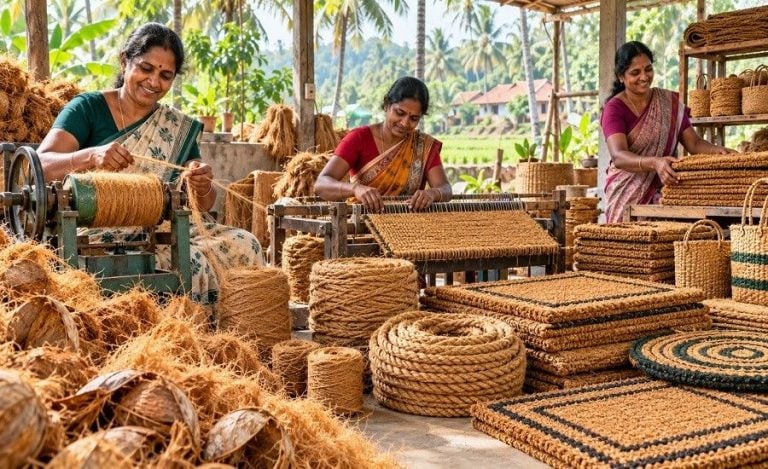
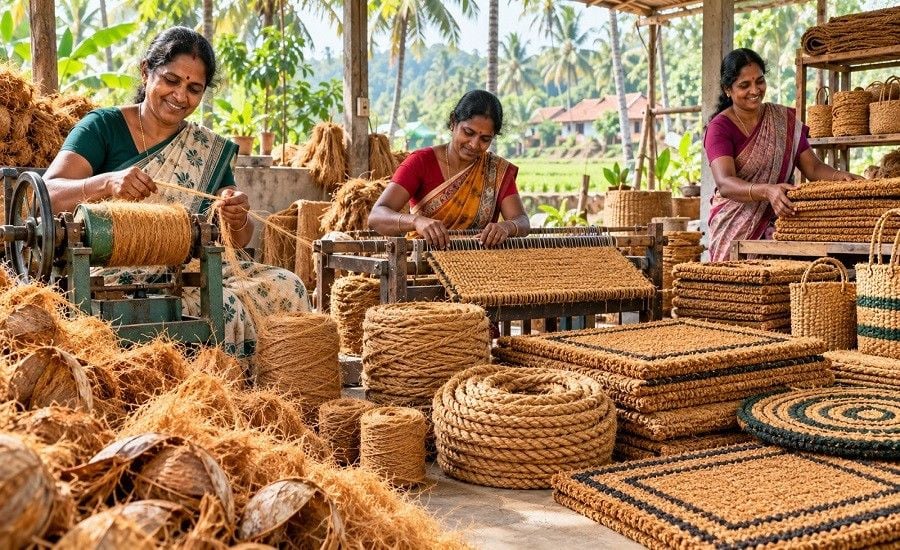
Coir is a natural fibre extracted from the tough outer husk of coconuts. The fibre is processed into a variety of commercial products, including mats, mattresses, ropes, brushes and other utility items.
As an eco-friendly manufacturing sector, the coir industry converts coconut husks into value-added products while supporting traditional skills and rural enterprises. Its emphasis on natural materials and sustainable production has helped expand the range of products available for domestic and international markets.
The Indian coir industry has an estimated turnover of approximately ₹16,000 crore and contributes close to 1% of the country’s Gross Domestic Product (GDP).
Read also: Small Businesses, Big Impact: Bihar Records 54 Lakh MSMEs and 2 Crore Jobs
India’s Coir Industry: Exports, Employment and Major Markets
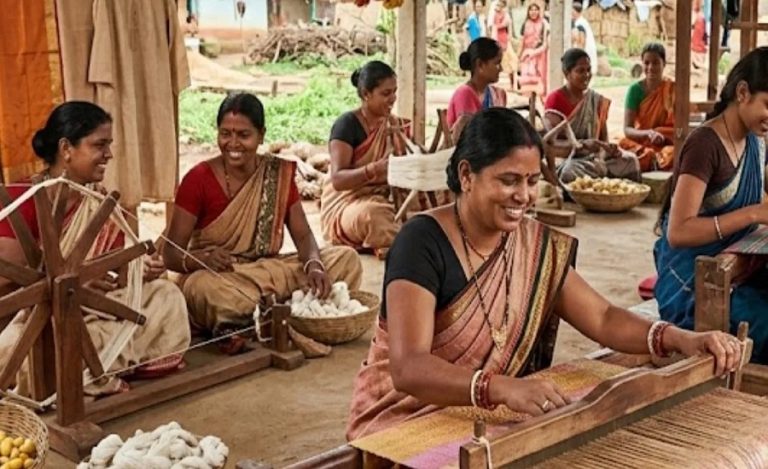
India’s coir sector has a strong presence in international trade and plays a significant role in employment generation, particularly among rural women.
Key highlights of the sector include:
- Global leadership: India is the world’s largest producer and exporter of coir and coir products, accounting for around two-thirds of global production.
- Export value: Exports of coir and coir products reached ₹6,614.40 crore in FY 2025-26.
- Major export destinations: The United States, China, the Netherlands, Spain and the United Kingdom are among India’s key export markets.
- Major exported products: Coir pith, coir fibre, coir yarn and tufted mats are among the principal products exported from India.
- Industry presence: The sector has more than 21,000 coir units registered on the Udyam registration portal.
- Employment generation: The industry provides direct and indirect employment to more than 7 lakh workers, approximately 80% of whom are women from rural households.
The registration of more than 21,000 units on the Udyam portal has also brought over 2.3 lakh people employed in these units into the formal MSME policy ecosystem.
Coir Vikas Yojana: Government Support for the Coir Sector
The Ministry of MSME implements the central sector scheme Coir Vikas Yojana (CVY) to promote the sustainable development and growth of the coir industry. The scheme supports coir artisans, entrepreneurs and businesses through technology development, skill training, product promotion and market expansion.
The major focus areas of the scheme include:
- Technology and product development: Developing new technologies, machinery and innovative products for the coir industry.
- Skill development: Conducting training programmes to improve the skills and capabilities of coir workers and artisans.
- Market promotion: Promoting coir and coir products in domestic and international markets.
- Publicity and awareness: Organising publicity campaigns and participating in trade fairs, exhibitions and expos.
- Financial assistance: Providing financial support to promote the sale of coir products.
- International market access: Facilitating the participation of coir exporters in international exhibitions.
- Sectoral statistics: Compiling and publishing data on the coir industry to support its development.
Through these initiatives, the government aims to strengthen traditional enterprises, improve product quality, encourage innovation and create additional market opportunities for coir manufacturers.
Coir Sector Achievements Since 2014-15
Over the past 12 years, the Indian coir sector has recorded progress in exports, skill development, technology and market promotion.
Exports Rise by More Than Four Times
Exports of coir and coir products increased from ₹1,630.33 crore in FY 2014-15 to ₹6,614.40 crore in FY 2025-26, registering growth of 305.70%.
The increase reflects the expansion of international markets for Indian coir products and the industry’s growing role in promoting sustainable alternatives.
More Than 68,000 People Receive Training
Over 68,000 people have received training through various programmes in the coir sector, with women accounting for more than 80% of the trainees.
These programmes aim to strengthen traditional skills, improve production capabilities and enable more people to establish or expand coir-based enterprises.
More Than 150 Innovative Machines and Products Developed
The sector has seen the development of more than 150 innovative machines, technologies and value-added coir products. These initiatives support improvements in production processes and encourage the creation of new products for different markets.
Export Promotion and International Exhibitions
The Coir Board has facilitated the participation of more than 1,000 exporters in international exhibitions abroad. Under Export Market Promotion initiatives, financial assistance exceeding ₹20 crore has been provided to more than 850 entrepreneurs.
At the domestic level, the sector has organised more than 1,400 promotional programmes and participated in over 950 exhibitions across India, helping businesses showcase products and connect with potential buyers.
Coir Entrepreneurs: Success Stories From Across India
The growth of the coir industry is reflected in the experiences of entrepreneurs who have established businesses with support from government schemes, Coir Board training and technical guidance. Their ventures demonstrate how traditional resources and skills can create employment and support local economies.
1. Ranjana Ramchandra Kadam Builds a Coir Business in Maharashtra
Ranjana Ramchandra Kadam, from Sindhudurg district in Maharashtra, turned her entrepreneurial ambition into a business with support from the Prime Minister’s Employment Generation Programme (PMEGP) and guidance from the Coir Board.
With assistance from the Coir Board office, she constructed a shed and procured the machinery and equipment required to establish her coir unit.
Her factory now manufactures coir ropes, pillows and doormats. The enterprise has created full-time employment for six people, demonstrating how support for small businesses can generate local livelihood opportunities.
2. Sampoorna Plus Agro Fertilizer Enterprises Expands in Kerala
Surendran P.’s Sampoorna Plus Agro Fertilizer Enterprises in Kozhikode, Kerala, received training and technical guidance from the Coir Board’s Sub-Regional Office in Kannur and the Central Coir Research Institute (CCRI), Kalavoor.
He participated in practical training programmes, demonstrations and awareness sessions focused on producing and effectively using coir pith bio-fertiliser.
Within one year, the enterprise developed a customer base of more than 500 customers and recorded sales of over 20 tonnes of coir pith bio-fertiliser.
The unit currently employs five workers, including two women, contributing to local employment while promoting the productive use of coir pith.
3. Allam Gowthamy Establishes Adigo Coir Products in Andhra Pradesh
Allam Gowthamy, from East Godavari district in Andhra Pradesh, attended a Coir Board Training Centre programme five years ago. Motivated by the training and technical guidance she received, she established her own enterprise, Adigo Coir Products, with financial assistance under PMEGP.
The business has since achieved an annual turnover of approximately ₹35 lakh and an annual profit of around ₹10 lakh. It has also created employment for six women.
Beyond running her enterprise, Gowthamy actively supports skill development in her community. With assistance from the Coir Board Regional Office in Rajahmundry and Mandal Parishat authorities, she has helped train nearly 120 women in coir mat weaving, rope making and handicraft production.
Her experience highlights the role of training and financial support in promoting women-led entrepreneurship and extending livelihood opportunities to other women.
4. G. Sabu Creates Local Jobs Through a Coir Spinning Unit in Kerala
G. Sabu, from Alappuzha, Kerala, established a coir spinning unit in 2024 under PMEGP with support from the Coir Board Regional Office in Kalavoor.
Within two years of operation, the unit established steady production of coir yarn and rope, supplying local coir societies and manufacturers in Alappuzha.
The enterprise has generated direct employment for eight to ten local workers, predominantly women from nearby villages. Its monthly turnover has increased substantially, providing the entrepreneur with a stable income and ensuring regular wages for employees.
The unit illustrates how government-supported entrepreneurship can strengthen local supply chains while creating employment in traditional industries.
Coir Industry Supports Women’s Empowerment and Rural Development
Women play a central role in India’s coir sector, accounting for approximately 80% of the industry’s direct and indirect workforce, according to the sector overview. They also represent more than 80% of participants trained under various coir-sector programmes.
The experiences of entrepreneurs such as Ranjana Ramchandra Kadam and Allam Gowthamy demonstrate how financial assistance, training and technical guidance can help women establish enterprises, create jobs and pass traditional skills on to others.
By combining established production techniques with improved machinery, innovative products and wider market access, the industry offers opportunities to strengthen rural incomes and expand women’s participation in entrepreneurship.
Coir Sector’s Role in India’s Sustainable Growth
India’s coir industry combines traditional knowledge with sustainable manufacturing, export growth and employment generation. Its contribution extends beyond the production of natural-fibre goods to include entrepreneurship, skill development and the economic participation of rural communities.
With more than 21,000 units registered on the Udyam portal, exports exceeding ₹6,600 crore in FY 2025-26 and thousands of entrepreneurs benefiting from training and market-promotion initiatives, the sector continues to demonstrate its economic potential.
Government support through the Coir Vikas Yojana and PMEGP, together with the efforts of the Coir Board and individual entrepreneurs, is helping the industry expand its reach while creating opportunities for workers and small businesses.
As India advances towards Viksit Bharat @2047, the coir sector is positioned to remain an important contributor to sustainable production, inclusive economic growth and rural livelihood development.