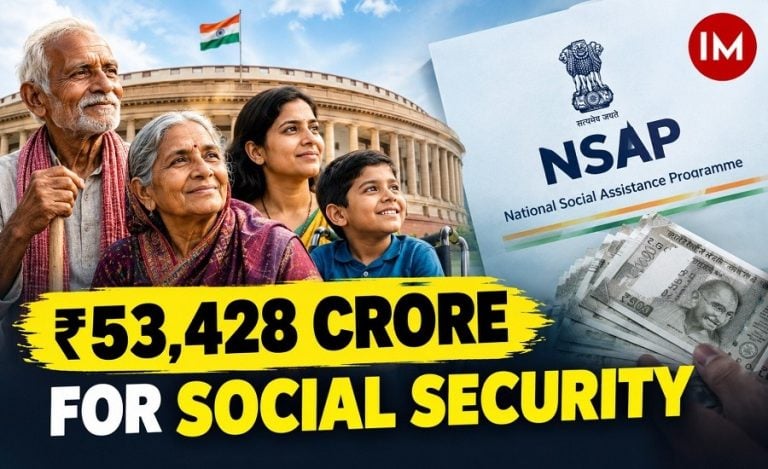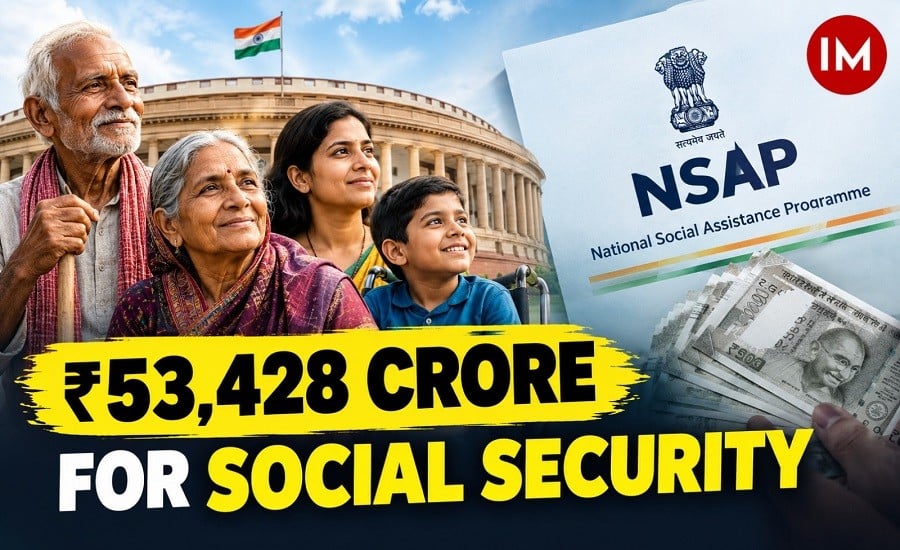
New Delhi: The Union Cabinet, chaired by Prime Minister Narendra Modi, has approved the continuation of the National Social Assistance Programme (NSAP) for five years, from 2026-27 to 2030-31, with a total financial outlay of ₹53,428 crore.
The proposal, moved by the Department of Rural Development, includes renaming the programme and its sub-schemes, revising eligibility criteria and increasing the rate of assistance under the disability pension scheme. The existing pension schemes for senior citizens and widows, along with the family benefit scheme, will continue in their present form.
The approval is expected to benefit approximately 3.20 crore beneficiaries across all 36 States and Union Territories.
NSAP and Its Sub-Schemes to Get New Names
Under the approved changes, the National Social Assistance Programme and its five sub-schemes will be renamed as follows:
- National Social Assistance Programme (NSAP): Pradhan Mantri Samajik Sahayata Yojana
- Indira Gandhi National Old Age Pension Scheme (IGNOAPS): Pradhan Mantri Vridhavastha Pension Yojana
- Indira Gandhi National Widow Pension Scheme (IGNWPS): Pradhan Mantri Vidhawa Pension Yojana
- Indira Gandhi National Disability Pension Scheme (IGNDPS): Pradhan Mantri Divyangjan Pension Yojana
- National Family Benefit Scheme: Pradhan Mantri Parivar Labh Yojana
The revised names are intended to replace the existing nomenclature of the programme and its component schemes.
Read also: Ayush Economy Hits $36.92 Billion, Supports 1.76 Million Livelihoods: RIS Study
Disability Pension Assistance Increased
A key feature of the Cabinet’s approval is the revision of assistance under the disability pension scheme. The monthly assistance will be ₹375 for beneficiaries aged below 80 years, including those from birth to 79 years, and ₹625 for beneficiaries aged 80 years and above.
The revised eligibility provisions will also widen access to disability pensions. The benchmark disability requirement will be reduced from the existing 80% to 40%, while the minimum age criterion will be changed to allow eligibility from birth.
These changes align the scheme’s eligibility criteria with the Rights of Persons with Disabilities Act, 2016, which recognises benchmark disability at 40%. The Act also mandates disability-related assistance to be at least 25% higher than comparable schemes for other categories.
Old-Age and Widow Pensions to Continue
The Cabinet has decided to continue the pension schemes for senior citizens and widows, as well as the National Family Benefit Scheme, in their existing form.
The changes to eligibility, beneficiary coverage and assistance rates will apply to the disability pension component. Detailed guidelines covering the revised eligibility criteria, number of beneficiaries and rates of assistance are expected to be issued and implemented within three months.
NSAP: Background and Objective
Launched on 15 August 1995, the National Social Assistance Programme provides social assistance to poor households and fulfils the Central Government’s responsibility under Article 41 of the Directive Principles of State Policy in the Constitution of India.
The programme provides 100% central assistance to ensure that eligible beneficiaries receive support across the country. Its pension and family benefit components are intended to provide a basic social safety net to vulnerable sections of society.
With the latest approval, the programme will continue through 2030-31, with revised disability pension provisions and updated scheme names forming part of its next five-year phase.
Read also: India Post and IndiGo Bring Handwritten Postcards Back at 30,000 Feet in Digital Detox Drive