By Nitish Narang and Parth Garg
“If we send the accused to jail, the girl will be the one who ends her life.”
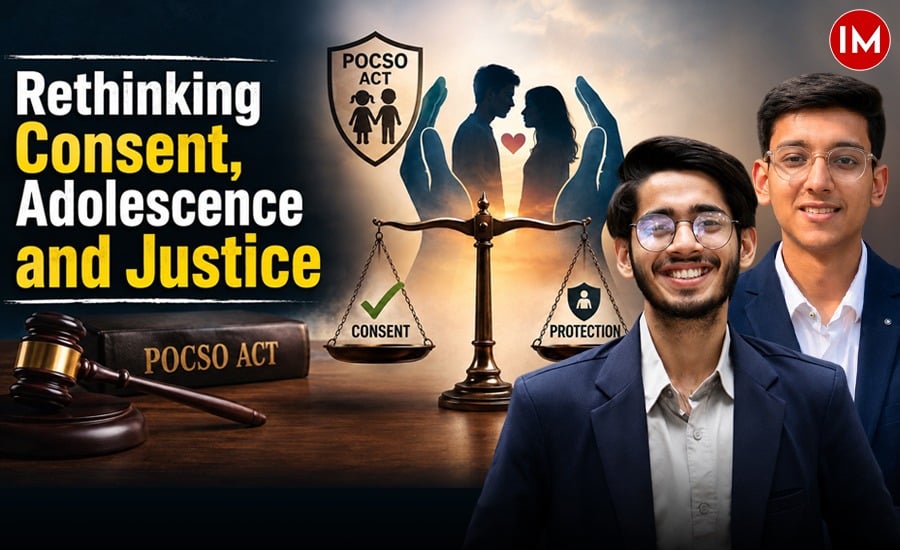
These baffling words from the Supreme Court’s May 2025 verdict point out a crisis deeper than legal overreach (“In Re Right to Privacy of Adolescents”). They underline the unintended ramifications of the Protection of Children from Sexual Offences (POCSO) Act, a law designed to safeguard minors but increasingly exploited to criminalise consensual adolescent relationships.
Though crafted with a pious intent, the Act’s sheer rigidity now often penalises those it was meant to shield, highlighting the urgent need to reform a neglected aspect of the law, one that calls for empathy, discernment and an honest engagement with how teenagers actually experience relationships.
The act aims to protect children below 18 years of age from all forms of sexual abuse. This law rigorously preaches the ‘zero-tolerance’ method, clearly defining that any sexual activity with a minor is classified as an offence, regardless of any mutual consent between the “victim” and the accused. Its Section 4 and Section 6 prescribe stringent penalties for penetrative and aggravated penetrative sexual assault, respectively, often mandating 10 to 20 years of imprisonment or even life in certain ‘brutal’ cases.
It is of grave concern that the law draws no line between exploitative acts and consensual sexual behaviour among adolescents, thus giving space to legal paradox. While the intention was to ensure zero tolerance towards child abuse, the Act’s blanket criminalisation of all sexual activity under 18 has led to the penalisation of consensual “romantic relationships,” especially among adolescents aged 16- 18, a reality increasingly recognised by courts but not yet acknowledged in the statute book.
Read Also: Why India Needs a National Architecture & Construction Cloud
This tension is evident in Aakash Nanasaheb Waghmare v. State of Maharashtra (2025), where a 27-year-old man was prosecuted under POCSO for a consensual relationship with a 17-year-old girl. Despite her plea to quash the case, citing the potential of the case to harm her and their child, the Bombay High Court, bound by the statute, refused (Waghmare v. State of Maharashtra).
This case mirrors a broader pattern of misinterpreting adolescent intimacy as criminality. Girls often testify in favour of their partners, but both still are compelled to suffer legal, emotional, and social consequences. In over 100 of the 194 romantic ‘boyfriend’ cases studied, it was found that girls turned hostile, often under family pressure, yet courts still prosecuted due to statutory obligation imposed on them. It ignites the need to revamp our legal frameworks to reflect the realities of adolescent relationships, where protection must not come at the cost of compassion or autonomy.
The kind of blanket criminalisation paves the way to monetary strain from prolonged legal battles, blots of social stigma and deep emotional setbacks. Adolescents lose agency over their relationships and families, driven only by caste, honour, or control, frequently misuse the law to punish consensual inter-community bonds.
Empirical research underscores this issue. A 2022 Enfold Proactive Health Trust study found that only 24.5% of so-called “romantic” POCSO cases involved non-consensual abuse, indicating that most prosecutions involved mutual relationships (Enfold Proactive Health Trust 5). Yet the law treats all adolescent sexuality as inherently predatory. The contradictions deepen when viewed alongside how Indian law treats adolescent agency in other domains.
Adolescents in India stand at a strange legal crossroads. In several domains, they are seen as capable of independent decision-making. For instance, the Juvenile Justice Act protects their identity in legal proceedings, even in heinous cases; the Mental Healthcare Act allows those above 16 to consent to treatment; and digital norms increasingly engage with the idea of youth navigating online platforms independently, as reflected in the proposed data protection frameworks. Yet, under the mandate prescribed by the POCSO Act, these adolescents are denied sexual agency. Any sexual act under 18, even when consensual and between peers, is criminalised. This contradiction doesn’t just brush aside the realities of adolescent development; it rampantly undermines their autonomy.
Globally, a more equitable approach is evolving. Nations like South Africa and Canada have employed “close-in-age” exemptions, making sure that consensual relationships between teenagers aren’t penalised. Several European nations set the age of consent below 18 while maintaining strong protections against abuse. The UN Convention on the Rights of the Child (UNCRC) also emphasises adolescents’ “evolving capacities,” urging states to consider their growing maturity while framing laws (United Nations). As global standards evolve, the path forward for India becomes clearer but politically and culturally sensitive. India’s challenge, then, is to strike this balance. Protection must not become paternalism. Reforming POCSO is essential to a just juvenile justice framework.
Reforms to the POCSO Act must strike a balance between protection and adolescent autonomy. A crucial first step is introducing “close-in-age” exemptions, similar to Canada’s Romeo-Juliet clauses, where consensual relationships between teens close in age, such as 16– 18, are not automatically criminalised, provided they are non-exploitative (Equality Law). This would prevent unjust prosecution of romantic teenage partners while still following its actual motive, shielding victims against abuse. Second, legal definitions within POCSO should be revised to draw a demarcating line between consensual intimacy and coercive sexual abuse. The law must define “consent” with examples and consider factors like power imbalance and coercion. Judicial discretion needs to be restored, granting judges autonomy to weigh context, maturity and genuine consent rather than enforce blanket penalties.
Further, reforms must employ a rights-based approach. Adolescents, parents, educators and clinical experts should be made part of the policy-making process. As the Supreme Court itself has suggested, framing a national sex education policy alongside legal reform can ensure adolescent well-being is holistically addressed. Finally, systemic changes are the need of the hour. Appoint trained Special Public Prosecutors in POCSO courts, revitalise support systems during trials and provide regular sensitisation training for police and prosecutors to reduce misuse based on caste, community or moral bias.
Can a law meant to protect truly serve its purpose if it turns young love into a criminal act? It is time we craft a justice system that distinguishes predation from mutual exploration, one that protects without punishing the innocent.
(About The Author – Nitish Narang and Parth Garg are final-year B.A. (Hons.) Political Science students at Atma Ram Sanatan Dharma College, University of Delhi.)
Disclaimer – (The views and opinions expressed in this article are solely those of the author and do not necessarily reflect the views of Indian Masterminds. For feedback or queries, please write to [email protected].)
Read Also: India’s AI Revolution Must Speak Every Indian Language