When development is linked with local skills and long-term market opportunities, it creates more than temporary employment—it builds self-sustaining communities. That is the idea guiding IAS Mohammad Aaquib, a 2021-batch AGMUT cadre officer currently serving as the Collector of Champhai district in Mizoram.
Under the District Transformation Project launched by the Mizoram government, Champhai has introduced several initiatives aimed at strengthening livelihoods across different sectors. From empowering women through garment manufacturing to helping farmers adopt greenhouse technology and supporting sericulture with modern infrastructure, the district is working to create sustainable economic opportunities.
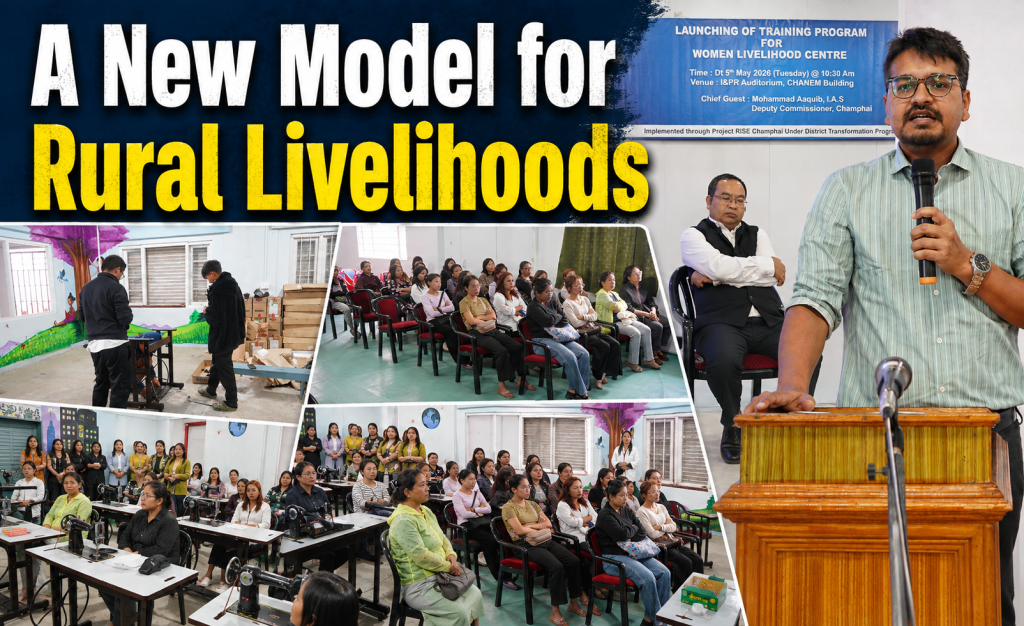
One of the flagship initiatives is Project RISE, a women-centric livelihood programme that seeks to transform traditional stitching skills into organised enterprises capable of serving schools, sports clubs, and markets across multiple districts.
Project RISE: From Skill Training to Entrepreneurship
Project RISE began after district officials identified a significant gap. Many women, including those who had completed Class 12 or graduated, possessed stitching skills but lacked structured training, modern equipment, and access to markets.
To bridge this gap, around 50 women from local Self-Help Groups were selected for intensive skill development.
“We realised many women were missing out on employment opportunities despite having immense potential in stitching and sewing. Project RISE is designed to convert that potential into sustainable livelihoods,” IAS Mohammad Aaquib told Indian Masterminds.
The training follows a carefully planned three-stage approach.
Stage One: Learning the Basics
The first phase focuses on building strong fundamentals. Three conventional sewing machines have been installed where the women are learning stitching techniques, fabric handling, measurements and garment construction.
Over the next four to five months, participants will learn to stitch shirts, trousers, T-shirts and other apparel while understanding different patterns and designs.
Since most participants had little or no prior experience with professional tailoring, the emphasis is on developing confidence before introducing advanced technology.
Stage Two: Industrial Sewing Machines
The district administration has already procured industrial sewing machines, which are electrically operated and designed for high-volume production.
Once the trainees complete their basic course, they will transition to these machines, learning faster production methods suited for commercial manufacturing.
According to the administration, this phase will also help identify women who demonstrate specialised abilities.
The district aims to identify:
- Around 5 women with entrepreneurial skills
- 5 women comfortable with computers
- 5–10 women capable of handling industrial sewing machines
- Around 10 women specialising in conventional stitching
These women will eventually become the core team of a livelihood centre capable of undertaking bulk production.
Stage Three: Designing and Printing
The final stage of Project RISE will introduce Direct-to-Film (DTF) printing technology, enabling participants to design and manufacture customised printed T-shirts.
Women with computer skills will receive specialised training in digital design while learning to operate DTF printers.
Interestingly, the district has deliberately postponed the procurement of printers.
“We will bring in the DTF printers only when the women are fully ready. These printers require regular usage, and purchasing them too early could lead to maintenance issues. We want every investment to be productive,” explains Mohammad Aaquib.
Building Champhai’s Own Apparel Brand
The administration’s vision extends beyond training.
Once participants gain sufficient experience, the sewing machines and related infrastructure will gradually be handed over to the women themselves.
The long-term objective is to establish a professionally managed, women-led garment enterprise.
The district also plans to support the women in registering their own brand while connecting them with institutional buyers.
Schools could source uniforms locally instead of placing orders outside the district. Similarly, Mizoram’s vibrant sports culture creates regular demand for customised jerseys and T-shirts, providing another steady market.
With nearly 30–35 trained women working together using both industrial and conventional machines, the unit could eventually cater not only to Champhai but also neighbouring districts.
“We don’t want this to remain only a training programme. Our aim is to build a livelihood centre where these women eventually own the enterprise, create their own brand and receive regular market orders,” says Aaquib.
Training has already been underway for nearly two weeks, with the first batch expected to complete its foundational course within five months.
Green Shield: Helping Farmers Produce More
Another major component of the District Transformation Project is Green Shield, which focuses on modernising agriculture through greenhouse cultivation.
Initially targeting tomato farmers, the project encourages cultivators to shift from traditional open-field farming to greenhouse-based production.
Working closely the administration expects greenhouse farming to significantly improve productivity.
According to district horticulture officials, farmers who currently harvest only one crop annually from open fields could potentially grow two to three crops inside greenhouses, increasing production by 200–300 percent from the same area.
If the pilot proves successful, the administration plans to expand greenhouse cultivation next year while also introducing small tomato-processing units.
These units will enable farmers to convert surplus tomatoes into products such as ketchup, reducing post-harvest losses while generating additional income.
Strengthening Sericulture Infrastructure
Champhai also enjoys a unique advantage in sericulture.
It is the only district in Mizoram where all four commercially important silkworm varieties—Mulberry, Oak Tasar, Muga and Eri—are cultivated.
The district administration is currently supporting around 107 sericulture families through infrastructure improvements.
One major intervention involves solarising sericulture farms in villages that lack reliable electricity. Solar-powered systems are expected to improve day-to-day operations while reducing dependence on conventional power sources.
Another important initiative focuses on post-harvest management. Since silkworm pupae and cocoons require proper storage to prevent spoilage, the district is developing freezer and storage facilities to improve quality and minimise losses.
At present, the supporting structures are being built, with solar panel installation scheduled in the next phase.
A Long-Term Development Model
Rather than introducing isolated schemes, Champhai’s District Transformation Project seeks to connect skill development, agriculture, entrepreneurship and market access into a single development framework.
Project RISE aims to create women-led enterprises. Green Shield focuses on improving farm productivity through technology. The sericulture interventions seek to strengthen an existing local industry with better infrastructure.
Together, these initiatives reflect a strategy that prioritises sustainable livelihoods, local value addition and community ownership—creating opportunities that can continue to grow long after the initial government support has ended.