By Khushi Patel
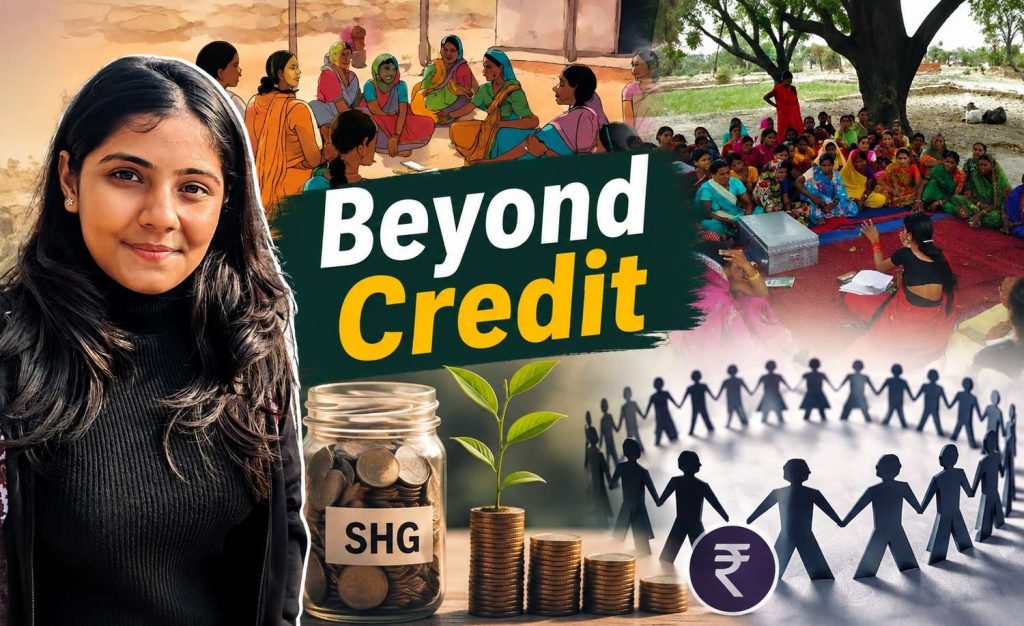
India’s Self-Help Group (SHG) movement is one of the country’s most impressive experiments in women’s collective action. It has brought millions of women into organised groups, expanded access to savings and credit, and created new spaces for confidence, mobility and public participation.
But if SHGs are judged only by the number of loans disbursed or how reliably those loans are repaid, we miss the larger question: Have SHGs changed women’s power in the economy, or merely improved their access to its lowest rungs?
That is where a feminist political economy lens becomes essential. It shifts the focus from inclusion to power, from participation to ownership, and from access to credit to control over income, time, assets and markets.
By that standard, the SHG movement has achieved much. But it still has a long way to go.
More Than a Credit Story
SHGs are often discussed primarily as financial institutions at the grassroots. That view is incomplete.
For many women, an SHG is the first institution outside the household where they can meet regularly, speak in public, share problems and act collectively. In a social context where women’s mobility and voice remain constrained by patriarchy, caste and domestic responsibilities, this is no small achievement.
Read Also: Can Consent and Protection Coexist? The Case for Reforming POCSO
These collective spaces build confidence alongside creditworthiness. Women gain experience in speaking, negotiating, maintaining accounts and engaging with public institutions. In some contexts, SHGs have also helped women participate in local politics, attend village meetings and assert themselves more confidently before officials and local elites.
Yet these gains do not automatically translate into economic transformation.
A woman may become a better borrower and a more active SHG member without becoming a stronger economic actor. That gap is the real issue.
The Power Question
A feminist political economy approach asks a different set of questions from conventional development policy.
Who controls the earnings? Who owns the assets? Who decides how an enterprise is run? Who captures the surplus created by women’s labour?
The focus is not merely on whether women are working, but whether they are working on their own terms and exercising meaningful control over the value they create.
This is where many SHG enterprises remain constrained. Women may undertake production, while others control branding, aggregation, transportation, distribution and access to larger buyers.
The result is that women participate in the economy without necessarily moving upward within it. They remain producers, but not always owners; workers, but not always decision-makers.
That is why financial inclusion, by itself, is an incomplete measure of empowerment.
Access to loans and savings can reduce vulnerability, but it does not automatically redistribute power. If women remain dependent on intermediaries, confined to low-margin activities and unable to negotiate the terms of exchange, inclusion has not yet become transformation.
Sustainability Needs a New Meaning
The word “sustainability” is widely used in the SHG sector, but it is often defined too narrowly.
For administrators and funders, sustainability may mean that a group continues to meet, save and repay after project support ends. That is an important institutional benchmark, but it is not enough.
For women inside these groups, sustainability means something much more concrete.
It means an income that is primary rather than merely supplementary. It means an enterprise capable of surviving a bad season, a health emergency or a sudden price shock. It means being able to reinvest in the business instead of constantly drawing from it to meet household needs.
Most importantly, it means having control over economic choices, not merely participating in them.
This distinction matters because many SHGs can be institutionally stable while remaining economically fragile. Meetings continue, loans are repaid and records are maintained, yet members may remain at income levels that cannot provide long-term economic security.
In that sense, the institution survives, but the livelihood does not truly scale.
The Missing Market Link
The central weakness in many SHG programmes is not necessarily production capacity. It is market access.
Women can produce goods and provide services, but without reliable buyers, effective aggregation, stronger logistics, quality systems and adequate working capital, their products often remain trapped in small local markets.
The result is a familiar pattern: local sales, seasonal demand, low margins and dependence on external support.
This is why many SHG enterprises struggle to move beyond supplementary income. They are productive, but not commercially strong. They are active, but not scalable. They operate within a market structure whose most profitable segments often remain beyond their control.
If SHGs are to become genuinely sustainable enterprises, policy must move from simply helping women make products to helping them capture more of the value chain.
That means building capabilities in branding, procurement, distribution, digital marketing and enterprise management. It also means creating market institutions around women’s collectives rather than designing systems primarily for the convenience of intermediaries.
What Must Change
If SHGs are to move from survival to genuine economic strength, policy needs to go beyond routine training and group formation.
Women need support that enables them to understand markets, develop enterprise strategies and position their products and services in ways that create greater value.
Federations also deserve a much larger role than they often receive. They are already trusted local structures with the potential to connect groups with buyers, pool production and negotiate better terms.
With adequate capacity and institutional backing, federations can become the bridge between scattered producers and larger, more organized markets.
Finance, too, needs to be redesigned around enterprise realities. The credit required to support a savings group is not the same as the financing required by a growing business.
SHG enterprises need flexible capital, working-capital support and financing aligned with production and payment cycles rather than a one-size-fits-all model.
Finally, policy must take women’s lived constraints seriously.
Time spent on unpaid care, household work and mobility restrictions directly shapes how much time, energy and attention women can devote to their enterprises. Unless these pressures are recognized in programme design, the benefits of SHGs will remain partial and uneven.
Beyond Inclusion
India’s SHG movement has demonstrated that women can organize, save, build institutions and lead collectively at scale. That is a significant achievement.
But the next stage must be judged against a tougher standard:
Are SHGs helping women gain durable control over work, income and economic decision-making?
That is the promise of a feminist political economy approach.
It does not dismiss financial inclusion. Instead, it insists that inclusion is only the beginning.
If SHGs are to become truly transformative, they must help women move from participation in the economy to power within it.
(About The Author – Khushi Patel is a Young Professional at Rajasthan Grameen Aajeevika Vikas Parishad (RGAVP) with an MA in Social Work (Rural Development) from TISS, Tuljapur. She works on rural livelihoods, women’s empowerment, and community institutions.)
Disclaimer – (The views and opinions expressed in this article are solely those of the author and do not necessarily reflect the views of Indian Masterminds. For feedback or queries, please write to [email protected].)
Read Also: Why India Needs a National Architecture & Construction Cloud