There is perhaps no better way of understanding Narendra Modi than through a Gujarati businessman’s instinct for spotting value where others see only routine. A line often associated with his Gujarati worldview captures it neatly: “Every Gujarati is basically a businessman — and he is first among the equals.” In Modi’s case, politics too seems to have acquired the character of a business proposition: identify the problem, set a target, remove the bottleneck, measure the outcome and move on to the next challenge.
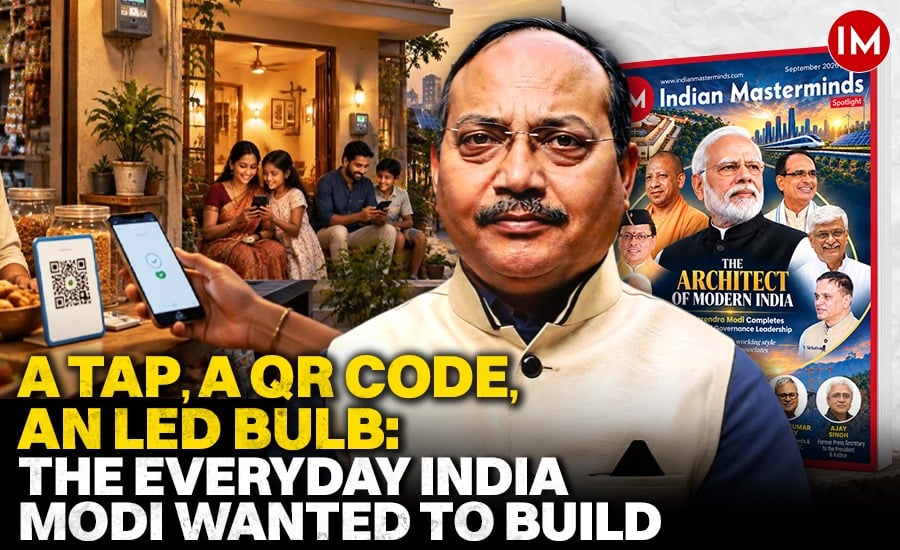
This is why the story of Narendra Modi is not merely about big political slogans or electoral victories. It is also hidden in small, almost mundane things: an LED bulb becoming affordable, a farmer receiving money directly in his bank account, a villager getting a tap connection, a shopkeeper holding up a QR code, a railway line entering a remote corner of the country, an irrigation project or an innovative project in education or even a government secretary being asked why a project is stuck.
Also Read – From Project Tiger to Species Recovery: How India’s Wildlife Conservation Approach Has Evolved
The LED bulb is a particularly revealing metaphor. When Modi launched UJALA in January 2015, an LED bulb that could cost ₹300-350 was brought down to roughly ₹70-80 through large-scale procurement. By January 2025, more than 36 crore LED bulbs had been distributed and the programme was estimated to save consumers ₹19,153 crore annually.
The interesting part was not the bulb. It was the thinking behind it. Instead of telling people to consume less electricity, the government tried to change the economics of consumption. Buy in bulk, reduce the price, create a market, make the efficient choice the affordable choice. That is classic business thinking applied to public policy.
Modi applies common sense in solving most complex problems. His visit to Diesel Locomotive Works (DLW) factory in his parliamentary constituency, Varanasi was another such revelation. Inside a Diesel Rail engine, he sought two design changes – a toilet for both men and women drivers and a bigger windscreen for better vision of the track. Veteran engineers marvelled why they never though of such simple alterations.
The same instinct can be seen in India’s digital payments revolution. UPI was piloted in April 2016; today it has become an everyday instrument of economic life, from large businesses to the smallest roadside vendor. In May 2026 alone, UPI recorded more than 23.2 billion transactions worth nearly ₹29.9 lakh crore.
But UPI did not emerge in isolation. It rested on the less glamorous architecture of Jan Dhan accounts, Aadhaar and mobile phones — the JAM trinity. The significance of this became particularly visible during Covid. When physical banking was severely disrupted, money could still be transferred directly into millions of accounts. Modi himself later described this as one of the advantages of having built the digital infrastructure before the crisis arrived.
His philosophy is simple. By scaling up production you can bring down the price. That’s how he got India one of the cheapest vaccines against Covid-19 virus. Vaccine manufacturers were not prepared to produce at such high scale. They needed to upgrade their machinery and that required lots of funds. That’s why he created PM Cares Fund so that he could lend them a hefty advance. No government audited by the CAG would have allowed an advance payment for the vaccines which were provided free of cost to a large number of Indians. That is perhaps another defining feature of Modi’s style: build the railway track before the train arrives.
PRAGATI was an early example. Instead of allowing files to move endlessly between ministries and state governments, Modi created a technology-enabled mechanism through which stalled projects could be placed directly before him and the concerned officials. He described the problem as one of governmental silos and decision-making paralysis. The last Wednesday of every month became, in effect, a date with the bureaucracy.
It was a striking departure from the traditional image of the Prime Minister as the final destination of files. Modi wanted the Prime Minister to become a problem-solving centre.
That same impatience with inherited systems is visible in infrastructure. Roads, railways, freight corridors, border connectivity and projects in Jammu & Kashmir and the Northeast have increasingly been treated not as isolated schemes but as pieces of one national network. PM Gati Shakti institutionalised this approach by forcing different infrastructure ministries to look at the same map rather than building their projects in silos.
The philosophy is simple: a road is not merely a road if it opens a market; a railway is not merely a railway if it changes the economic geography of a region.
The same logic applies to the Jal Jeevan Mission. On Independence Day in 2019, Modi announced the ambition of providing piped drinking water to every rural household. At the time, only about one in five rural households had tap-water access. The mission subsequently turned water from a scattered state-level welfare concern into a national infrastructure project.
Again, the story is not simply about pipes. It is about changing the definition of development. A woman who no longer has to walk kilometres carrying water has gained something more valuable than a tap: labour and time.
Defence provides an even more dramatic illustration of the transformation Modi has sought to drive. The journey from the ageing MiG-21 era to the induction of the Rafale became a symbol of the changing technological aspirations of the Indian military. The first five Rafales arrived in India in July 2020 and were formally inducted into the Indian Air Force that September.
Yet the larger story is not Rafale. It is what came after the import.
India increasingly began asking whether it could manufacture its own military equipment, develop its own technologies and eventually sell them abroad. Defence production reached a record ₹1.78 lakh crore in 2025-26, while exports reached ₹38,424 crore.
In other words, the strategic journey is from “What can we buy?” to “What can we make?” and finally to “What can we sell?”
That change in mindset runs through Modi’s foreign policy as well. He has become India’s most travelled Prime Minister, with 100 international visits by 2026 and engagements spanning at least 80 countries, according to recent analyses. He doesn’t merely visits nations. He observes their progress and innovations and applies them in India.
But the significance is less about the number of airports and more about the diversification of India’s diplomatic geography. The outreach has extended across the Indo-Pacific, Africa, West Asia, Europe, Latin America and the Pacific islands. Foreign policy under Modi has increasingly been treated not simply as diplomacy but as an economic, technological, strategic and civilisational enterprise.
There is also another, less visible, change: the attempt to remove the colonial imprint from India’s institutions and vocabulary. New criminal laws replaced the Indian Penal Code, the Code of Criminal Procedure and the Indian Evidence Act from July 2024. The government explicitly described the exercise as a transition away from colonial-era legal legacies towards a modern system of justice.
Names, buildings, symbols and institutional language matter because they influence how a country imagines itself.
Perhaps nowhere is this transformation more consequential than in areas once associated with Left-Wing Extremism. Violence associated with LWE has declined dramatically over the past decade, alongside a shrinking geographical footprint. Government data show LWE-affected districts falling from 126 in 2014 to 11 by December 2025, while violent incidents also declined sharply.
The larger Modi story, therefore, may not be about one grand ideological project at all. It may be about changing the operating system of the Indian state.
The secret lies in his way of looking at things. Even when he was not holding a public office, way back in late 90s, once I spotted him in the BJP’s national headquarter after a long gap. He said he was visiting Puttaparthi, abode of Sai Baba, a sage accused of sexually exploiting boys in his Ashram. A reference to the dark allegations brought out a riposte I will never forget in life, “I had gone there to see the good work he has done in providing education and irrigation in neighbouring villages. You will see in some one, what you want to see.” It’s the same development mantra he has followed in his 25 years of administrative leadership of Gujarat first and then India.
A QR code at a tea stall. A tap outside a village house. An LED bulb in a modest home. A road through a previously isolated landscape. A fighter aircraft on a runway. A bureaucrat answering a Prime Minister’s question about a delayed project. A farmer receiving money without visiting an office.
These are very different images. Yet they tell essentially the same story. Modi’s distinctive contribution to Indian governance has been the attempt to convert aspiration into systems, and systems into scale. That is why the most revealing image of Modi may not be the Prime Minister standing at the Red Fort, addressing the nation.
It may be an ordinary Indian, somewhere in the country, doing something that had once required a middleman, a journey, a file, a queue or a favour — and now doing it with a tap, a phone, a road, a bank account or a QR code. That is where the story of Modi ultimately becomes a story about India itself.
Also Read – How Narendra Modi Turns Challenges Into Opportunities: Nripendra Mishra’s First-Hand Account