New Delhi: India has taken another step towards strengthening its high-altitude military capabilities with the successful maiden live jump of the indigenous Advanced High-Altitude Parachute (AHAP) developed by the Defence Research and Development Organisation (DRDO).
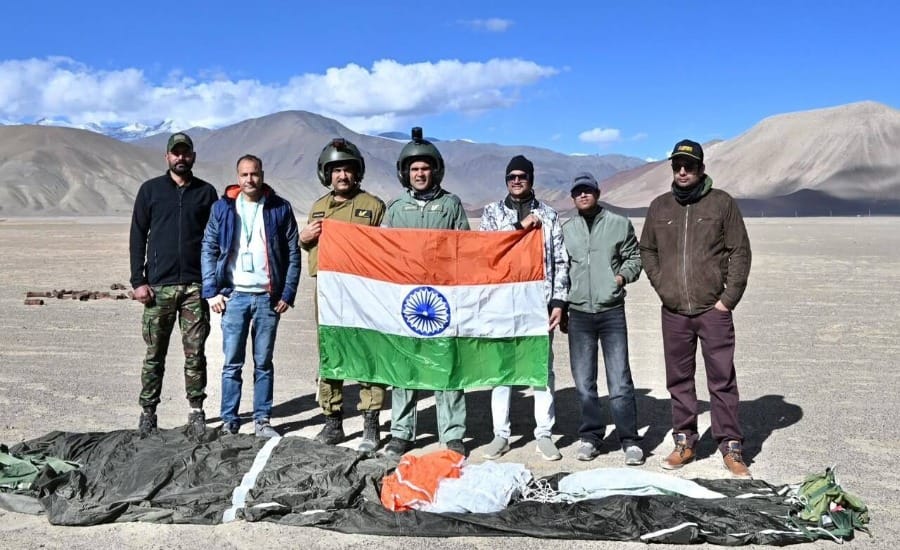
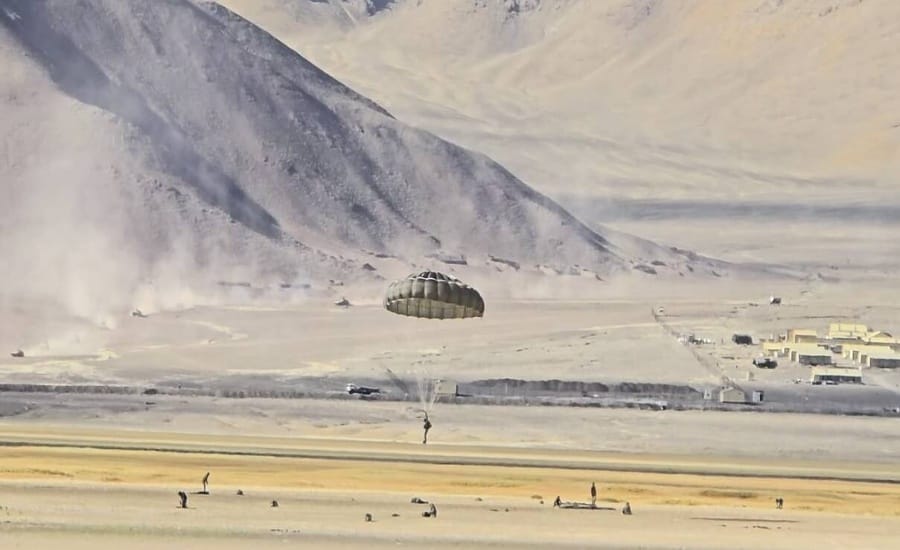
The live jump was conducted at Nyoma’s Mudh Drop Zone, one of the country’s highest-altitude drop zones. The jump was carried out from 16,000 feet above mean sea level, while the parachute deployed at 15,500 feet before the landing at Nyoma, located at around 13,700 feet.
The successful trial demonstrated the AHAP system’s effectiveness and tactical suitability for extremely high-altitude terrain, where parachute operations are significantly more challenging.
AHAP Designed for High-Altitude Paratrooper Operations
The Advanced High-Altitude Parachute has been designed and developed by DRDO’s Aerial Delivery Research and Development Establishment (ADRDE), Agra.
It is a static-line parachute system designed for the mass drop of paratroopers. The system has been developed to meet the operational requirements of the Indian Defence Forces, particularly in difficult high-altitude environments.
Static-line parachute jumps at extreme altitudes involve considerable risks because of factors such as high opening shock and the rate of descent. The AHAP has therefore been designed with features aimed at improving operational safety and performance.
The system offers multiple deployment modes and has a wide operational altitude range of up to 18,000 feet.
Read also: What Is DRDO Flatfish AUV? Features, Range, Capabilities And Strategic Importance Explained
Maiden Live Jump Tests Tactical Capability
The Nyoma trial was important because it moved the AHAP beyond development and certification into a live operational environment.
The parachute was deployed at 15,500 feet and successfully completed its descent to the Mudh Drop Zone at 13,700 feet.
According to DRDO, the jump demonstrated the system’s efficacy and tactical employability in extremely high-altitude terrain.
Such capabilities can be particularly important for military operations in mountainous and high-altitude regions, where conventional aerial delivery and troop deployment can present additional operational challenges.
The successful trial also provides an important validation of the system’s performance under actual jump conditions rather than only controlled testing environments.
Indigenous Defence Ecosystem Behind AHAP
The AHAP programme brings together several Indian defence organisations and agencies.
The system was developed by ADRDE, Agra, while manufacturing was undertaken by the Ordnance Parachute Factory (OPF), Kanpur.
The parachute was inspected by the Directorate General of Aeronautical Quality Assurance (DGAQA) and certified by the Centre for Military Airworthiness and Certification (CEMILAC), Regional Centre for Military Airworthiness, Kanpur.
This collaboration highlights the role of India’s defence research, manufacturing, inspection and certification ecosystem in developing specialised equipment for the armed forces.
The successful live jump therefore represents not only a test of the parachute itself but also the maturity of the domestic system that designed, manufactured and cleared it for operational evaluation.
Why High-Altitude Parachutes Matter
Operating at high altitudes presents unique challenges for airborne military operations. Lower temperatures, thinner air, difficult terrain and the effects of high-altitude deployment can make parachute operations more demanding.
For paratroopers, a reliable parachute system is essential for safe deployment and controlled landing.
The AHAP has been designed with a wide operational altitude range and a rate of descent suited to the tactical requirements of the Indian Defence Forces.
Its ability to operate at altitudes of up to 18,000 feet could provide greater flexibility for airborne operations in mountainous and high-altitude areas.
The Nyoma test also provides a realistic demonstration of how the system performs in terrain where operational conditions can be significantly different from those at lower-altitude drop zones.
Rajnath Singh Hails Major Step for Aatmanirbhar Bharat
Defence Minister Rajnath Singh congratulated DRDO, the Defence Forces, defence public sector undertakings and industry partners following the successful maiden live jump.
He described the achievement as another major step towards Aatmanirbhar Bharat in defence.
The success strengthens India’s efforts to develop critical military technologies within the country and reduce dependence on external sources for specialised defence equipment.
Defence Secretary and Secretary, Department of Defence R&D and Chairman, DRDO Rajesh Kumar Singh also congratulated the teams involved in the design and development of the AHAP system.
Strengthening India’s High-Altitude Defence Readiness
The successful AHAP trial comes as India continues to focus on strengthening capabilities suited to its challenging geographical environment.
High-altitude regions require specialised equipment that can perform reliably under demanding conditions. Indigenous systems such as AHAP can provide the armed forces with equipment specifically designed around their operational requirements.
The successful jump at Nyoma demonstrates that India’s defence research ecosystem is moving from laboratory development and certification towards practical field validation of advanced systems.
For India’s armed forces, the capability could offer another tool for troop deployment and airborne operations in high-altitude terrain. For the country’s defence manufacturing ecosystem, the achievement reinforces the potential to develop and produce specialised military technologies domestically.
The maiden live jump of AHAP at 16,000 feet is therefore more than a parachute test. It marks another step in building an indigenous defence capability designed for some of India’s most demanding operational environments.