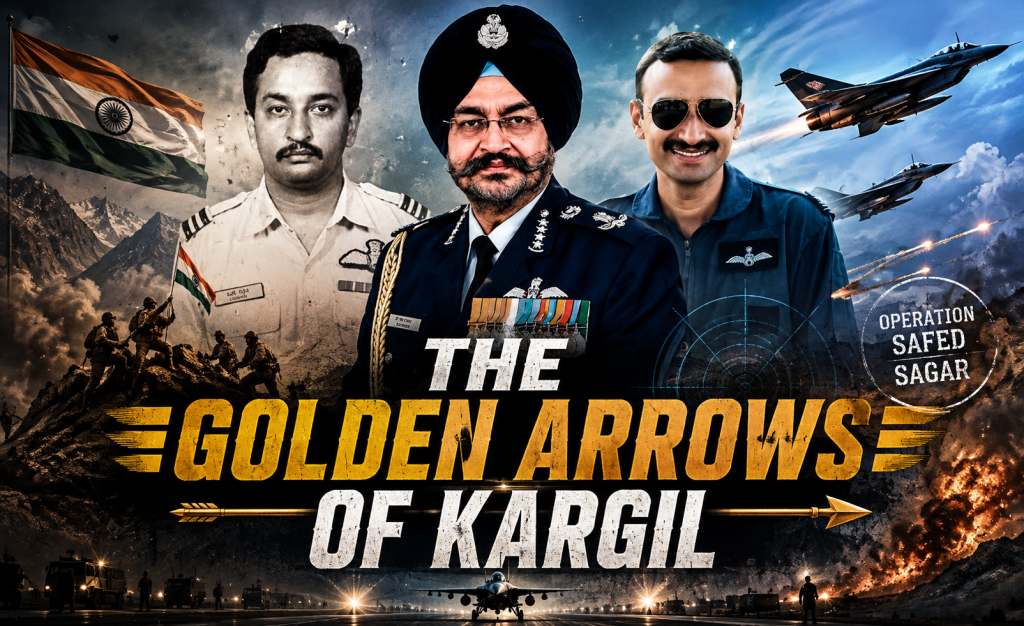
On the morning of May 27, 1999, Squadron Leader Ajay Ahuja knew that he was flying into danger. A fellow Indian pilot, Flight Lieutenant K. Nachiketa, had been forced to eject from his MiG-27 near the Batalik sector and had landed in an area controlled by Pakistani forces. The situation was extremely dangerous. Enemy troops had shoulder-fired missiles and the surrounding mountains offered little room for a safe approach. Yet Ahuja did not simply return to base. He stayed in the area, trying to locate Nachiketa and guide the rescue effort. He knew that his own aircraft could become a target, but he continued flying. Soon, his MiG-21 was hit by a surface-to-air missile. Ahuja ejected but landed across the Line of Control and was later killed. He was posthumously awarded the Vir Chakra. His final mission became one of the most remembered stories of courage from the Kargil War.
But it was also part of a larger story – the story of No. 17 Squadron of the Indian Air Force, better known as the Golden Arrows.
A SQUADRON WITH A LONG HISTORY
The Golden Arrows were not created for the Kargil War. No. 17 Squadron was formed on October 1, 1951, and over the years became one of the Indian Air Force’s important fighter squadrons. It operated several aircraft during its long history, including Harvard-II B, Vampire, Hunter and MiG-21 aircraft. The squadron had already seen combat during the 1965 and 1971 wars. By 1999, its pilots were flying MiG-21s. Their aircraft were not the newest in the IAF inventory, but the pilots flying them had experience, discipline and a strong sense of duty. When the Kargil conflict began, they were called upon to perform a role that would test all three.
The squadron was commanded during the war by Wing Commander Birender Singh Dhanoa, popularly known as B.S. “Tony” Dhanoa. He was an experienced fighter pilot and qualified flying instructor. His job was not merely to send aircraft into the air. He had to understand a battlefield that was unlike the conventional environments for which many air operations had been planned. He had to protect his pilots while ensuring that the squadron contributed effectively to the larger military campaign. Years later, Dhanoa would become the Chief of the Air Staff, but in the summer of 1999, his world revolved around a small group of pilots, their aircraft and the dangerous mountains of Kargil.
WHEN THE MOUNTAINS BECAME THE BATTLEFIELD
The Kargil War created an extraordinary challenge for the Indian Air Force. The enemy had occupied high mountain positions, many of them above 16,000 feet. These positions were difficult to see from the air and even harder to attack. The terrain was covered with ridges, rocks and shadows that could hide bunkers and troops. Weather conditions could change quickly, while the thin air at high altitude affected aircraft performance and weapon delivery. The IAF also had to operate under a strict political and military limitation: its fighter aircraft were not permitted to cross the Line of Control. This meant pilots had to attack enemy positions from the Indian side, even when a different approach might have been tactically easier.
Also Read – A Rank Gets You In, Character Makes You Stay: Sanjay Gehlot on Becoming a Better Civil Servant
The Golden Arrows were soon drawn into this difficult air campaign, known as ‘Operation Safed Sagar.’ Their MiG-21s were used for photo reconnaissance. Their job was to fly over dangerous areas and gather information about enemy positions. Before commanders could decide where and how to strike, they needed to know what was on the ground. Where were the bunkers? Where were the supply lines? Which ridges were occupied? Where were the enemy’s artillery positions? In a mountainous battlefield where the enemy was often invisible from the ground, information from the sky became extremely important. The Golden Arrows helped provide that information.
On May 26, Wing Commander Dhanoa and Flying Officer R.S. “Dhali” Dhaliwal conducted reconnaissance over important targets, including Tiger Hill and Tololing. Their missions gave the Air Force a clearer picture of the battlefield. These were not routine flights. Every time an aircraft entered the area, the pilot knew that enemy missiles and anti-aircraft fire could turn a reconnaissance mission into a fight for survival. Yet these pilots continued to fly because the information they gathered could help Indian forces on the ground.
LEARNING TO FIGHT A NEW KIND OF WAR
The IAF had fought wars before, but Kargil presented a very different challenge. The pilots had to operate at extreme altitudes, often against targets hidden among mountains. Traditional methods could not simply be applied. The Air Force had to adapt while the war was underway. The Golden Arrows played a role in this process of adaptation.
Under Dhanoa’s leadership, the squadron developed techniques for high-altitude night bombing. Operating at night had its own risks, but it could also reduce the exposure of aircraft to shoulder-fired missiles. Flying in darkness over unfamiliar mountain terrain demanded enormous concentration and skill. The pilots had to understand the geography, calculate their approach and release weapons accurately while dealing with the limitations of their aircraft. It was an example of how the Golden Arrows responded to the battlefield rather than simply following a pre-existing script.
THE MISSION THAT CHANGED EVERYTHING
The story of the Golden Arrows took a tragic turn on May 27. The previous day, Flight Lieutenant K. Nachiketa of No. 9 Squadron had been forced to eject from his MiG-27 after the aircraft was hit during a strike mission in the Batalik sector. He landed in an area controlled by Pakistani forces. A rescue operation became urgent.
Squadron Leader Ajay Ahuja was involved in the effort to locate him. Ahuja was an experienced officer who had joined the IAF after graduating from the National Defence Academy. Commissioned in 1985, he had flown MiG-21 and MiG-23 aircraft and had more than 1,000 hours of instructional flying experience. By the time of Kargil, he was the Flight Commander of the Golden Arrows. His colleagues remembered him as a patient instructor and a professional pilot.
Ahuja’s decision to remain over the area was an extraordinary act of courage. He knew that the enemy possessed shoulder-fired missiles, but he continued trying to locate Nachiketa and guide the rescue effort. His MiG-21 was eventually struck by a missile. He ejected but landed across the Line of Control. He was later killed. The exact circumstances surrounding his death became a subject of dispute between India and Pakistan, but there was no dispute in India about the courage displayed during his final mission. He was awarded the Vir Chakra posthumously.
For his commanding officer, Ahuja had done something extraordinary. Dhanoa later said that Ahuja had gone beyond the call of duty. He had knowingly placed himself in danger while trying to help another pilot. In a war where every pilot knew that the next flight could be his last, Ahuja’s final decision became a powerful example of the bond between airmen.
THE FRIEND WHO BROUGHT AHUJA HOME
The human story of Ahuja did not end with his death. It continued through his fellow Golden Arrow, C.H. Bal Reddy. Reddy had been called by Dhanoa to move from Bathinda to Srinagar during the conflict. He met Ahuja shortly before his final mission. The two men were colleagues who understood the risks they were facing, but there was no reason to believe that their conversation would be their last.
Ahuja was expecting to return from the mission. He was even thinking about arranging air tickets for his wife and young son. But the mission ended differently. When Ahuja’s body was brought back, Reddy was asked to help identify him. He recognised his colleague and friend. Reddy later accompanied Ahuja’s mortal remains and helped bring him home. It was a deeply painful duty, but it also reflected the bond within the squadron. Pilots who flew together were not simply colleagues. They were members of a small community in which each person’s life could depend on another.
THE PILOTS WHO BECAME THE EYES OF THE WAR
Flying Officer R.S. “Dhali” Dhaliwal was another important member of the Golden Arrows during Kargil. His role in the early reconnaissance missions gave him a direct view of the battlefield. Flying alongside Dhanoa, he helped survey targets such as Tiger Hill and Tololing. His work was part of the information-gathering effort that allowed the IAF to understand the enemy’s positions and plan subsequent operations.
Dhaliwal’s later career took him into another celebrated part of the IAF. He served with the Surya Kiran aerobatic team, where precision and discipline were equally important. His journey was a reminder that the pilots who flew through the dangers of Kargil went on to serve the Air Force in many different roles.
THE GOLDEN ARROWS IN THE LARGER AIR WAR
The Golden Arrows were one part of a much larger air campaign. Operation Safed Sagar involved fighters, reconnaissance aircraft, helicopters and support units. The IAF eventually flew around 5,000 strike missions, 350 reconnaissance and electronic intelligence missions and about 800 escort flights. Helicopters also flew more than 2,000 sorties for casualty evacuation and transportation.
Different aircraft performed different tasks. MiG-23s and MiG-27s carried out ground attacks. Mirage 2000s later became famous for their precision strikes. MiG-29s provided fighter protection. Jaguars were also involved. In this larger campaign, the Golden Arrows’ MiG-21s performed reconnaissance and other missions in an environment that pushed both machine and pilot to their limits.
Their aircraft were from an older generation. But the pilots made up for technological limitations through experience, preparation and adaptability. Their contribution was not always visible in dramatic images of bombs striking targets. Much of their work involved gathering information, flying into danger and helping commanders understand what was happening on the ground.
A LEGACY THAT SURVIVED THE MiG-21
The Golden Arrows’ story did not end with the Kargil War. The squadron was resurrected in 2019 and given a completely different aircraft – the Rafale.
The transformation was remarkable. In 1999, the squadron had flown MiG-21s over some of the most difficult terrain in the world. Two decades later, its pilots were operating one of the world’s most advanced multi-role fighter aircraft.
The aircraft had changed. Technology had changed. The nature of air warfare had changed. But the squadron’s identity remained rooted in its history.
FROM A KARGIL COMMANDER TO AIR CHIEF
Dhanoa’s own career reflected the same journey. He had joined the fighter stream of the IAF in June 1978 and went on to fly the MiG-21, Jaguar, MiG-29 and Su-30MKI. He was also a qualified flying instructor.
After Kargil, he held several important command and operational positions. In December 2016, he became the Chief of the Air Staff, a position he held until September 2019.
His rise from commanding the Golden Arrows during Kargil to leading the entire Air Force is one of the most remarkable threads in the squadron’s history.
MORE THAN AIRCRAFT AND MISSIONS
The Golden Arrows’ Kargil story is ultimately not about the MiG-21, the Rafale or even the number of sorties flown. Those are important parts of the history, but they do not explain why the squadron continues to be remembered.
The real story lies in the people.
It lies in Dhanoa leading his pilots through an unfamiliar battlefield. It lies in Dhaliwal flying reconnaissance over dangerous mountain positions. It lies in Bal Reddy carrying the mortal remains of his colleague back home. And it lies most powerfully in Ajay Ahuja’s decision to remain in the danger zone while trying to help another pilot.
That is what makes a military squadron more than a unit on an organisational chart.
It is a family built on trust.
During Kargil, the Golden Arrows flew into skies where one mistake could mean death. They faced high mountains, unpredictable weather, enemy missiles and strict operational restrictions. They adapted their tactics, carried out reconnaissance and supported the larger campaign.
Some came back. Some did not.
But all became part of the squadron’s history.
Today, the Golden Arrows fly the Rafale. Their aircraft are faster, smarter and far more technologically advanced than the MiG-21s of 1999. Yet the spirit that defined the squadron during Kargil remains the same.
The mountains of Kargil may have been the battlefield.
But the Golden Arrows showed that courage can travel far beyond the cockpit.
Their greatest contribution was not simply that they flew into danger.
It was that when one of their own was in trouble, another pilot was willing to go back.
Also Read – NEET to MBBS to PG: Why India’s Medical Education Funnel Keeps Getting Narrower