
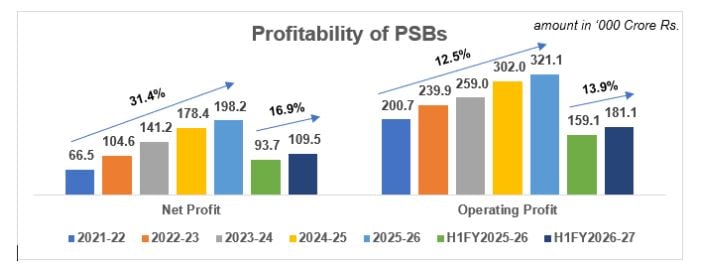
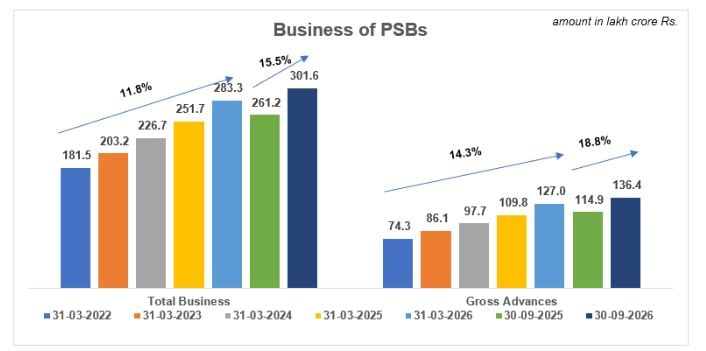
Mumbai: Public Sector Banks (PSBs) continued their strong financial performance in the first half of FY2026-27, recording their highest-ever aggregate net profit of ₹1,09,540 crore, registering a year-on-year (YoY) growth of 16.9%. Their total business also crossed the ₹300 lakh crore milestone for the first time, reaching ₹301.6 lakh crore as of September 30, 2026, with an annual growth of 15.5%.
According to data released by the Government of India on November 18, 2026, the improved financial performance reflects sustained progress across profitability, business growth, asset quality, capital adequacy and operational efficiency. The continued improvement has been attributed to systemic reforms, stronger governance standards, improved risk management and greater adoption of technology.
PSBs’ Net Profit Rises to Record ₹1.10 Lakh Crore
Public Sector Banks recorded an aggregate net profit of ₹1,09,540 crore in the first half of FY2026-27, marking a growth of 16.9% compared to the corresponding period last year. Their aggregate operating profit also increased by 13.9% year-on-year to ₹1.81 lakh crore.
The Return on Assets (RoA) of PSBs improved to 1.11%, registering a year-on-year increase of 3 basis points (bps). The continued growth in both net and operating profits for the fifth consecutive year highlights the positive impact of reforms and improved governance practices in the public banking sector.
Read also: Public Sector Banks Post Record Rs 52,603 Crore Profit in Q3 FY26, SBI Leads Growth
Total PSB Business Crosses ₹300 Lakh Crore
The aggregate business of Public Sector Banks grew by 15.5% year-on-year to reach ₹301.6 lakh crore as of September 30, 2026, crossing the ₹300 lakh crore mark for the first time.
Aggregate deposits increased by 13.1% year-on-year to ₹275 lakh crore, while aggregate advances registered a robust growth of 18.8% to reach ₹136.4 lakh crore.
Credit growth remained broad-based across key sectors, including retail, agriculture and Micro, Small and Medium Enterprises (MSMEs). The growth in lending to these segments reflects the continued role of PSBs in supporting grassroots economic development, encouraging entrepreneurship and expanding financial inclusion.
The year-on-year credit growth across major segments was recorded as follows:
- Retail loans: 17%
- Agriculture loans: 19.5%
- MSME loans: 20.4%
Gross and Net NPA Ratios Decline to Historic Lows
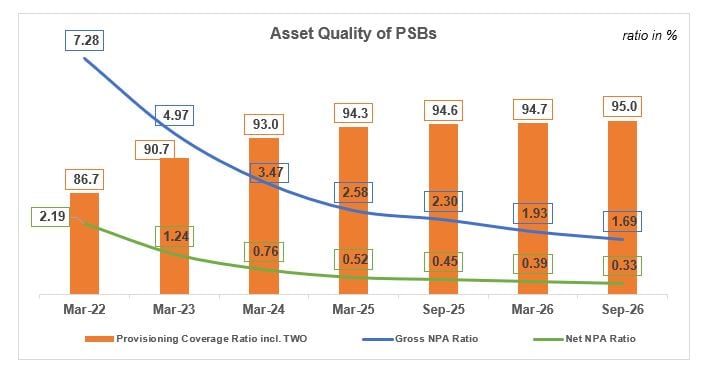
Public Sector Banks continued to strengthen their asset quality, with both Gross Non-Performing Assets (GNPA) and Net Non-Performing Assets (NNPA) declining to historically low levels.
As of September 30, 2026, the Gross NPA ratio declined to 1.69%, while the Net NPA ratio fell to 0.33%.
The improvement was supported by better underwriting standards, reflected in low slippages of 0.62%, along with focused recovery and collection efforts. Recoveries and upgradations improved by 21.1%.
Furthermore, all Public Sector Banks recorded a Provisioning Coverage Ratio (PCR) of more than 90%, indicating stronger provisioning practices and improved resilience against potential loan losses.
PSBs Maintain Strong Capital Adequacy Position
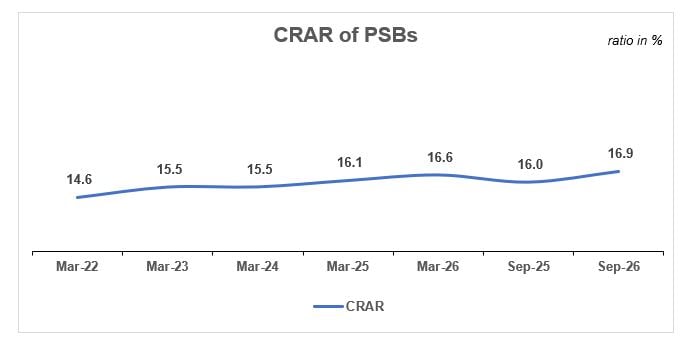
Public Sector Banks continued to maintain capital buffers well above the regulatory minimum requirements, supported by higher retained earnings and strong capital-raising efforts.
The Capital to Risk-Weighted Assets Ratio (CRAR) of PSBs stood at 16.89% as of September 30, 2026, registering a year-on-year improvement of 93 basis points.
The improvement was also supported by a 94-basis-point decline in Risk-Weighted Asset (RWA) density to 47.9% during the same period.
The strong capital position provides banks with sufficient capacity to support future credit growth while maintaining the ability to absorb potential financial and systemic shocks.
Operational Efficiency Improves with Digital Transformation
Public Sector Banks also reported improvements in operational efficiency during the first half of FY2026-27.
Their cost-to-income ratio improved by 191 basis points year-on-year to 47.38%. The cost per asset also declined by 14 basis points to 1.60%.
These improvements reflect the benefits of investments in technology, digital transformation and efficient cost management. Greater operational efficiency is also helping banks strengthen their service delivery and overall financial performance.
Government Reforms Drive Transformation of Public Sector Banks
The improved financial performance of Public Sector Banks reflects the outcomes of institutional reforms undertaken by the Government to strengthen the public banking system.
The reforms have primarily focused on improving governance standards, enhancing operational efficiency, promoting prudent banking practices, strengthening risk management systems and encouraging the adoption of advanced technologies.
The sustained improvement across profitability, credit growth, asset quality and capital adequacy indicates a significant transformation in the functioning of PSBs.
With stronger balance sheets, improved lending capabilities and better financial resilience, Public Sector Banks are continuing to play an important role in meeting the country’s credit requirements, supporting economic development and advancing the Government’s vision of Viksit Bharat 2047.
Read also: BSE BANKEX Becomes First Indian Sectoral Index Futures Contract Approved by US CFTC