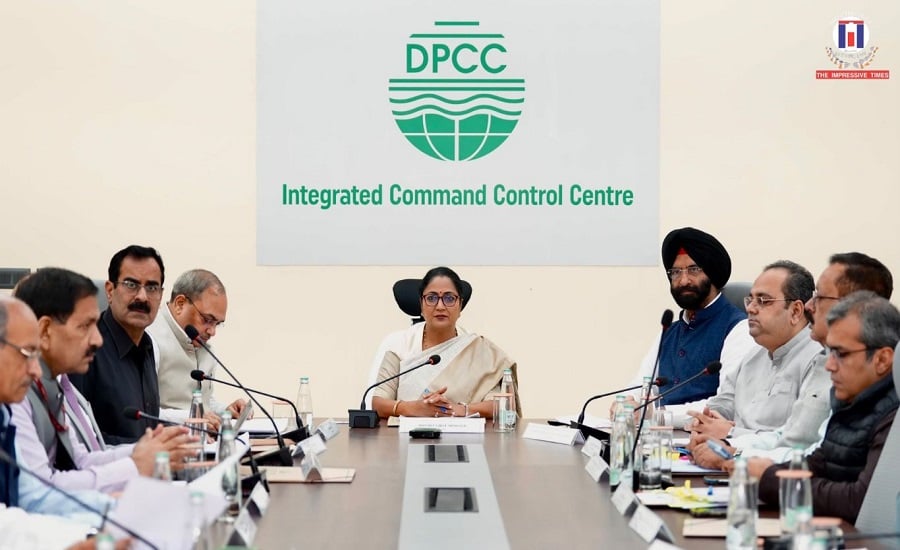
New Delhi: Delhi Chief Minister Rekha Gupta on Wednesday chaired a high-level meeting at the Integrated Command and Control Centre (ICCC) of the Delhi Pollution Control Committee (DPCC) to review the government’s efforts to control air pollution in the national capital. She directed the Municipal Corporation of Delhi (MCD) and the Public Works Department (PWD) to intensify deep cleaning of roads, footpaths and central verges, with special emphasis on removing accumulated dust, soil and silt.
The meeting reviewed several pollution-related issues, including identified pollution hotspots, field inspections, enforcement measures, road and construction dust, vehicular emissions, public transport, industrial pollution, construction and demolition (C&D) waste, and solid waste management.
The Chief Minister said November had brought relief for the first time in the last 10 years, attributing the improvement to coordinated efforts by various government departments and public cooperation. However, she emphasised that strict pollution-control measures would continue.
Appealing to Delhi residents to participate in pollution-control efforts, she said the government was committed to making the capital a developed and cleaner city.
Rekha Gupta Directs Departments to Ensure Ground-Level Implementation
The Chief Minister instructed all departments to work in coordination, ensure accountability and make the results of their action plans visible on the ground. She made it clear that negligence at any level would not be tolerated.
Appreciating the results of regular inspections in pollution hotspots, she said field visits had helped identify shortcomings, fix responsibility among agencies and accelerate corrective action.
She directed officials to ensure that inspections did not become a mere formality. Any deficiencies identified during inspections must be addressed immediately, and follow-up action should be regularly monitored.
The meeting was informed that an order issued on September 3, 2026, appointed nodal secretaries and commissioners in every district to monitor pollution-control measures.
Between November 2 and 17:
- Nodal officers from 13 districts conducted 41 inspections.
- MCD zonal Deputy Commissioners carried out 134 inspections.
- A total of 301 locations were assessed by MCD officials between November 2 and 16.
The Chief Minister directed officials to continue monitoring areas with both high and low Air Quality Index (AQI) levels, particularly locations recording high pollution but relatively fewer inspections.
She also stressed the effective use of the ICCC monitoring system, regular updates on pollution levels and departmental action, and sector-wise progress reports.
Read also: Delhi Plans Single-Agency Model for Infrastructure Projects; DSIIDC Invites Consultant Empanelment
Road Repairs and Pending Complaints to Be Prioritised
The meeting reviewed pending complaints related to damaged roads, unpaved stretches and potholes within a three-kilometre radius of identified pollution hotspots.
Rekha Gupta directed the concerned departments to prioritise and resolve all pending complaints, particularly those involving potholes and unpaved roads.
She also took a strict view of roads being left damaged for extended periods after excavation work.
The Chief Minister directed that the department or agency responsible for digging a road must restore it to its original condition immediately after completing the work. She stressed that delays in restoration would not be tolerated and that both the quality of repairs and completion timelines must be ensured.
MCD and PWD Asked to Intensify Mechanised Road Cleaning
The Chief Minister directed the MCD and PWD to intensify deep cleaning of major roads, footpaths and central verges.
She instructed agencies to ensure regular removal of dust, soil and silt and make effective use of mechanised road sweeping machines, water sprinkling and road-washing systems.
The meeting reviewed the availability of mechanised road sweeping machines against the requirement of 171 large and medium-sized machines.
Currently, 108 machines are available, while the MCD is deploying 70 additional machines to bridge the gap.
The corporation is also procuring picker machines with a capacity of 1,000 litres. Of these, 600 machines are expected to be available by December 2026, with the remaining machines scheduled for January 2027.
The 108 currently available machines have collectively cleaned 4,085 kilometres of roads so far.
The Chief Minister directed that all machines be utilised to their maximum capacity and deployed more extensively in areas where they are needed.
Seized Vehicles Around Police Stations to Be Removed
Rekha Gupta expressed concern over dust and dirt accumulating around seized vehicles and vehicles kept as case property outside police stations for extended periods.
She said regular cleaning beneath these vehicles was difficult, resulting in increased dust and pollution in surrounding areas.
The Police Commissioner was asked to review the situation around all police stations and issue written instructions.
The Chief Minister also directed an audit and immediate disposal of vehicles for which legal proceedings had been completed or disposal orders had already been issued.
The concerned departments were asked to jointly formulate a policy to shift the remaining vehicles kept as case property to designated locations.
Construction Sites Must Follow Dust-Control Standards
The Chief Minister directed that green nets at construction sites must not be installed merely as a formality.
She said green nets should be properly installed along with scaffolding and in accordance with prescribed standards. Barricading, windbreakers and dustbreakers must also be provided wherever necessary to prevent dust from spreading beyond construction sites.
The meeting reviewed inspections of:
- 2,118 construction sites measuring 500 square metres or more.
- 6,756 construction sites measuring less than 500 square metres.
Rekha Gupta directed construction agencies and concerned departments to ensure strict compliance with pollution-control standards at all construction and demolition sites. Immediate action must be taken wherever dust-control arrangements are found inadequate.
Essential Road Development Works to Continue After December 10
The meeting reviewed road redevelopment projects being undertaken under the Commission for Air Quality Management (CAQM).
A total of 3,744 kilometres of roads have been identified for redevelopment in 2026.
The Chief Minister directed that essential road development and public convenience-related works should not be unnecessarily affected by construction and demolition restrictions coming into force from December 10.
She instructed agencies to continue permitted works in accordance with applicable rules and exemptions while ensuring that pollution-control measures are followed.
She also directed officials to complete pending projects within the stipulated timelines and strengthen coordination to resolve issues affecting stalled works.
Delhi Metro Asked to Operate Anti-Smog Guns and Mist Sprays Regularly
The meeting also reviewed the installation and operation of mist spray systems for dust suppression.
The Chief Minister directed that these systems must be installed according to prescribed standards, operated regularly and monitored strictly. Action should be taken against agencies or individuals violating the rules.
The Delhi Metro was specifically directed to operate available anti-smog guns and mist spray systems regularly in its areas between 7 pm and 11 pm.
Strict Action Against Vehicles Without Valid PUC Certificates
The meeting reviewed enforcement measures against vehicular pollution.
According to the figures presented:
- 25,610 vehicles were challaned between November 1 and 17, 2026, for not having valid Pollution Under Control (PUC) certificates.
- 1,81,548 non-Delhi vehicles below BS-VI standards, excluding CNG and electric vehicles, were inspected.
- 30,742 vehicles were turned back at Delhi’s borders.
- 2,817 vehicles were challaned.
- 189 vehicles were seized.
- Fines exceeding Rs 5.42 crore were imposed.
Between January and November 16, a total of 41,659 old polluting vehicles were seized and 64,800 were scrapped.
Automatic Number Plate Recognition (ANPR) cameras also identified 7,055 old vehicles complying with BS-III standards or below over the last 12 months.
Delhi to Add 2,395 Electric Buses in 2026
To promote cleaner public transport and reduce vehicular emissions, the government is adding 2,395 electric buses to Delhi’s public transport fleet in 2026.
As of October 30, 2026, a total of 1,703 buses had joined the fleet, while the remaining 692 were expected to be added by December.
The restructuring of bus routes across all four Delhi Transport Corporation (DTC) zones has also been completed.
The meeting was further informed that 6,000 electric vehicle charging points were installed between January and October 2026. As of October 30, Delhi had a total of 14,913 EV charging points.
Parivartan Scheme to Promote Cleaner Goods Transportation
The government also reviewed the progress of the Parivartan scheme, which aims to encourage 78,112 polluting goods vehicles to shift to cleaner alternatives.
As of November 17, 2026, a total of 28,995 vehicles had registered on the scheme’s portal, including:
- 25,737 trucks.
- 3,258 buses.
Under the scheme, electric light goods vehicles are eligible for a purchase subsidy of up to Rs 1 lakh during the first year.
A scrapping bonus of Rs 50,000 is also available for scrapping BS-IV light goods vehicles.
The scheme is being integrated with the Delhi EV Policy 2026 to encourage cleaner goods transportation.
Traffic Congestion Reduced by 54% at Identified Locations
The meeting reviewed initiatives to ease traffic congestion and improve road connectivity.
According to the figures presented, improvement work has been completed at 43 of the 62 identified traffic congestion points.
Work was undertaken across 42 corridors, covering 250 points and 353 individual works. These interventions resulted in a 54% reduction in congestion at the identified locations compared with last year.
Of the 18 corridors targeted for making signal-free, work on eight has been completed. The Chief Minister directed officials to expedite the remaining work.
The meeting also discussed difficulties in checking polluting vehicles at Delhi’s borders, as checking every vehicle could lead to traffic congestion. Monitoring vehicles entering through smaller routes at night was another challenge highlighted by Delhi Police.
The Chief Minister directed increased surveillance at major and smaller entry points and greater use of technology.
Work has been assigned to implement the Multi-Lane Free Flow (MLFF) system at 154 entry points into Delhi, including 20 major toll points and nine national highways.
She instructed officials to complete the project within the stipulated timeline and expedite the expansion of parking facilities to improve traffic movement and parking availability.
Construction and Demolition Waste Management Reviewed
The meeting reviewed the management of construction and demolition waste across Delhi.
A total of 119 secondary collection centres have been equipped with barricading, water sprinkling systems, CCTV cameras and air quality sensors.
The Chief Minister directed officials to ensure regular monitoring, effective dust suppression and proper barricading at all authorised collection centres.
Action Against Industrial Pollution: Polluting Units Shut Down
The government also reviewed compliance with regulations relating to Online Continuous Emission Monitoring Systems (OCEMS) and Air Pollution Control Devices (APCDs).
The meeting was informed that:
- 76 industrial units had installed APCDs.
- 75 of these units had been certified as meeting prescribed standards.
- Exemptions had been granted to 14 units.
- A closure order had been issued against one unit.
In non-conforming industrial areas, 90 of the 94 polluting industries identified under CPCB standards had been connected to the CPCB server, while four units had been sealed.
In conforming areas, 709 illegal and polluting units had been shut down, with their electricity and water connections disconnected.
A survey of 11,415 industrial units in non-conforming areas identified 1,762 air-polluting and 684 water-polluting units. A total of 2,446 units were reported to have been shut down and sealed.
Joint enforcement action is also continuing across 48 identified industrial clusters in these areas.
Landfill Sites: 100 Acres of Land Reclaimed in Delhi
The meeting reviewed progress in clearing legacy waste from the Bhalswa, Okhla and Ghazipur landfill sites under the solid waste management programme.
Between January and September 2026, Delhi’s average daily waste processing capacity increased from 18,000 tonnes per day (TPD) to 27,000 TPD.
Of the total 202 acres of land at the three landfill sites, 100 acres have been reclaimed.
The reclaimed land includes:
- 45 acres at Bhalswa.
- 35 acres at Okhla.
- 20 acres at Ghazipur.
Public Awareness Campaign on Seven Key Pollution Sources
The government is conducting a coordinated public awareness campaign from September 2026 to March 2027 to educate residents about the major sources of air pollution.
The campaign focuses on seven key areas:
- Industrial pollution.
- Compliance with diesel generator (DG set) regulations.
- Scientific management of road dust.
- Construction and demolition waste.
- Solid waste management and biomass burning.
- Stubble burning.
- Vehicular pollution and clean transportation.
The initiative aims to encourage public participation and promote responsible practices to reduce pollution.
Delhi Aims to Reduce Pollution by 10-15% Every Year: Manjinder Singh Sirsa
Environment Minister Manjinder Singh Sirsa said pollution-control efforts under the leadership of Chief Minister Rekha Gupta had delivered positive results.
He said the government’s efforts over the past year were appreciated during a meeting with the CAQM Chairman at the ICCC.
According to the minister, no day with severe pollution had been recorded so far in the year, and the AQI had not crossed 400. He contrasted this with the November period over the previous 10 years, when four to six days often recorded AQI levels above 400.
He added that the average AQI during the first half of November was around 170, while October was the best month of the last decade. The number of clean-air days had also reached a record 220.
Sirsa highlighted several government initiatives, including doubling the shifts of mechanical road sweeping to clean 4,000 kilometres of roads daily, introducing 24-hour monitoring, controlling fires, taking action against around 12,000 polluting industrial units and reducing traffic congestion in markets.
He said pollution, fires, traffic and construction activities were being continuously monitored through the ICCC to enable timely action.
The minister also stated that around 60% success had been achieved in cleaning the Yamuna and clearing garbage mountains.
The government aims to reduce pollution by 10-15% every year and provide Delhi residents with better air quality.
Health Department Strengthens Preparations for Winter Pollution
Health and Transport Minister Dr Pankaj Kumar Singh said the government was working on both immediate interventions and long-term strategies to control pollution.
He said departmental action plans and monitoring arrangements were reviewed at the ICCC meeting, with directions issued to control pollution caused by road dust, construction activities and vehicles.
With pollution levels expected to rise during winter, the government has directed the Health Department to ensure the safety of patients suffering from respiratory illnesses and children.
Government hospitals have been equipped with adequate beds, doctors and essential medical facilities.
To reduce vehicular emissions, the government is increasing the number of electric buses and encouraging the adoption of electric mobility across two-wheelers, three-wheelers and four-wheelers. The fitness and emissions of vehicles entering Delhi from outside will also be monitored.
The minister further informed that Rs 5 crore had been approved for modernising PUC centres. Authorised centres at 500 locations will be upgraded in accordance with prescribed standards.
Rekha Gupta Appeals for Public Participation in Pollution Control
Concluding the meeting, Chief Minister Rekha Gupta said pollution control required coordinated and continuous efforts from all departments and government agencies.
She directed District Magistrates and district-level Deputy Commissioners to increase field inspections and regularly monitor construction activities, dust-control measures, open waste burning, cleanliness, water sprinkling and deep-cleaning operations.
She emphasised that the impact of government initiatives must be visible on roads, construction sites, industrial areas and in people’s daily lives rather than being limited to meetings and reports.
The Chief Minister said pollution control must be treated as a year-round responsibility. Better roads, completion of pending infrastructure projects and expansion of green spaces would also contribute to improving air quality.
She appealed to government departments, agencies and Delhi residents to work together towards the shared goal of making the national capital cleaner and pollution-free.
Read also: Delhi Rooftop Solar Drive Crosses 1.27 Lakh Applications; Vendor Selection Remains Pending