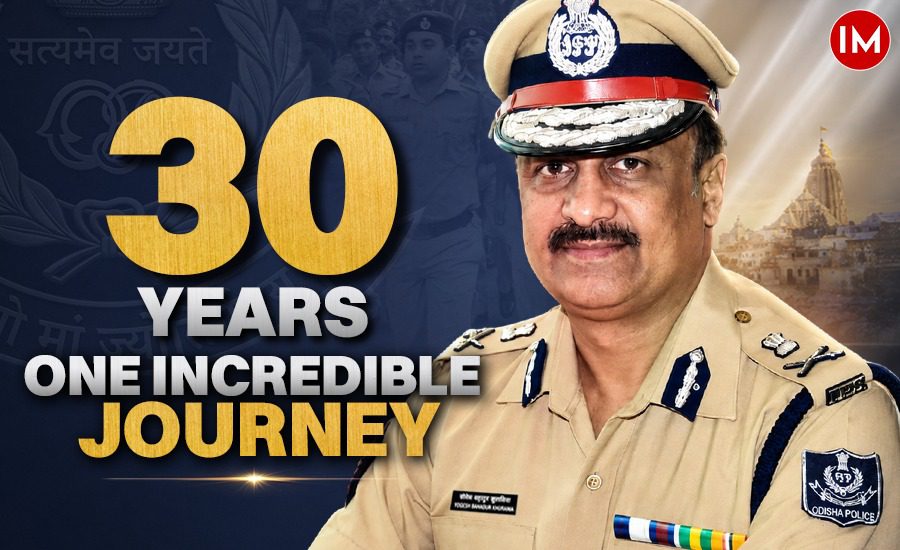
When Yogesh Bahadur Khurania took charge as Odisha’s Director General of Police in August 2024, he was not stepping into unfamiliar territory. He was returning to a force he had helped shape for more than three decades.
A 1990-batch IPS officer of the Odisha cadre, Khurania’s career has unfolded across some of the state’s most challenging districts, anti-Maoist operations, vigilance investigations, urban policing, police training institutions and India’s international borders. Few officers have experienced such a wide spectrum of policing before reaching the top post.
Born in Haryana and trained in Commerce and Law, Khurania entered the Indian Police Service at a time when Odisha was grappling with complex law-and-order challenges. What followed was a career built largely in the field rather than behind office desks.
LEARNING THE GROUND REALITIES
His early years took him across Odisha as Superintendent of Police in districts such as Nayagarh, Jajpur, Mayurbhanj, Ganjam and Rourkela.
Each district presented a different challenge. From tribal regions and forested terrain to industrial hubs and politically sensitive areas, these assignments exposed him to the realities of policing at the grassroots level. They also gave him a firsthand understanding of the diverse social and security landscape of Odisha.
As he rose through the ranks, Khurania went on to lead major police ranges in Bhubaneswar, Berhampur and Sambalpur, overseeing law enforcement across vast regions of the state.
TAKING ON THE MAOIST CHALLENGE
One of the defining chapters of his career came in anti-Naxal operations.
As IG Operations, Khurania became deeply involved in planning and supervising efforts against Left-Wing Extremism. The assignment demanded coordination between intelligence units, district police forces and central security agencies operating in difficult terrain.
Years later, as DGP, he would oversee one of the most significant milestones in Odisha’s security history. Districts that had once struggled with Maoist influence were gradually declared Naxal-free, and Odisha moved towards eliminating active Maoist presence altogether.
The achievement marked the culmination of years of sustained operations, intelligence gathering and strategic planning.
THE FACE OF URBAN POLICING
Beyond anti-insurgency work, Khurania also became one of the most visible police officers in the state when he served as Commissioner of Police for Bhubaneswar and Cuttack.
The role placed him at the centre of Odisha’s urban security network. Managing crime, traffic, law and order, VIP movements and large public events in the twin cities required a different style of policing—one that balanced enforcement with public engagement.
It was a position that showcased his ability to move seamlessly between rural security challenges and metropolitan policing.
FROM VIGILANCE TO POLICE TRAINING
Khurania’s career was not limited to operational assignments.
As Special Director in the Vigilance Department, he handled investigations into corruption and abuse of public office. Later, as Director of the Biju Patnaik State Police Academy and IG Training, he played a key role in shaping future generations of Odisha Police officers.
These assignments added another dimension to his leadership—building institutions and strengthening systems from within.
GUARDING INDIA’S BORDERS
In 2018, Khurania moved to the Border Security Force on central deputation.
Over the next six years, he held several senior positions, including IG of the South Bengal Frontier, IG Personnel at BSF Headquarters, Additional Director General of the Eastern Command, Special DG Operations and eventually Special DG of the BSF’s Western Command.
His responsibilities stretched from personnel management to operational leadership along some of India’s most sensitive borders. The experience expanded his perspective beyond state policing and brought him into the national security framework.
LEADING ODISHA POLICE INTO A NEW ERA
When he returned to Odisha and assumed charge as DGP, Khurania brought with him the experience of both state policing and border management.
Under his leadership, Odisha Police has accelerated its push towards technology-driven policing. Advanced surveillance systems, artificial intelligence-based monitoring, anti-drone technology and modern command-and-control infrastructure have become key components of the force’s modernization plans.
The world-famous Rath Yatra in Puri has also witnessed enhanced security arrangements featuring AI-enabled surveillance and anti-drone systems, reflecting a shift towards smarter policing methods.
At the same time, Khurania has consistently emphasized stronger investigations and improved conviction rates, particularly in crimes against women.
A CAREER BUILT ACROSS EVERY LAYER OF POLICING
From district police stations and anti-Maoist operations to vigilance probes, police training academies, city policing and international borders, YB Khurania’s career covers nearly every major facet of law enforcement.
His journey mirrors the evolution of modern policing itself—where field experience, technology, intelligence and institutional leadership increasingly work together.
Today, as Odisha’s top cop, he carries with him lessons gathered from some of the toughest assignments in policing, both within the state and across the country.
Also read: Amar Preet Singh: The Fighter Pilot Who Rose from Tejas Trials to Lead the Indian Air Force