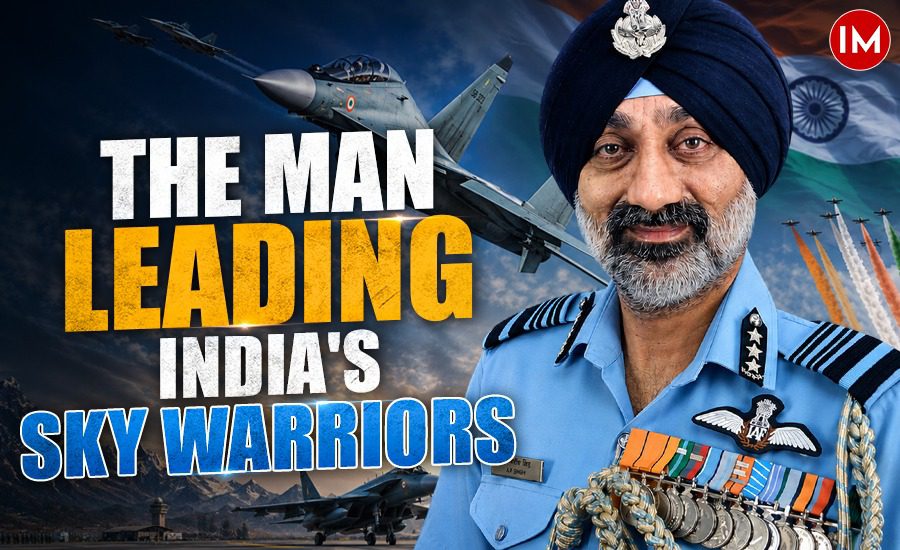
When Air Chief Marshal Amar Preet Singh took charge as the 28th Chief of the Air Staff in September 2024, it marked more than a routine change of command. It brought to the top of the Indian Air Force a man who had spent four decades at the intersection of flying, technology, combat preparedness, and India’s quest for self-reliance in military aviation.
His journey is not merely the story of a fighter pilot rising through the ranks. It is also the story of a man who helped test India’s indigenous fighter aircraft, managed critical defence projects abroad, commanded key operational formations, and eventually assumed responsibility for one of the world’s largest air forces.
Also read: How IPS Vineet Kapoor’s ‘Srijan’ Is Transforming Slums Into Safer Spaces For Girls And Youth In Madhya Pradesh
A DELHI BOY WITH HIS EYES ON THE SKY
Born in New Delhi on October 27, 1964, Amar Preet Singh grew up far from the spotlight that would later follow him. He studied at S.B.M. School before entering the demanding world of military training.
His path led him to the National Defence Academy and later the Air Force Academy, institutions that have shaped generations of India’s military leaders. On December 21, 1984, he was commissioned into the fighter stream of the Indian Air Force, beginning a career that would span some of the most transformative decades in Indian military aviation.
BUILT FOR THE COCKPIT
Flying fighters requires speed, precision and split-second decision-making. Singh mastered all three.
Over the years, he accumulated more than 5,000 flying hours on a variety of fixed-wing and rotary-wing aircraft. But what set him apart was his evolution beyond being an operational pilot. He became a Qualified Flying Instructor and later an Experimental Test Pilot—one of the most demanding roles in military aviation.
Test pilots do not merely fly aircraft; they push machines to their limits, evaluate performance, identify flaws, and help shape the future of aviation. That experience would become one of the defining features of his career.
THE MAN BEHIND INDIA’S TEJAS JOURNEY
Few chapters in Singh’s career are as significant as his association with India’s indigenous Light Combat Aircraft programme.
As Project Director (Flight Test) at the National Flight Test Centre, he became deeply involved in the development and evaluation of Tejas. At a time when India was striving to build a modern fighter aircraft of its own, Singh was among the select group entrusted with proving that the aircraft was ready for operational service.
The experience gave him a front-row seat to the challenges of indigenous defence manufacturing and helped shape his strong belief that India must build and sustain its own military capabilities.
FROM MOSCOW TO MILITARY LEADERSHIP
Singh’s expertise extended far beyond Indian skies.
He headed the MiG-29 Upgrade Project Management Team in Moscow, overseeing a crucial modernization programme for one of the Indian Air Force’s frontline fighter fleets. The assignment exposed him to international defence collaboration, complex negotiations, and large-scale aerospace project management.
Back home, he steadily climbed the command ladder.
He commanded an operational fighter squadron, led a frontline air base, served as Air Defence Commander in the strategically important South Western Air Command, and later became Senior Air Staff Officer at Eastern Air Command, one of India’s most sensitive military theatres.
Each role expanded his understanding of operational readiness, force planning, and strategic challenges facing the country.
PREPARING FOR THE TOP JOB
By 2022, Singh was entrusted with the leadership of Central Air Command as Air Officer Commanding-in-Chief. Soon after, he was appointed Vice Chief of the Air Staff, placing him at the centre of decisions involving modernization, acquisitions, capability development, and future force planning.
It was during this period that he became known for speaking candidly about delays in defence projects and the need for greater accountability. His message was simple: India’s military ambitions must be matched by timely execution.
LEADING THE INDIAN AIR FORCE
On September 30, 2024, Amar Preet Singh assumed office as Chief of the Air Staff.
Today, he leads an air force navigating a rapidly changing security environment while pursuing ambitious modernization goals. His priorities reflect the experiences gathered throughout his career—operational readiness, technological advancement, indigenous capability, and stronger integration among the armed forces.
The fighter pilot who once evaluated aircraft performance now oversees the future direction of Indian air power.
BEYOND THE UNIFORM
Despite occupying one of the country’s highest military positions, Singh has largely kept his personal life away from public attention. He is married to Sarita Singh and is the father of a son and a daughter.
Away from professional responsibilities, he is known to be an enthusiastic squash player.
Decorated with the Param Vishisht Seva Medal and the Ati Vishisht Seva Medal, Air Chief Marshal Amar Preet Singh represents a generation of military leaders shaped not only by operational experience but also by technological innovation.
From the flight-testing halls of Tejas to the office of the Chief of the Air Staff, his journey mirrors India’s own rise in military aviation—a story still being written, now from the very top.
Also read: How IFS Sandeep Kumar Helped Assam Achieve Zero Rhino Poaching in Kaziranga After Nearly 45 Years