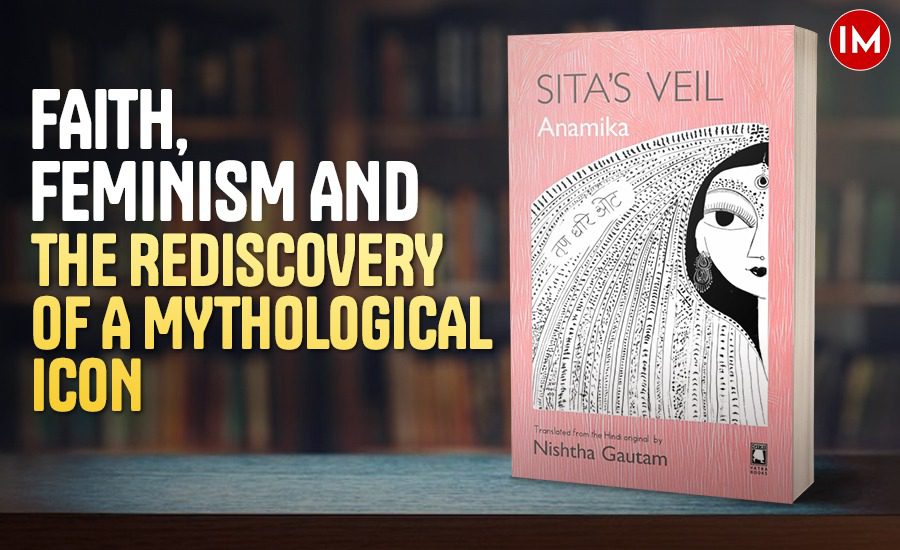
If history is the paternal dadihaal, mythology is the maternal nanihaal. Both together lend richness to a civilization. In India, mythological history is inherited outside of museums; so domestic that gods and goddesses are our neighbours. “As any other common girl down the lane,” writes Anamika in her Author’s Note, “I, too, was born, connected to these gods and goddesses with some kind of umbilical cord. Parents and grandparents on both sides were people of Faith and it never struck me that Faith can be an apple of discord because I always saw both parents and grandparents deeply connected to people of other Faiths… all Faiths are close cousins who add colour and spice to the leela called life: “khelat mein ko kako gausainya” (in the playfield, who is the boss). Only when I grew up to the harsher realities of life, I discovered that both Faith and Marxism, which had begun their journey with the same kind of altruistic motives (the ideal of ego dissolution and also of granting self-interest a backseat) have ended up being victims of the same kind of non-dialogic oneupmanship and holier-than-thou approach.”
Anamika is from Mithila – the land of Sita – and her father, Professor SNP Kishore, had been working on a Mahakavya about Sita when he passed away. His daughter took on the project as tarpan to her mother, an ode to her parents. This profound personal connection is a canopy under the larger sky of Anamika’s book, which seeks to revisit and upturn our strange contemporary misreading of Sita as meek or passive. Anamika argues that Sita, Savitri, Parvati, and Saraswati were inherently independent. To flatten their strength is a disservice to them, and to assume that they were compliant because they were equanimous is incorrect. There are no silent, suffering women in our mythological history. The integrated feminism of the Hindu tradition includes Devis of all kinds, extraordinary and ordinary, and men are invaluable within its principles of equality in larger society. “Igniting the ‘Dheerodatta’, ‘Dheerlalit’, ‘Dheerprashant’ elements even in the wildest of men is the objective of this Maithil or Tirhutiya variety of protest which I refer to in my novel.”
The title Trin Dhari Ote is taken from a verse in the Ramcharitmanas by Tulsidas: “Trin dhari ote kahat Vaidehi/ Sumiri Awadhpati Param Sanehi” (Thus spake Sita, raising the screen of a grass blade and remembering her dear Lord of Awadh). At no point during her captivity in Lanka did Sita speak to Ravan without the screen of a blade of grass between them. The Translator’s Note by Nishtha Gautam records that, “In Anamika and my understanding, it is Ravan who needs to be protected from Sita, who’s both the nurturer and destroyer. This veil [of grass] also reminds Ravan of his station: he can keep Sita captive but cannot access her… Sita grows like grass, undermining the pride of monumental masculinity.” To both author and translator, Sita’s own ability to destroy Ravan is unquestioned; she does not do so because there is a larger cosmic design at play which is destined to unfurl in the final consequence of Ram causing the death of Ravan.
The story of the Ramayana is well-known, as is the tale of Sita. Daughter of the Earth, Ayonija is found by the plough of King Janaka and raised in his palace. But, in this reading, Maithili considers herself a foundling despite her attachments to worldly parents and contexts. This larger awareness of being an ‘orphan’ enables her to see herself without any limitations of caste categories, and with the capacity to adopt any ideals: “With devotion Brahmin, with bravery Kshatriya, with calculation Vaishya, and with service Shudra—this freedom to become anything is bestowed on only those not constricted by the station of birth.” Sunayananandini’s earthly mother encouraged her to excel in both words and weapons. Janaki’s earthly father shared with her the philosophies of Saraswati, Lakshmi, and Kali who regulate three different phases of time. This charmed childhood in the Baal Kaand of Sitayan closes on Siya’s first, unforgettable glimpse of the Blue Lotus prince whom she knows she is destined to marry — Ram.
Ayodhya Kaand opens with their wedding: a day when ants and stars alike are asked to be elated together, and all the world seems to align in celebration of an auspicious union. Barely have the new couple settled into the heart of their kingdom when they are sentenced to a cruel exile. Sita’s quest to accompany Ram to the forest is contrasted against the separation of Lakshman and Urmila at this juncture. But, having persuaded her case and arranged for the maintenance of her duties in the palace, Raghavpriya departs with husband and brother-in-law for a new chapter of her life in the Aranya Kaand.
Anamika’s text imbues Sita with the virtues of patience and forbearance which have long been associated with her. As a forest bride on the banks of the Saryu, Vandevi learns lessons from the daily conversation of village women and listens with restraint to disagreeable opinions from those elder to her. Yet she too is flawed, and her tendency towards overflowing compassion is chastised by her husband; her pleasure in beauty becomes a source of sorrow when she coaxes Ram to capture a golden fawn which has delighted her senses. Thus, by a vice which is also part of fated destiny, Ratnagupta is taken into the Sundar Kaand.
“When gold is pure, it sparkles in fire.” Hanuman’s tail is set alight, but the blaze serves only to destroy Ravan’s kingdom. Lanka Kaand is a short chapter for Sita, of war missives from a squirrel whose back is marked in the stripes of Ram’s affection. News of her husband’s victory over Ravan has only just reached, Seete has scarcely alighted from a chariot with an escort of Rakshashis to set her yearning eyes on Ram, when their long-awaited reunion simmers into a public trial of purity. Pavitrayai calls upon the God of Fire for justice — gold cannot be destroyed by flame.
The Nishkriti Khand of redemption ends with Sita’s decision to leave Ram’s kingdom for Valmiki’s hermitage, where she gives birth to twins in the company of divine femininities, sage wives, forest women, and her worldly mother Sunayana. Mother to Luv and Kush, Lokajanani creates new life outside royalty. If Volume I (Secret Correspondence) of her Sitayan establishes that philosophical motherhood can be greater than biological motherhood, Volume III (Uttarayan) suggests that all dualities contain the potential for transcendence. “However luxurious a palace is, grass eventually covers it…” Having written final letters to Ram, Shoorpankha, and her two beloved sons, Bhoomija – daughter of Mandodari and Matangi and the Earth – returns to the infinite womb of her mother. Mahalakshmi’s myriad mythological aspects continue to add colour in the leela of our lives. The lesson of Sita’s life, in this novel and elsewhere, is of humblingly radical faith that the cosmos in its own time-space will ensure its own harmonies.
Also Read – How Bihar’s NBPDCL Became One of India’s Top 5 DISCOMs Through Smart Governance and Technology