When governance moves beyond files, offices and administrative routines to become a force for social transformation, its real meaning is felt not in government buildings but in the lives of people at the grassroots. In Odisha’s tribal heartland, IAS officer Parul Patawari’s pioneering initiative, Shikshartha emerged as a powerful example of how public administration can respond to local realities with innovation, empathy and a deep understanding of community needs.
Recognised by NITI Aayog for its transformative potential, Shikshartha is reimagining the way children in tribal communities experience education. Implemented in Rayagada district, where more than 56 per cent of the population belongs to tribal communities, the initiative seeks to overcome language and cultural barriers by bringing learning closer to children’s everyday lives.
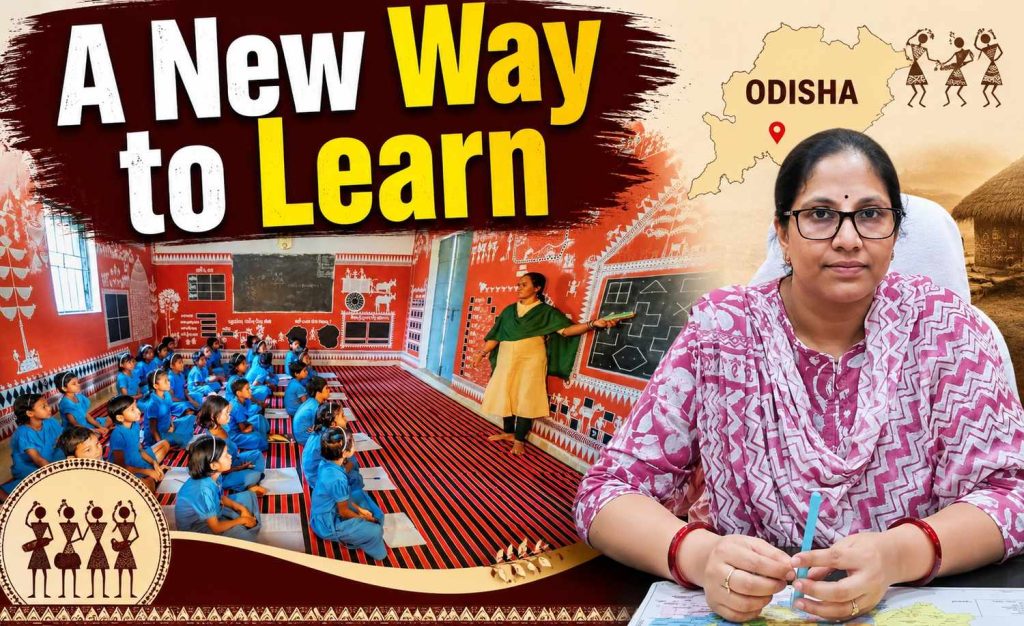
Instead of treating education as something confined to textbooks and classrooms, Shikshartha turns the school environment itself into a learning resource – using walls, floors, open spaces, local traditions, folklore and indigenous art to make education more experiential, accessible and meaningful.
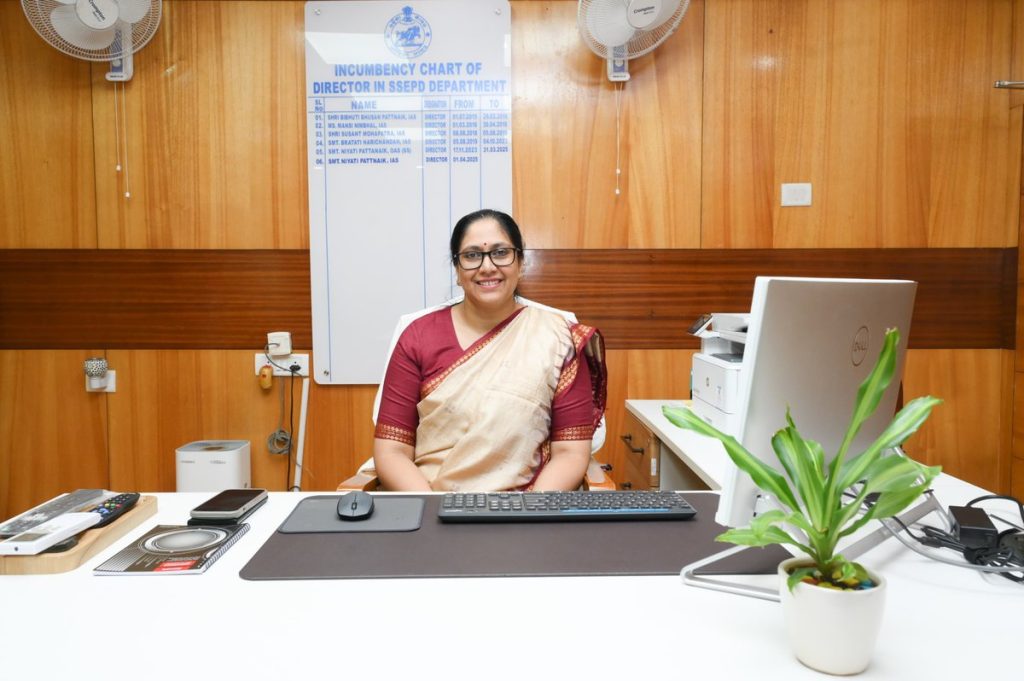
The initiative took shape during the 11-month tenure of 2015-batch IAS officer of Odisha cadre, Ms Patawari as Collector of Rayagada, from August 2024 to July 2025. Ms Patawari, who is currently serving as Director of the Social Security and Empowerment of Persons with Disabilities (SSEPD) Department, Odisha, used her tenure in the tribal-dominated district to focus on making education more contextual, inclusive and closely connected with local culture and community realities.
The Shikshartha initiative covers 55 schools and 7,500+ tribal students. By using local languages and native Idittal art to teach, it tackles the district’s 42.13% literacy rate and supports a 97% student retention rate.
At its heart, the initiative reflects a simple but powerful idea: when education speaks the language of a child’s surroundings, culture and lived experiences, learning becomes easier to understand, remember and embrace.
And that idea is now attracting attention beyond Rayagada.
How It Started: Recognising the Gaps in Tribal Education
Rayagada has a distinctive socio-cultural landscape, with tribal communities accounting for more than half of its population. While the district has continued to work towards improving educational access and outcomes, children in many tribal communities face challenges that go beyond the availability of schools.
Language differences, limited access to contextual learning resources, cultural disconnects and the gap between formal curriculum design and children’s everyday realities can make the learning process difficult.
It was against this backdrop that Shikshartha was conceptualised.
The initiative emerged from the recognition that improving education in tribal areas requires more than simply increasing access to conventional teaching methods. The learning process has to acknowledge the cultural and linguistic environment in which children grow up.
Under Ms Patawari’s administrative leadership, the district sought to develop an approach in which education could become more relatable, participatory and rooted in local realities.
The underlying philosophy was to make the child’s environment part of the classroom.
Rather than asking children to leave their familiar world behind when they enter school, Shikshartha attempts to bring elements of that familiar world into the learning process.
“For children to learn effectively, education has to connect with the world they know. In a tribal setting, that means recognising their language, culture, traditions and everyday experiences as valuable parts of the learning process,” Ms Patawari said.
Reimagining the Classroom
One of the most distinctive aspects of Shikshartha is its use of school infrastructure as an educational tool.
Walls, floors and outdoor spaces are transformed into interactive learning surfaces. Instead of remaining passive structures, these spaces become visual aids through which children can learn concepts, recognise patterns, develop vocabulary and engage with numbers and other foundational skills.
The approach moves away from an exclusively textbook-driven model and introduces activity-based and contextual learning.
For children, a mathematical concept presented visually within a familiar environment can become easier to understand. A story connected to their surroundings can become easier to remember. Visual representations can help strengthen vocabulary and comprehension.
In this way, Shikshartha seeks to make learning less abstract and more connected to everyday experiences.
The initiative also places considerable emphasis on Foundational Literacy and Numeracy (FLN), an area that has become central to efforts to improve learning outcomes across India.
Storytelling, visual learning, hands-on activities and contextual exercises are incorporated to help children develop basic literacy, vocabulary and numeracy skills.
The broader objective is not merely to make classrooms more colourful, but to make the learning process itself more engaging and effective.
She said, “We wanted to look at the classroom differently. A wall, a floor or an open space in a school can become a learning resource when it is designed around the way children understand and experience their surroundings.”
Bringing Indigenous Knowledge Into the Classroom
Perhaps the most significant feature of Shikshartha is the way it connects formal education with indigenous culture.
The initiative incorporates local traditions, folklore and art forms into the learning environment, allowing children to see their own cultural identity reflected within the school.
One notable example is the use of Idittal paintings, the traditional art form associated with the Lanjia Saura community and recognised with a Geographical Indication (GI) tag.
By integrating such indigenous art into educational spaces, Shikshartha creates a bridge between the formal curriculum and local knowledge systems.
For tribal children, this cultural connection has significance beyond aesthetics. It helps create a sense that their heritage, traditions and community knowledge are valuable parts of the educational journey.
The approach therefore works on two levels: it seeks to improve academic learning while simultaneously strengthening cultural confidence and pride.
In this sense, the initiative represents an effort to ensure that education does not become disconnected from identity.
From Textbooks to Experiential Learning
Traditional classroom learning can sometimes leave children struggling to connect academic concepts with their everyday experiences. Shikshartha attempts to close that gap through experiential learning.
The programme uses storytelling, visual aids, activities and hands-on exercises to make concepts more relatable.
Children are encouraged to learn through observation and participation rather than simply through memorisation.
This contextual approach is particularly relevant in tribal communities, where the language and cultural environment of children may differ significantly from the language and framework used in conventional educational material.
By bringing familiar cultural references into the learning process, the initiative aims to improve comprehension and retention.
The philosophy behind the model can be summed up in the broader administrative approach reflected in Patawari’s work: education becomes more effective when public systems adapt themselves to the realities of the communities they serve, rather than expecting communities to adapt entirely to the system.
“Education should not make a child feel disconnected from his or her own identity. By bringing local art, stories, traditions and indigenous knowledge into the classroom, we can make learning more relatable while also creating a sense of pride in the child’s own culture,” she added.
Implementation on the Ground
Shikshartha is currently being implemented across around 55 schools in Rayagada district, reaching more than 7,500 students.
The initiative has also been reported to benefit more than 7,500 students, according to district-level descriptions of its reach, with a strong representation of children from tribal communities and Particularly Vulnerable Tribal Groups (PVTGs).
A crucial component of the programme is teacher training and capacity building.
The idea is not to create a model that depends solely on individual administrative intervention. Instead, teachers are being trained to understand and implement the approach so that the methodology can continue to function over the long term.
Teacher capacity building is therefore central to the sustainability of the initiative.
By equipping teachers to use activity-based, visual and contextual methods, the administration is seeking to embed Shikshartha into everyday teaching practices rather than treating it as a one-time intervention.
This also gives the model greater potential for replication and expansion.
“Using local tribal languages and traditional Idittal wall paintings to teach foundational literacy and numeracy, the programme is helping bridge cultural and language barriers. It particularly supports children from the Dongria Kondh and Lanjia Saura tribes and has been recognised by NITI Aayog as a scalable model for inclusive indigenous education.”
Early Signs of Change in Learning Outcomes
The initiative’s impact is being observed at multiple levels.
Preliminary observations from the district administration indicate improvements in basic literacy, vocabulary development and numeracy skills among participating students.
Thousands of students have demonstrated progress in areas such as vocabulary retention and mathematical problem-solving, suggesting that contextual and experiential methods can help children engage more effectively with foundational concepts.
But the impact of Shikshartha is not limited to academic indicators.
Schools have reported better attendance and increased student engagement, while the programme has also contributed to stronger linkages between schools and local communities.
Increased participation from communities is particularly important in areas where education can sometimes remain institutionally separated from the social and cultural environment around it.
Shikshartha seeks to change that relationship by making the community’s own culture and knowledge part of the educational process.
More Than Learning: Building Cultural Pride
One of the less visible but potentially significant outcomes of the initiative is its contribution to cultural identity.
When children see their traditions, stories, artistic practices and community knowledge represented in their schools, the school environment can become a place where their identity is recognised rather than something that exists separately from formal education.
The incorporation of local art forms such as the Idittal paintings of the Lanjia Saura community is therefore not simply a design intervention.
It is an attempt to establish a connection between education and cultural pride.
For tribal children, this can create a stronger emotional relationship with school while reinforcing the idea that indigenous knowledge has a legitimate place within contemporary education.
In that sense, Shikshartha attempts to address two challenges simultaneously—improving learning outcomes and strengthening the cultural relevance of schooling.
Strengthening the School-Community Connection
Education becomes more sustainable when parents, communities and schools see themselves as partners in the learning process.
Shikshartha has helped strengthen these linkages by creating an educational environment that reflects local contexts.
The involvement of local cultural elements makes the initiative easier for communities to relate to, while the increased engagement of students creates greater visibility for the value of education within the community.
The model thus extends beyond the classroom.
It brings together teachers, students, local communities and the administrative system around a shared objective: creating an educational experience that is both academically meaningful and culturally relevant.
A Leadership Style Rooted in Innovation and Field Engagement
The story of Shikshartha is also closely linked to the wider administrative journey of Parul Patwari.
IAS Patawari has served across diverse parts of Odisha and has worked in areas ranging from mining belts to coastal and industrial regions.
Her assignments in tribal regions such as Keonjhar and Rayagada have particularly highlighted her focus on community engagement and long-term development.
Her administrative career has also included critical responsibilities during the COVID-19 pandemic.
As Additional District Magistrate in Ganjam and later as Additional Commissioner at the Bhubaneswar Municipal Corporation, she played important roles during the public health crisis. Her crisis management and citizen-centric administrative approach earned appreciation from the state’s top leadership.
Her experience extends beyond social-sector interventions.
As District Collector of Jagatsinghpur, one of Odisha’s important industrial hubs, Patawari facilitated major investments, including integrated steel plant projects involving JSW Utkal Steel and ArcelorMittal Nippon Steel at Paradeep.
These assignments reflect the breadth of her administrative experience – from crisis management and industrial development to tribal welfare and education.
Yet, Shikshartha stands out because it demonstrates how administrative innovation can operate at the intersection of education, culture and community participation.
The NITI Aayog Recognition
The recent recognition of Shikshartha by NITI Aayog has brought national attention to the initiative.
The acknowledgement is significant because it places a district-level education intervention from Rayagada within a wider national conversation about improving learning outcomes in underserved communities.
The initiative is being viewed as a potentially scalable model for tribal education because its approach does not depend solely on expensive infrastructure or highly specialised resources.
Instead, it draws substantially on existing school spaces, local culture, indigenous art, teacher capacity and community participation.
Its central proposition is that innovation in education does not always require replacing existing systems. Sometimes, it requires looking at familiar resources differently.
A school wall can become a teaching aid. A traditional painting can become a learning resource. A local story can become a tool for language development. An everyday experience can become a way of understanding a mathematical concept.
That shift in perspective is at the core of Shikshartha.
The Road Ahead: Scaling the Model
The recognition by NITI Aayog has also strengthened the possibility of taking the initiative to more schools and other tribal-dominated regions.
District authorities have proposed expanding Shikshartha further, particularly in areas with a high concentration of PVTG populations.
Future phases are expected to focus on several areas, including:
- Expanded teacher-training modules
- Stronger capacity-building mechanisms
- Integration of digital learning tools
- Structured impact-assessment systems
- Expansion to additional schools
- Greater focus on PVTG-dominated areas
The proposed integration of digital tools is expected to complement, rather than replace, the initiative’s existing emphasis on local culture and experiential learning.
At the same time, structured impact assessments can help determine which interventions are producing the strongest improvements in learning and how the model can be refined before being scaled further.
“The objective is not to create a model that remains limited to a few schools. We want to understand what works, strengthen the system through teacher training and assessment, and explore how the approach can reach more children, particularly in areas with a high concentration of PVTG communities.”
A Model for Inclusive and Contextual Education
The significance of Shikshartha extends beyond the 50 schools where it is currently being implemented.
Its larger contribution lies in demonstrating how district-level governance can respond to educational challenges by understanding the socio-cultural environment of the people it serves.
The model reflects an evolving approach to public education—one that places greater emphasis on inclusivity, contextual learning, foundational skills and community participation.
For tribal communities, where language, culture and geography can influence access to quality education, such an approach can help address some of the long-standing gaps between formal systems and lived realities.
As India continues to focus on equity, foundational learning and improving educational outcomes in underserved regions, models such as Shikshartha offer an important perspective: the path to better education may not always lie in making every classroom identical, but in making every classroom meaningful to the children who learn there.
From an Administrative Initiative to a Larger Educational Vision
What began as a district-level response to the distinctive educational challenges of Rayagada is now gaining recognition as a model with wider relevance.
Shikshartha demonstrates that governance can be both systematic and sensitive; that administrative innovation can be rooted in local culture; and that public institutions can become more effective when they listen to the communities they are designed to serve.
For Parul Patwari, the initiative adds another dimension to a career marked by work across very different administrative landscapes.
For Rayagada’s children, however, the significance is more immediate.
It is about seeing learning in the world around them.
It is about recognising their own culture inside the classroom.
It is about making education something they can experience, understand and connect with.
And perhaps that is where the real strength of Shikshartha lies—not simply in transforming school walls into educational tools, but in changing the way children see the relationship between their education, their community and their own identity.
As the initiative moves towards wider implementation, stronger assessments and greater integration of technology, its journey will continue to be watched closely.
If its early outcomes are sustained, Shikshartha could offer more than a successful district-level intervention. It could become an example of how people-centric governance, indigenous knowledge and innovative pedagogy can come together to create an education system that is not only accessible, but genuinely relevant to the children it seeks to empower.
Read Also: The Fight Against Drug Abuse: A Shared Responsibility of Family, Society and Police