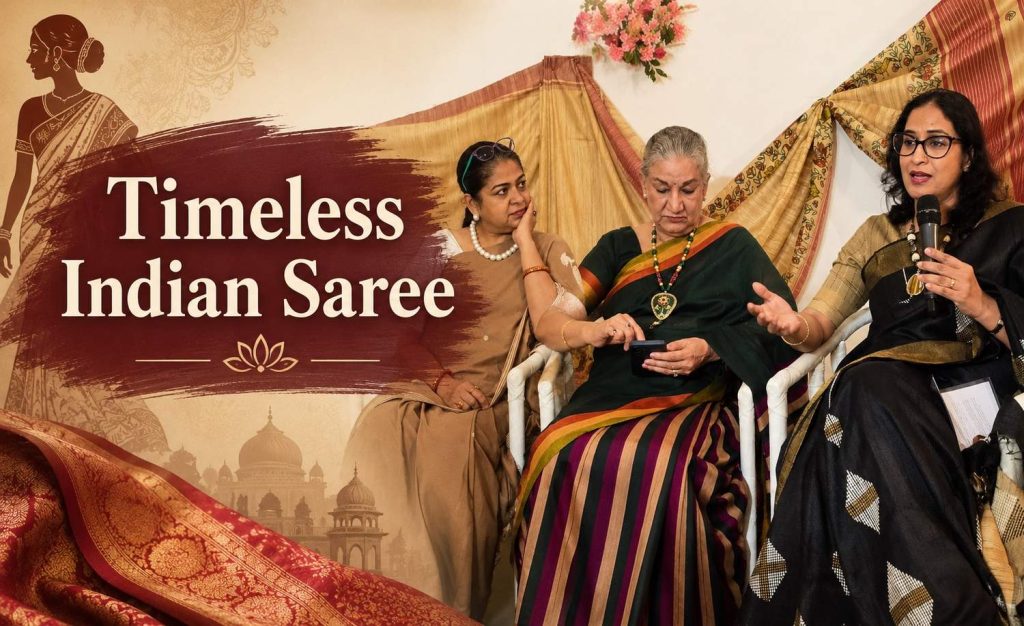
The saree is much more than a garment. It is inclusive, adaptable, sustainable and deeply rooted in India’s civilisational history. From accommodating different body types and ages to adapting to diverse climates and occupations, the saree represents a remarkably sophisticated traditional knowledge system, said Mugdha Sinha, an IAS officer of 1999 batch from Rajasthan cadre and Chairman and Managing Director of India Tourism Development Corporation (ITDC).
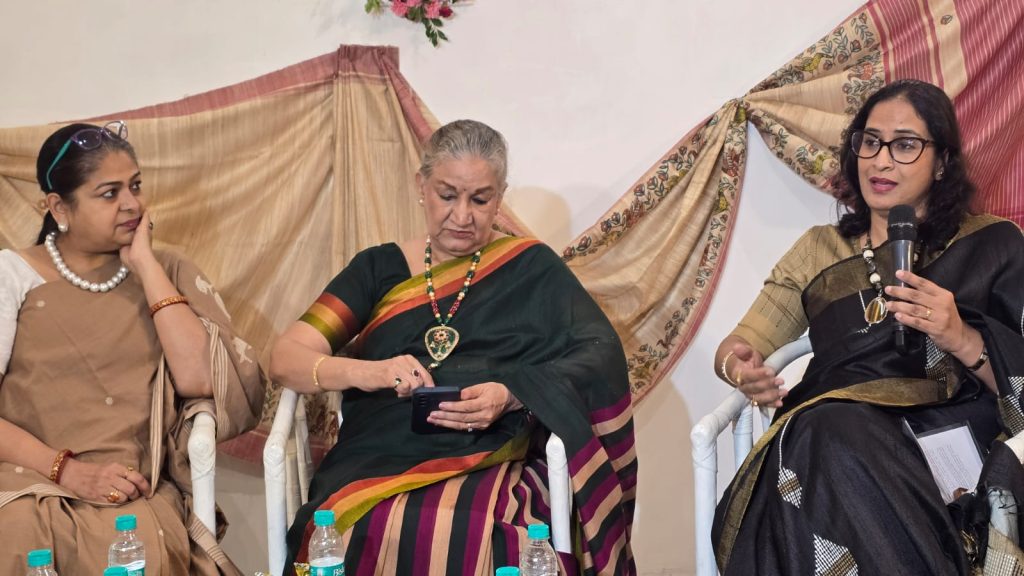
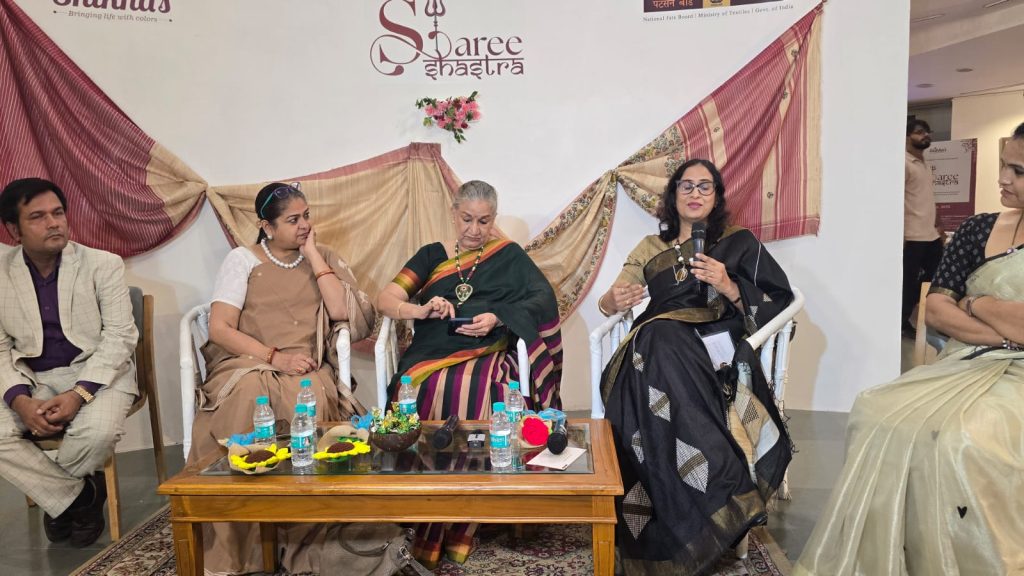
Speaking at an exhibition celebrating the saree and India’s textile traditions aptly named ‘Saree Shastra’, Ms. Sinha said one of the garment’s greatest strengths was that it did not demand that the wearer adapt to it. “The saree adapts to you,” she said, pointing out that women can wear the same garment through different stages of life without alteration or concern about body shape.
Other guests who agreed the gathering were two saree aficionados Ms Rita Menon (IAS:1975:UP), a former bureaucrat who once helmed the Textile Ministry as Secretary and Ms Bandana Preyashi, an IAS officer of 2003 batch from Bihar cadre and Joint Secretary in Ministry of Fertilizers, Government of India.
Ageless
Unlike modern fitted garments, the saree involves virtually no concept of body shaming or permanent alteration. “You can wear it as a child, as a youngster, as a pregnant woman and later in life. It remains the same garment,” she observed.
Ms Sinha also highlighted how India’s different regions evolved distinctive ways of draping and weaving the saree according to their cultural and climatic conditions. From Maharashtra’s nine-yard Nauvari saree to Kerala’s Kasavu, Odisha’s Sambalpuri and Goa’s traditional drapes, the garment has historically reflected local lifestyles and environments.
Remarkable Functionality
Its functionality, she said, was equally remarkable. Maharashtra’s women, for instance, traditionally wore the Nauvari while riding horses and undertaking physically demanding activities. In Bihar, women historically draped the saree in ways that allowed them to carry infants while working. The saree could also be adapted to protect the wearer from sun and rain or to facilitate movement.
Sinha connected this versatility with the contemporary global emphasis on sustainability. A saree can be worn repeatedly for decades and passed down generations, unlike many modern garments that generate considerable textile waste. She recalled that some of her own cotton sarees had remained with her for years and had acquired a special emotional value because they were associated with important occasions such as her UPSC interview.
“The saree is a gift of our traditional Indian knowledge system,” she said, noting that representations of draped garments can be found in India’s ancient art and sculpture, including the Ajanta murals and Buddhist imagery. The tradition has survived continuously for thousands of years rather than being something that had to be rediscovered.
A Unisex Garment
She also argued that the saree was inherently unisex in the larger philosophy of Indian traditional clothing. The dhoti, like the saree, is essentially an unstitched garment that can be adapted to different bodies and purposes.
Ms Sinha highlighted another important dimension – the knowledge embedded in traditional motifs. Sambalpuri textiles, for example, draw inspiration from sacred and temple traditions, while sarees from southern India often incorporate motifs inspired by temple architecture, including gopurams and shikhars.
Master Weaver Remembered
She paid particular tribute to Bihar’s Bawan Buti tradition and the late master weaver Kapil Dev Prasad, who was awarded the Padma Shri in 2023. Sinha recalled visiting his village and meeting his family while working on a Khadi experiential centre in Bihar. She described the Bawan Buti saree as a piece of “sacred geometry”, with motifs inspired by Buddhist imagery.
But preserving such traditions requires more than government awards and exhibitions, she cautioned. Artisans must receive fair compensation and greater recognition for the intellectual and creative value of their work. She expressed concern that traditional designs are often copied by designers and commercial platforms without adequately acknowledging or compensating the original craftspeople.
Please Don’t Bargain
IAS Sinha urged consumers not to bargain aggressively with artisans. “Buy what you can afford, but never expect a free thing from an artisan,” she said. If a particular product is beyond one’s budget, consumers should purchase something else from the same artisan that fits their pocket.
She also advocated treating master artisans as “Professors of Practice”, allowing them to teach their specialised skills and transmit traditional knowledge directly to future generations.
Best Way to Honour Artisans
Ultimately, IAS Sinha said, the best way to honour artisans is to wear what they create and tell their stories. Every handmade product, she noted, carries the labour, knowledge and life of the person who made it.
“The saree is not merely something I am wearing,” she said. “It represents the hands, knowledge and heritage of the person who created it. If we can preserve that connection, their life’s work will continue to live – and so will a part of our own heritage.”
Ms Preyashi, who has helmed Bihar Museum and department of Industries in Bihar government, talked of the Aura, a saree exudes. Former Union Minister and erstwhile King of Kashmir, Dr. Karan Singh, address the gathering through a televised speech. The exhibition was organised by Shikha’s Karigari and featured hand-painted and hand-created sarees.