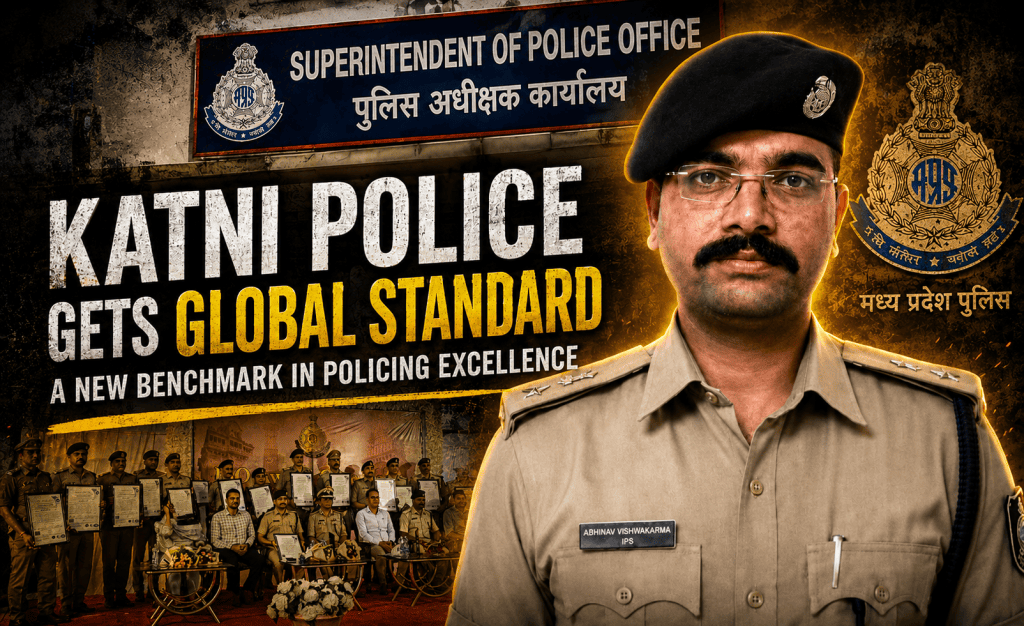
On June 29, 2026, Katni Police marked a moment that could reshape how policing is seen at the district level in India. Sixteen police units, including police stations, SDOP offices, and the Superintendent of Police office, received ISO certification, an international recognition of quality management, transparency, and structured public service.
At the center of this major administrative shift stands IPS Abhinay Vishwakarma, the Superintendent of Police of Katni district, a 2019-batch officer whose focus on systems, accountability, and public trust has pushed the district police into a new phase.
For many, police reforms are often spoken about in theory. In Katni, they have been built into everyday functioning.
TURNING POLICE STATIONS INTO SERVICE CENTRES
The idea behind the ISO certification was straightforward but ambitious: make police services more professional, predictable, transparent, and citizen-friendly.
Under Abhinay Vishwakarma’s leadership, Katni Police began working toward aligning their functioning with international quality standards. This meant improving not just paperwork, but the entire citizen experience, from entering a police station to filing complaints and receiving timely services.
“Policing cannot only be about responding to crime. It must also be about how people experience the system when they walk in seeking help,” Vishwakarma shared in an exclusive conversation with Indian Masterminds.
That thought became the foundation of the district’s ISO journey.
The certification process covered crucial aspects such as Quality Management Systems (QMS), citizen satisfaction, scientific record maintenance, effective use of resources, time-bound service delivery, workplace safety, accountability, and continuous improvement.
These aren’t just administrative terms. They directly shape how citizens interact with law enforcement.
A GROUND-LEVEL TRANSFORMATION
Before the formal certification ceremony, senior officials conducted detailed inspections of five major police units: Sleemnabad Police Station, Traffic Police Station, Kotwali Police Station, Kuthla Police Station, and NKJ Police Station.
The inspection focused on every detail.
Cleanliness of the police station premises. Organized workspaces. Duty office systems. Visitor assistance rooms. Proper seating arrangements for citizens. Separate male and female lock-ups. Meeting halls. Malkhana management. Armouries. SHO chambers. Drinking water. Clean washrooms. Information boards. Complaint registration systems. Record management. Security arrangements. Timely public services.
These are often overlooked elements. But together, they define whether a police station feels intimidating or accessible.
Katni Police worked to ensure that each of these spaces reflected order, efficiency, and dignity.
“A police station should not feel like a place people fear. It should feel like a place where problems find solutions,” Vishwakarma explains.
That vision pushed officers to rethink their workspaces and workflows.
SIXTEEN UNITS, ONE SHARED MISSION
At the honor ceremony held at the NKJ Police Station premises, certificates were formally awarded to 16 units.
These included the Office of the Superintendent of Police, Katni, led by Abhinay Vishwakarma himself, along with the SDOP offices of Vijayraghavgarh and Sleemnabad.
The certified police stations included Kotwali, Kuthla, Madhavnagar, Traffic, NKJ, Sleemnabad, Umaria Pan, Bahoriband, Dhimarkheda, Reethi, Badwara, Barhi, and Vijayraghavgarh.
Each unit represented months of procedural upgrades, audits, and internal changes.
What makes this significant is scale.
Rarely do so many units in a district move together under a common quality framework. It signals a coordinated administrative shift rather than isolated reform.
Deputy Superintendent of Police (Headquarters) Ratnesh Mishra, who closely handled the ISO process, explained the journey in detail during the event, highlighting the quality requirements, challenges faced during implementation, achievements made, and the expected long-term improvements in police services.
He emphasized that ISO certification is not a one-time award, but an ongoing process of improving work culture and service quality.
RECOGNITION FROM THE TOP
The ceremony was attended by Additional Director General of Police, Jabalpur Zone, Pramod Verma, along with Katni Collector Ashish Tiwari, the Municipal Commissioner, and the Divisional Forest Officer.
Before the ceremony, ADG Pramod Verma personally visited the police stations to assess the ISO-aligned systems.
In his address, Verma called Katni Police’s achievement an example for the entire Jabalpur Zone. He stressed that the real goal is not simply achieving standards but maintaining them consistently while delivering sensitive, transparent, and timely services to every citizen.
For Katni Police, this public recognition mattered. But for Abhinay Vishwakarma, the larger objective remains ahead.
“This certification is not the finish line. It is a framework that reminds us every day that public trust has to be earned repeatedly, through action and service,” he says.
BEYOND CERTIFICATION
The bigger story here is not about a certificate hanging on a wall. It is about changing the culture inside police institutions.
By introducing standardization, better infrastructure, clear systems, and measurable accountability, Katni Police is attempting to close the distance between the police force and the public.
At a time when conversations around policing often focus on force, Katni’s experiment highlights something else: service.
And that shift can be powerful.
For a district police force, ISO certification may look like an administrative milestone. But in reality, it is a signal.
A signal that policing can evolve. That systems can be improved. And that leadership, when focused on process and people together, can change how citizens experience governance itself.
In Katni, IPS Abhinay Vishwakarma is showing what that change can look like.