By Harshendra Vardhan Singh
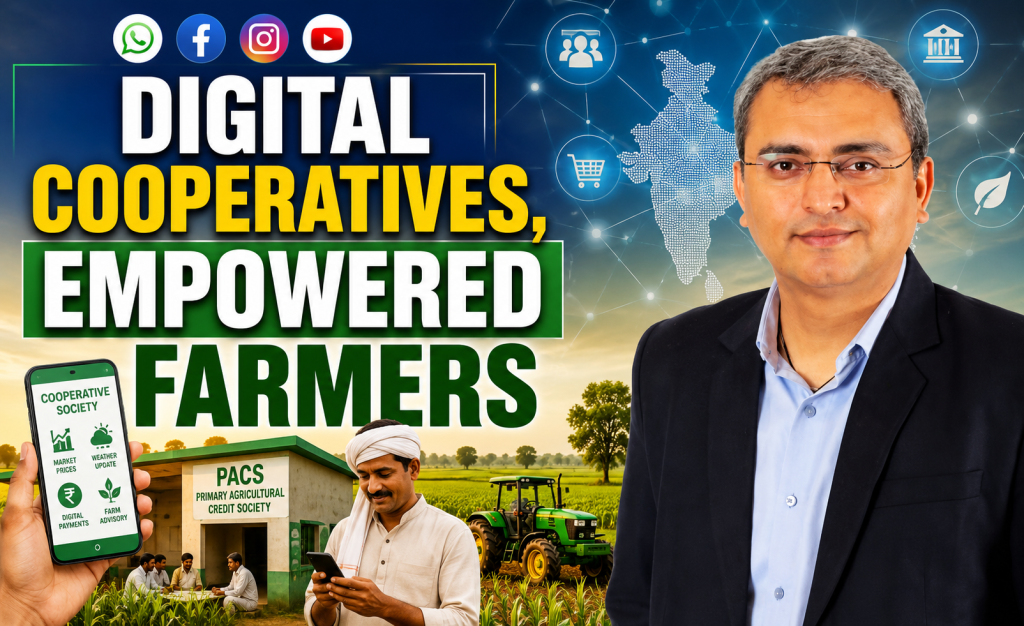
The widespread availability of 4G-5G connectivity, coupled with affordable smartphones and user-friendly platforms such as WhatsApp, Facebook, Instagram and YouTube, has played a pivotal role in taking information related to the cooperative movement to the rural masses. This has enabled even the smallest unit of the cooperative ecosystem, the Primary Agricultural Credit Society (PACS), to disseminate its innovations among cooperative members with the same ease and reach as a large urban institution.
IFFCO, with a membership of more than 5.5 crore farmers, has set yet another exemplary benchmark. More than one crore farmers have watched videos on the application of Nano Urea and Nano DAP in agriculture on its YouTube channel, gaining valuable knowledge about modern and sustainable farming practices. Through WhatsApp and Facebook, IFFCO has built strong engagement with farmers. By connecting directly with farmers, even in some of the country’s most backward districts, IFFCO has also been creating awareness about the benefits of the cooperative movement.
Also Read – India’s Strategic Autonomy Is Facing Its Hardest Test
Under the Government’s Operation Green Initiative, NAFED has used Instagram and digital marketplaces to connect more than 50,000 cooperative societies dealing with pulses, oilseeds, and horticultural produce to the national commodity market, while helping stabilise prices. KRIBHCO has used Facebook Live sessions to provide virtual training on organic farming, enabling it to reach lakhs of farmers across the country and document improvements in crop productivity among participating members.
Through digital platforms, these institutions have not only expanded the reach of the cooperative movement but have also strengthened public trust and understanding of cooperation.
Under the leadership of Union Home Minister and Cooperation Shri Amit Shah, the Ministry of Cooperation, over the past five years since its establishment, has been steadily advancing towards transforming cooperative societies into modern, transparent, and financially vibrant institutions through technological and strategic initiatives, including the computerisation and modernisation of PACS, while contributing to the vision of ‘Atmanirbhar Bharat’. A National Cooperative Database is being developed to provide every cooperative institution in the country with a unified digital identity. Through digital communication, awareness is being created among farmers, dairy producers, artisans, fishermen, rural youth, and women.
India’s leading cooperative institutions have demonstrated that the consistent adoption of digital communication can produce transformative results. Amul is perhaps the finest and most instructive example. With 36 lakh farmer-members spread across 18,000 villages, Amul has established a powerful presence on social media, with more than 25 lakh followers on Instagram alone. Through reels featuring farmers’ stories, behind-the-scenes glimpses of dairy operations, and its iconic ‘Utterly Butterly Delicious’ campaign, Amul has proved that a cooperative institution can not only remain commercially competitive but also build a deep cultural connection with people.
The cooperative sector lies at the heart of India’s development vision and is driving inclusive growth across rural India. More than 8.5 lakh cooperative societies are providing services to nearly 30 crore members across the country. A substantial share of the agriculture, fertiliser, banking, and dairy sectors is operated through cooperative institutions. Prime Minister Shri Narendra Modi‘s vision of ‘Sahkar Se Samriddhi’ is gaining new momentum through the wings of digital transformation. Cooperative societies are increasingly embracing digital platforms, particularly social media, to expand their outreach. Various social media channels are playing a vital role in carrying the message of the Ministry of Cooperation to every corner of the country, as they represent the fastest, widest-reaching and most democratically accessible means of communication, extending even to the remotest villages.
About the Author– (Mr. Harshendra Vardhan Singh Head, PR, Publicity and Brand Communication, IFFCO)
Disclaimer—(The views and opinions expressed in this article are solely those of the author and do not necessarily reflect the views of Indian Masterminds. For feedback or queries, please write to [email protected].)
Also Read – From Tiger Rescues to 12 Wetlands: How IFS Akash Deep Badhawan Is Transforming Conservation in UP