India has one of the world’s largest workforces, yet a persistent gap remains between job seekers, employers and training institutions. Skills often go unrecognised, vacancies do not always reach the right candidates, and many citizens remain outside formal employment and skilling systems.
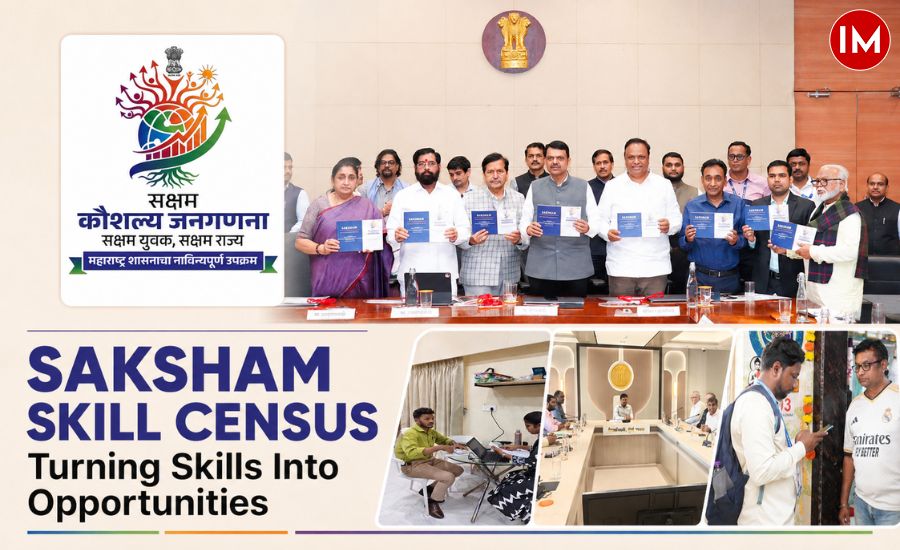
In an attempt to address this gap, the Maharashtra government has launched Saksham Skill Census, an initiative designed to move beyond conventional surveys and create a live database of skills, aspirations and livelihood needs.
Launched in Mumbai Suburban district, the initiative aims to connect citizens with employment, skilling, entrepreneurship and other livelihood opportunities through technology and data-driven interventions.
The initiative was formally launched on 2 March 2026, with H West Ward selected as the pilot geography. The ward was scientifically divided into 108 micro-territories, with more than 120 trained and certified enumerators deployed for door-to-door and self-enumeration exercises.
More than 50 professionals monitored field operations, reviewed incoming information and used AI-enabled verification to improve the quality of the data.
But Saksham was designed to be more than a census.
From Skill Census To Livelihood Intelligence
The District Collector’s Office brought together more than 25 government departments to ensure that the exercise did not operate in departmental silos. More than 200 employers and 50 training partners also engaged with district authorities through multiple round-table discussions.
Strategic partnerships were established with organisations including FICCI FLO, World Trade Center Mumbai and Maharashtra State Skills University, further strengthening the initiative’s employer and training ecosystem.
The scale of public engagement was significant, with awareness campaigns generating more than 1.1 crore digital impressions.
According to IAS Saurabh Katiyar (2016 batch, Maharsahtra Cadre), Collector, Mumbai Suburban, the objective goes well beyond collecting information.
“Skill Census has been successfully conducted in the Mumbai Suburban district for the first time in India. It aims to identify the youth, bridge the skill gap and provide employment by connecting with the employers. The Saksham Skill Census does not end with data collection. Using AI-enabled analytics, it creates a career profile for every resident and identifies contextualised pathways to employment, entrepreneurship and other livelihood opportunities,” he told Indian Masterminds.
What The Census Found
The ground-level exercise covered 59,824 households and identified 44,982 candidates. Of these, 5,887 people, or 13.1%, were unemployed or actively seeking work.
Another 20,541 employed citizens expressed a need for upskilling or career guidance, while 3,995 people were identified as self-employment or gig-work aspirants. The survey also identified 6,891 homemakers who could potentially take up part-time livelihood pathways.
In total, 37,314 candidates were found eligible for skilling.
The exercise also surveyed 1,018 employers and 52 training partners and institutes, providing the administration with information on both sides of the employment market.
One of the most striking findings was that nearly 98% of surveyed citizens lacked formal skill certification. The survey also recorded an active-need rate of 13.1%, significantly higher than the reported state average of 5.2% and national average of 6.4%.
This highlighted a segment of informal and under-documented livelihood needs that may not be fully captured through broader sample-based statistics.
Turning Data Into Jobs And Opportunities
The real test of Saksham lies in what happens after the survey.
More than 32,000 candidates have already been reached through post-survey engagement, with personalised career pathways being developed for individuals. More than 22,000 candidates are being taken towards employment-linked skilling programmes aligned with market demand.
At the same time, over 5,800 unemployed youth are being connected with suitable employment opportunities, while employers have already directly contacted more than 1,690 candidates for interviews and recruitment.
The initiative is also expanding its focus beyond conventional job seekers. More than 4,000 aspiring entrepreneurs are set to receive structured training, mentoring and business guidance.
Similarly, over 6,000 homemakers, persons with disabilities and members of other previously unreached communities are being brought into formal skilling, livelihood and self-employment pathways.
The approach combines CSR-backed training partnerships, employer engagement, job drives and data-driven policy interventions to shorten the distance between identifying a candidate and creating an actual livelihood opportunity.
A Pilot With A Larger Ambition
The scale becomes clearer when compared with existing annual targets. Mumbai Suburban’s annual skilling and employment target was around 800–1,000 candidates. The single pilot ward has already created a livelihood pipeline of approximately 22,000 candidates, more than 20 times that scale.
The model has also begun attracting attention beyond Maharashtra. Saksham has been presented as a case study at Northwestern University in Chicago, while knowledge conversations have expanded across the United States, Dubai, Guyana, Albania and Angola.
Discussions and case-study collaborations have also been initiated with institutions including IIT Bombay, IIM Mumbai, TISS Mumbai and the Indian Institute of Population Science.
AI At The Core Of Saksham
Artificial intelligence is positioned as the central technology layer of Saksham. Instead of treating the census as a static database, the administration intends to develop it into a continuously updated Livelihood Intelligence System.
The system can integrate information from the Skill Census, employer requirements, mobile applications, AI-enabled voice interactions, job fairs and training programmes. AI can then help clean, validate and standardise this information before creating dynamic profiles based on citizens’ education, skills, experience, aspirations and availability.
These profiles can subsequently be used to recommend suitable jobs, training programmes, apprenticeships, government schemes and entrepreneurship opportunities.
The system is also expected to support multilingual citizen engagement through voice calls, WhatsApp interactions and automated follow-ups, while giving employers access to more relevant candidate pools.
For the administration, dashboards, predictive analytics and trend analysis can provide a real-time picture of changing livelihood needs and help shape targeted interventions.
The intended AI cycle is straightforward: data collection, intelligent processing, recommendations, action and continuous feedback. Outcomes from placements, training and employer interactions can feed back into the system, allowing it to evolve over time.
The Road Ahead
The next phase of Saksham includes weekly ward-level job drives, employer-led training programmes and structured career guidance reports for candidates.
Self-employment aspirants will be mapped to schemes such as PMEGP, Mudra and CMEGP, while mentor pools and incubation-centre partnerships are planned to provide support beyond initial training.
The administration also plans to connect eligible candidates with NAPS, NATS, MAPS, CMYKPY and PMIS, creating pathways for apprenticeships, on-the-job training and stipend-supported opportunities.
What began as a skill census in one Mumbai ward is therefore being positioned as a broader experiment in livelihood governance. Its larger promise lies not simply in counting how many people have jobs or skills, but in understanding what they can do, what they aspire to do, what employers need and what support can help bridge that gap.
Saksham’s central idea is simple: data should not end in a database. It should lead to opportunity.