Forests are often measured in hectares, timber volumes and green cover. But behind their management lie questions that numbers alone cannot answer: how should natural resources be used, how can economic interests be balanced with conservation, and what knowledge do future forest officers need to make those decisions?
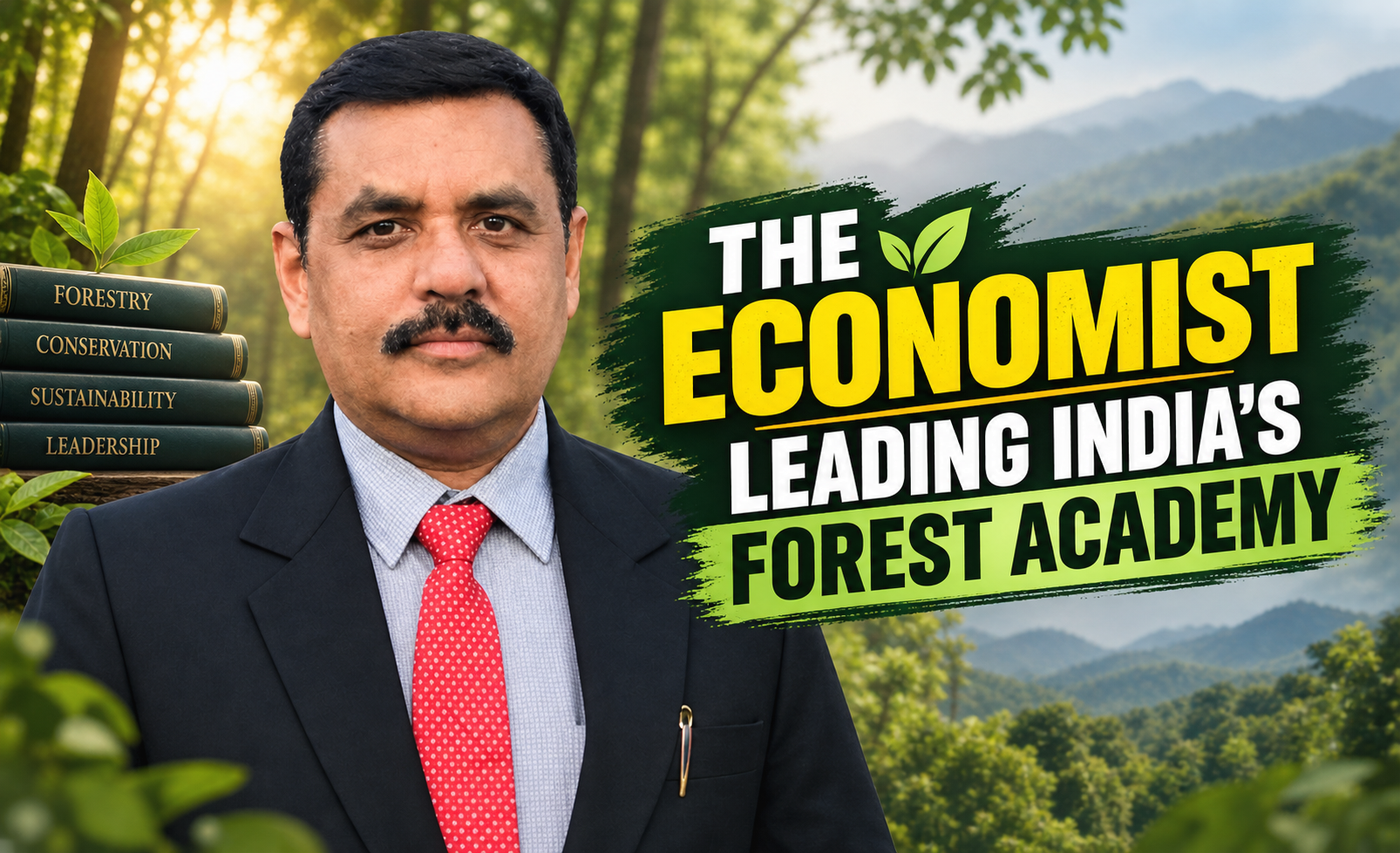
For Dr Rajendra Prasad Khajuria, a 1991-batch Indian Forest Service officer of the Andhra Pradesh cadre, these questions have featured in both his academic work and professional career. On July 2, 2026, he took charge as Director of the Indira Gandhi National Forest Academy (IGNFA), Dehradun, the institution responsible for training Indian Forest Service probationers and in-service officers.
His appointment brings a forester with a background in mathematics, management and forest economics to the helm of the country’s national forestry training academy.
Also read: How IAS Dhatri Reddy Is Turning Andhra Pradesh into a Launchpad for India’s Next Big Ideas
From Mathematics to Forestry
Originally from Jammu and Kashmir, Khajuria’s academic journey began with mathematics and the sciences. He completed his BSc in Physics, Chemistry and Mathematics at Maulana Azad Memorial College, Jammu, in 1987, followed by an MSc in Mathematics from the University of Jammu in 1990.
He subsequently entered the Indian Forest Service, joining the Andhra Pradesh cadre as part of the 1991 batch. His professional training took him to IGNFA, where he completed a postgraduate diploma in forestry in 1993.
His education continued alongside his professional development. In 2000, he obtained an MBA in Management through distance education from the American International Institute of Technology. Eight years later, he earned a PhD in Forest Economics from the University of Toronto, Canada.
The progression brought together scientific training, management studies and the economics of forest resources—a combination reflected in his published research.
Studying the Economics of Forests
Khajuria’s doctoral thesis, Three Essays on Real Options Analysis of Forestry Investments under Stochastic Timber Prices, examined how uncertainty in timber prices affects forestry investment decisions.
The research explored the timing of timber harvesting, the valuation of forestry investments and the economic feasibility of carbon-sequestration projects involving managed forests. It highlighted the importance of market information and adaptive management when decisions must be made under uncertain economic conditions.
His research interests have also extended to sustainable forest management, timber supply and the relationship between forestry and development.
In a 2009 paper published in Land Economics, he examined the valuation of timber-harvesting options. His subsequent publications included Enhancing Green Cover in Andhra Pradesh and Role of Forestry in Ensuring Sustainable Development Goals, both published in The Indian Forester in 2020.
In 2022, he presented a paper on strategies for self-reliance in India’s wood sector at the XV World Forestry Congress in Seoul.
Together, these works document a sustained academic engagement with the economic and policy questions surrounding forests, from harvesting decisions to expanding tree cover and strengthening the domestic wood sector.
From Research to Environmental Administration
Khajuria’s career has also involved senior responsibilities in Andhra Pradesh’s forest and environmental administration.
Before moving to IGNFA, he was serving as Managing Director of the Andhra Pradesh Environment Management Corporation Ltd. He had also held responsibilities associated with the Andhra Pradesh Forest Development Corporation.
His documented work in the state has intersected with questions of forest production, tree cover and environmental policy.
In 2020, his research examined ways to expand green cover in Andhra Pradesh, including the potential role of agroforestry and trees outside forests. In 2024, he participated in a consultation on the state’s agroforestry policy, where he discussed tree coverage and regulatory arrangements.
These areas of work connect forest management with broader questions of land use, production and environmental governance.
Taking Charge at IGNFA
Khajuria assumed charge as IGNFA Director on July 2, 2026, succeeding Smt Bharati, who superannuated on June 30.
Upon taking charge, he interacted with the academy’s faculty members and staff and reviewed the activities being undertaken by the institution.
The responsibility places him at the head of an academy that prepares officers for the complexities of forest administration, wildlife management and environmental governance. Its work includes professional training for newly recruited Indian Forest Service officers as well as programmes for serving officers.
For an institution charged with preparing forest officers for responsibilities across India, training must address both the fundamentals of forestry and the changing demands of public administration.
Khajuria’s documented academic work spans forestry economics, timber markets, green-cover expansion and sustainable development. His professional experience includes senior assignments in state environmental administration, while his new position places him within the national system for developing the next generation of forest officers.
His journey, from studying mathematics in Jammu to earning a doctorate in forest economics in Toronto and taking charge of IGNFA in Dehradun, brings these strands together at a significant stage of his career.
At the academy, the responsibility now before him is to lead an institution whose central task is to prepare forest officers for the decisions, challenges and public responsibilities that lie ahead.
Also read: How IFS Prajesh Jena Is Bringing AI to Rural Youth in Palamau Tiger Reserve