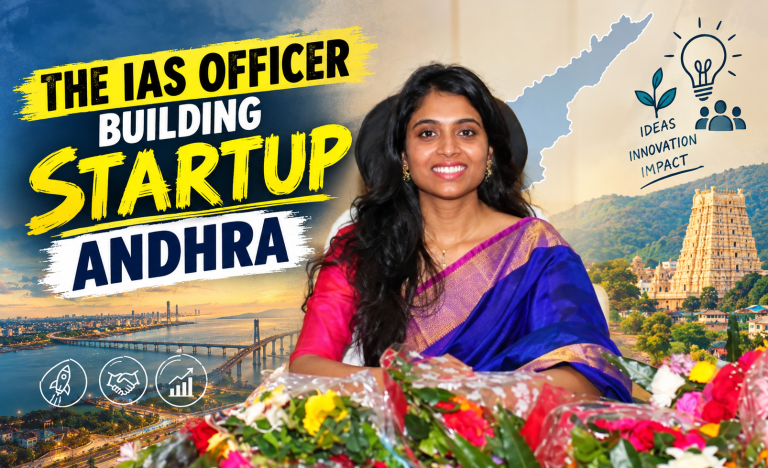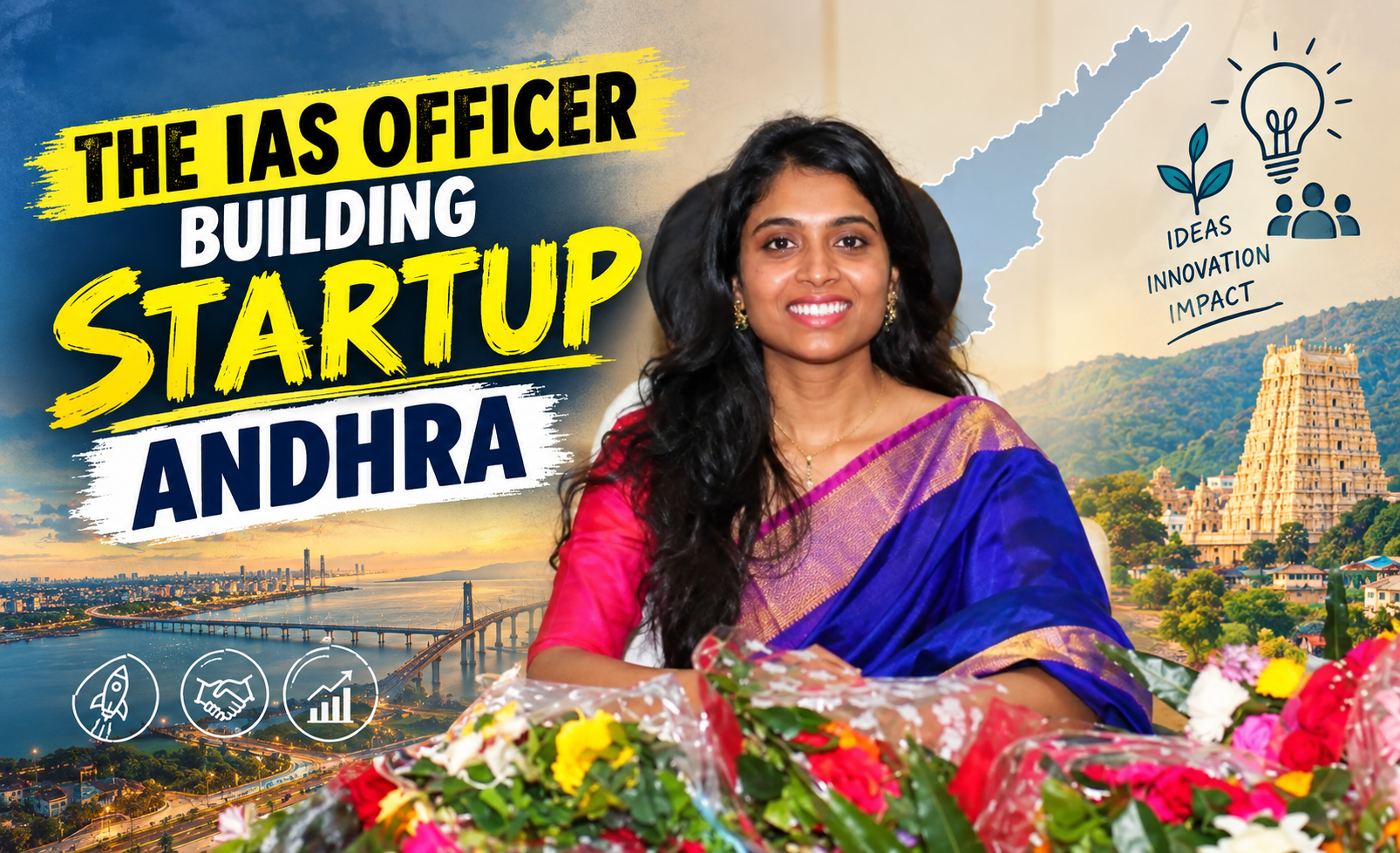
Most people would think twice before walking away from a coveted investment banking career in London. For Dhatri Reddy, however, success was never simply about reaching the top of a profession. It was about finding work that mattered.
An IIT Kharagpur graduate, Karate black belt, social entrepreneur, investment banker, IPS officer and later an IAS officer, Reddy has taken a route few would imagine for themselves. Each turn brought a different challenge, but also a new opportunity to put her abilities to work. Today, as a key leader in Andhra Pradesh’s innovation ecosystem, she is pursuing a goal that extends far beyond individual success: making entrepreneurship and technology accessible to people across the state.
Also read: How IFS Prajesh Jena Is Bringing AI to Rural Youth in Palamau Tiger Reserve
From IIT Kharagpur to London, and Back
Reddy’s instinct to create change surfaced long before she entered government service. While studying at IIT Kharagpur, she founded Feed India, a youth-led initiative that sought to tackle hunger by mobilising students for social impact. At a time when many of her peers were preparing for corporate careers, she was already exploring how collective action could address real-world problems.
After graduating, she joined Deutsche Bank in London. The job offered the attractions of international finance, professional growth and a career many aspire to build. Yet the promise of a successful life in the financial district could not settle a deeper question about what she wanted to accomplish.
She left investment banking and returned to India to prepare for the UPSC Civil Services Examination, one of the country’s most demanding competitive examinations.
Her entry into the Indian Police Service marked another turn in her career. She later joined the Indian Administrative Service, moving towards a role that offered a broader canvas for public policy, institution building and social change. The transition from finance to policing, and then administration, was unusual, but it brought together different ways of understanding people, systems and problems.
When Governance Began with Children
Even in her early administrative assignments, Reddy looked beyond conventional measures of governance. As Assistant Collector, she conceptualised Project Play, recognising that public infrastructure should do more than meet basic requirements. Children also need spaces where they can play, learn, develop confidence and grow.
The initiative reflected a distinctly human approach to administration: the idea that the quality of public life is shaped not only by roads and buildings, but also by the opportunities communities can offer their youngest members.
It was a small window into a larger philosophy, one that would eventually shape her work in Andhra Pradesh’s innovation ecosystem.
Building an Innovation Ecosystem, Not Just an Incubator
When Reddy took leadership roles at the Andhra Pradesh Innovation Society (APIS) and the Ratan Tata Innovation Hub (RTIH), the state was seeking to establish itself as a major innovation destination. She saw an opportunity to go beyond supporting a handful of promising startups.
Her ambition was to build a statewide network in which innovation would not remain the privilege of metropolitan centres or elite campuses. Students, researchers, entrepreneurs, artisans and small businesses across Andhra Pradesh needed access to the same possibilities.
The answer was a Hub-and-Spoke innovation network, designed to extend entrepreneurship support, technology access and startup opportunities into districts and underserved regions.
The scale of the effort is reflected in the numbers. Under her stewardship, RTIH engaged more than 5,200 founders, supported over 2,500 startups and connected with upwards of 5,000 micro, small and medium enterprises. It validated 576 startup ideas, conducted 371 ecosystem events, facilitated more than 1,970 hours of mentorship and enabled over ₹5.28 crore in grants and startup support.
Behind every figure is a potential business, a founder looking for direction or an idea waiting for the right opportunity.
From First Idea to Investment-Ready Startup
Reddy’s approach also recognised that entrepreneurship cannot thrive on isolated workshops and occasional events. Founders need sustained support, with different forms of assistance at different stages of their journey.
The resulting innovation pipeline brought together four programmes. SPARK opened the door for aspiring innovators. Future Founders encouraged student entrepreneurs and first-time founders to take their ideas forward. Catalyst offered structured incubation, while Velocity Lab was designed to help promising ventures prepare for investment and scale.
The objective was to create a connected pathway, from the first spark of an idea to a venture ready to grow.
Infrastructure formed another part of this vision. The Advanced Prototyping and Innovation Centre (APIC) gave innovators access to product-development facilities, while the Mobile Innovation and Entrepreneurship (MINE) initiative took support directly to districts and underserved communities.
Through FoundHer Andhra, the focus extended to women entrepreneurs, with an emphasis on mentorship, visibility, policy advocacy and access to the wider entrepreneurial ecosystem.
Taking Andhra Pradesh into the Future
The ambitions reach well beyond conventional startups. Reddy has played a key role in advancing initiatives involving an Artificial Intelligence Centre of Excellence, quantum technology, assistive technology, MedTech collaborations and statewide innovation platforms connecting government, academia, industry, investors and startups.
Partnerships with premier institutions, technology companies, research organisations, incubators, investors and global partners have helped broaden the state’s innovation landscape. The larger goal is to position Andhra Pradesh not merely as a destination for new businesses, but as a participant in the development of deep technology, artificial intelligence, quantum computing, advanced manufacturing and public-sector innovation.
For these efforts to endure, the challenge is to create institutions and networks that can continue serving innovators beyond any one person’s tenure.
A Career Connected by Purpose
At first glance, Reddy’s journey appears to contain several unrelated lives. Karate brought discipline; engineering offered tools for solving problems; investment banking exposed her to scale and execution; policing demanded courage under pressure; and administration opened the door to institution building. Innovation has brought these experiences together.
Her career offers a different understanding of professional success. It need not follow a straight line, nor must every change of direction be a retreat from ambition. Sometimes, the bigger achievement lies in applying what one has learned in an entirely new setting.
From IIT Kharagpur to London, from the IPS to the IAS, and from an early social initiative to a statewide innovation network, Dhatri Reddy’s story is ultimately about expanding the reach of opportunity.
For thousands of founders and aspiring entrepreneurs across Andhra Pradesh, the significance of that work lies not simply in the startups supported or the grants facilitated, but in the possibilities it opens up.
She did not return from London merely to change careers. She returned to find a larger purpose, and is helping build an ecosystem in which others can find theirs.
Also read: How IFS Arpit Poonia Is Turning Tapi’s Forests into Engines of Local Prosperity