मृत्यु: सर्वहरश्चाहमुद्भवश्च भविष्यताम् ।
कीर्ति: श्रीर्वाक्च नारीणां स्मृतिर्मेधा धृति: क्षमा ॥ ३४ ॥
mṛtyuḥ sarva-haraś cāham
udbhavaś ca bhaviṣyatām
kīrtiḥ śrīr vāk ca nārīṇāṁ
smṛtir medhā dhṛtiḥ kṣamā
‘I am all-devouring death, and I am the generating principle of all that is yet to be. Among women I am fame, fortune, fine speech, memory, intelligence, steadfastness and patience’.
The above shloka from the Bhagvad Gita says it all. It is the 34th shloka from the 10th Chapter, where Krishna tells Arjuna about the qualities that his feminine side consists of. He is not merely talking of the feminine, he is laying claim to the feminine and he attributes some of the most prized human qualities to his feminine side. Kirti or fame, Shri or wealth, vak or fine speech, smriti or memory, medha or intelligence, dhriti or steadfastness, Kshama or forgiveness.
At this stage itself I think I can rest my case because if Krishna himself has said it, what more remains to be said!
However, many people in this day and age of Gen Z may be shocked to learn that historically, philosophers like Aristotle, Hegel, Descartes and even our very own Manu, have considered women as property, objects, and exchangeable commodities. Such are the antecedents that women had to struggle against and continue to struggle even today at several levels, to lay claim to their rightful place in society.
I often wonder how, a being who is central to life itself, without who there would be no human life as we know it, could become so marginalized in decision making. Decisions which impact the family, immediate community and society at large. Decisions that impact her own body are also taken by someone else! The fact that half of all human beings who have ever inhabited our planet have been women, is self-evident but accounting for half of humanity yet having such little say in running the affairs of the world speaks of extreme disempowerment to say the least!
Anyone of lesser mettle would have given up long ago but not women. They continue to contribute to society in whichever way they can. Nowhere else is this more demonstrable than in the natural resources sector.
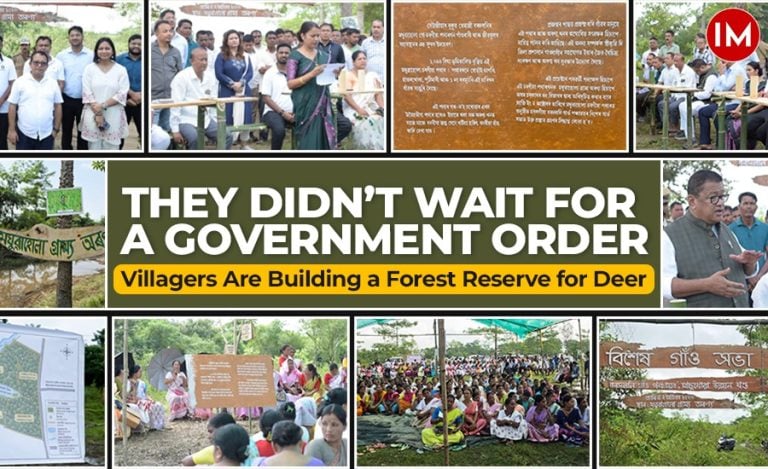
Also read – In Dhemaji, Villagers Are Building a Forest Reserve for 150 Deer — And They Started With Shramadan
Reciprocity
Women enjoy a unique relationship with nature and that is reciprocity. They take from the environment in terms of food, fuel and fodder but give back in equal measure. Of the roughly 250–300 million Indians who depend on forests for some part of their subsistence, women contribute an overwhelming share of collection labour, and hold the deepest working knowledge of species, seasons and sustainable collection. When a forest degrades, the first tax is levied on women’s time: collection rounds lengthen by hours, and those hours are taken from farm work, schooling of daughters, and the rest.
Data shows that of all the human deaths that happen due to conflicts with wild animals in forest fringe villages, almost 80% are that of women. These data points tell a story. The story of the gendered landscape in and around forests revealing dis-empowerment of that section of society that has the most organic links with the forest ecosystem. Women have always been an integral part of the forest landscape but have been noticeably absent from its governance.
What constitutes knowledge?
To answer this question let me take you back to the great oral traditions of the world. The entire body of work in the Vedas is a result of knowledge which was passed down over thousands of years from one generation to the next by word of mouth. It was reduced to writing much later. Women got access to formal education, as we know it, only in recent times and all the accumulated knowledge possessed by women is a result of their ‘lived experiences’. It is these lived experiences that must be captured in a respectful manner and it is these lived experiences that must be recognized as legitimate sources of knowledge.
Forest Governance
For most of India’s forestry history, governance has been designed as if this reality did not exist. Working plans, patrolling rosters, committee constitutions and benefit-sharing formulas though written in gender-neutral language, in practice, defaulted to male participation. Even wild animal conflict is referred to as man-animal conflict though of late people have started using the term human-animal conflict. The result is a paradox the country can no longer afford: the people most dependent on forests, most knowledgeable about them and most invested in their regeneration have had the least formal authority over how they are governed.
People’s Participation in forest Management
People’s involvement in forest planning got a fillip under the policy plank of the Joint Forest Planning and Management (JFPM). Over one lakh Committees were formed covering over 20 million hectares of forests, nationwide, from the 1990’s onwards.
Its most consistent but least advertised finding concerns women. Wherever Village Forest Committees and Van Suraksha Samitis moved beyond token membership and placed women in decision-making roles, as president, secretary, treasurer etc, it was seen that regeneration outcomes, protection compliance and the fairness of benefit-sharing improved measurably. Landmark field research by Bina Agarwal and others found that committees with a critical mass of women in their executive ie, roughly a quarter to a third were genuinely active and showed significantly better outcomes in terms of forest protection and sustainable use.
The reasons are not far to seek. Women’s approach to forests is different because they weigh a standing forest against household fuel, fodder, nutrition and health security, not against one-time timber or lease revenue. They favour rotational and regulated harvesting because they are the ones who must return next season. Odisha’s thengapalli tradition which involved women patrolling community forests by rotation, a lathi passed from household to household, resulted in regeneration of Sal forests for decades with no budget line at all. In Karnataka they agitate against large scale mining because the run-offs from such areas pollutes the water bodies from where they fetch drinking water.
The Gap Between the Law and its Practice
Even when the law mandated to have a certain percentage (33-50%) of women members, the women’s voices were neither recorded nor heard, because of the gap between the law and its practice. The gap is in the lack of adequate institutional strength. The meetings of JFM committees record women as present but the minutes of these meetings are disquietingly silent on what those women said! This should not surprise anyone who has worked in the field and has attended these meetings. They are overwhelmingly dominated by the vociferous and powerful majority in the village consisting mostly of upper caste men. The agendas are set by them, the meetings are scheduled to suit their timings and the venues are chosen by them. Often these timings do not suit women nor do the spaces nor does the agenda. Issuing rights pattas, Jointly in the name of men and women is a token gesture because bank accounts, transit permits and negotiation with traders remain male domains. A large majority of JFM committees are chaired by men, the member secretary is by default invariably a man because it is an ex-officio position held by the local Forester and women’s recruitment to the lower cadres of the Forest bureaucracy did not exist at the time when JFPM guidelines were issued.
The SHG movement has shown us that women’s collectives, given decision making and financial authority, outperform on repayment, transparency and asset maintenance. The same is true of the livelihood economy growing around forests. Van Dhan Vikas Kendras, NTFP value-addition enterprises, nursery raising, biochar and agroforestry-linked incomes are overwhelmingly operated through women’s Self-Help Groups. This is a lesson for forest institutions.
The Green Economy
A new force is now pressing on this old architecture. India’s restoration and climate commitments and schemes like the Green India Mission, CAMPA-financed afforestation, agroforestry missions, and a fast-growing pipeline of voluntary carbon projects under methodologies such as VM0042 and VM0047, all carry documented social-safeguard requirements. International buyers and standards increasingly demand gender-disaggregated benefit-sharing plans, grievance mechanisms and evidence of women’s participation as a precondition of registration and price. A carbon project that cannot show women’s authority in its governance is a project carrying reputational and delivery risk. The institutions governing markets for NTFPs are increasingly emphasizing sustainably sourced produce with a strong gender focus. For once, the market and the moral case point the same way.
The Road Ahead
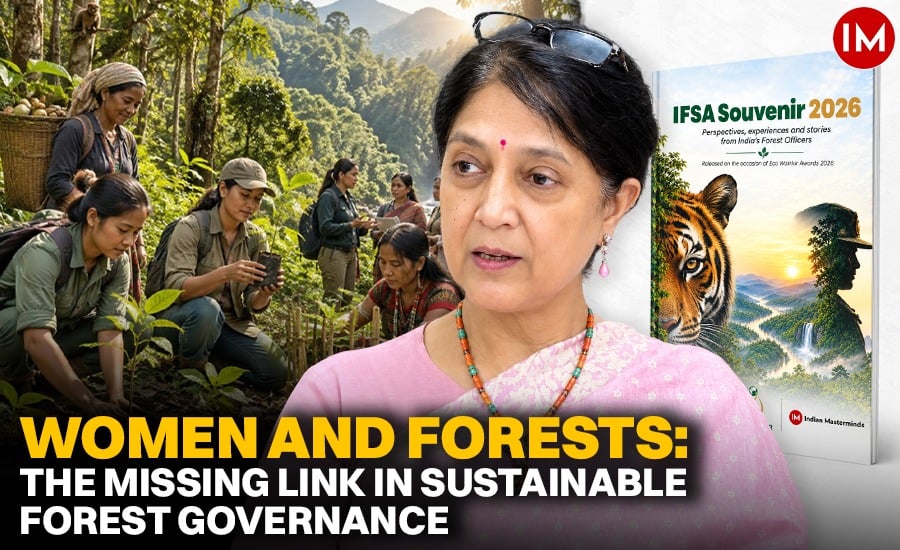
Forests play a vital role in maintaining ecological balance, conserving biodiversity, supporting livelihoods, and addressing climate change. Across India, women including women professionals have made significant contributions to forest conservation, sustainable resource management, wildlife protection, environmental governance, and community engagement. Their experiences, leadership, and knowledge systems though largely undocumented, have enriched forestry practice and policy at multiple levels. Their leadership in conservation, conflict resolution, community participation, technology adoption, and institutional development has significantly shaped the forestry sector. However, there remains a need for greater documentation and dissemination of these experiences to inspire future generations and inform policy and practice.
Today, the emphasis has shifted from women’s development to women lead development but this vision can be realized, only when the agency of women is recognised, promoted and given its due place at the ‘high table’. Nari Shakti must move beyond mere sloganeering to genuine engagement.
Also read – From Manuscripts to AI: How Technology Is Opening India’s Knowledge Heritage to the World