When most people lose faith in politics, they complain, debate, or stop voting. Few ask a more uncomfortable question: what if politics and politicians are not the same thing? What if governance could survive—and even improve—without the traditional political class?
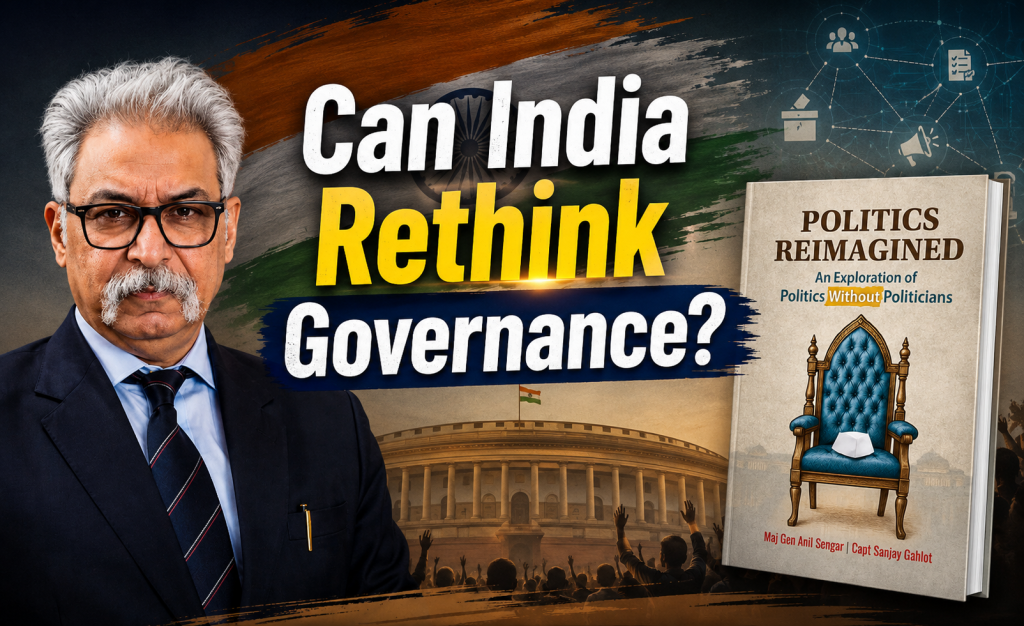
That question became the foundation of Politics Reimagined: An Exploration of Politics Without Politicians, a book that challenges one of democracy’s deepest assumptions. Written by Maj Gen Anil Sengar and retired IRS officer Capt Sanjay Gahlot, the book is not merely a critique of the political system. It is an attempt to imagine a different future.
For Capt Sanjay Gahlot, a retired Indian Revenue Service officer of the 1991 batch, the idea did not emerge overnight. It was shaped by decades of service, first in the armed forces and later in the civil services. Years of watching institutions function efficiently on one side and political dysfunction on the other convinced him that governance needed to be rethought.
In a conversation with Indian Masterminds, Gahlot explained why he felt compelled to write the book and why he believes the time has come to rethink how democracies work.
WHEN SERVICE RAISED HARD QUESTIONS
The idea for Politics Reimagined grew out of lived experience.
Gahlot spent years in highly structured institutions where responsibility, expertise and accountability were closely linked. But his experience in public life also exposed him to corruption, short-term politics and administrative paralysis.
“Decades in the Army and the Indian Revenue Service revealed a striking contrast between professional administration and political decision-making,” Mr Gahlot told Indian Masterminds. “Repeated exposure to corruption, short-term populism and institutional paralysis convinced me that governance should be driven by competence, accountability and citizen participation rather than career politicians.”
That contrast stayed with him. It eventually became the central question of the book: Do societies really need politicians to govern, or do they simply need good governance?
POLITICS WITHOUT POLITICIANS
The title itself is provocative. It immediately invites scepticism. After all, can democracy exist without politicians? Gahlot believes the question is worth asking because history shows that ideas once dismissed as impossible often become accepted realities.
“Every major democratic reform was once considered impossible,” he said. “Universal franchise, independent election commissions and digital governance were all dismissed initially.” He argues that the book is not calling for the abolition of politics. Instead, it seeks to professionalise governance while retaining democratic values.
“Our proposal does not abolish politics. It professionalises governance by combining citizen oversight, expert leadership, transparent institutions and technology-enabled participation within constitutional democracy,” he told Indian Masterminds. The distinction is important. The authors are not rejecting democracy. They are asking whether democracy can become more participatory, more transparent and less dependent on electoral politics alone.
WHO MAKES THE DECISIONS?
One of the biggest criticisms of such an idea is simple: difficult decisions still have to be made. If politicians are not at the centre, who governs? Gahlot proposes a shared model of authority. Citizens would define priorities. Domain experts would help frame policy. Professional administrators would implement decisions. Independent constitutional bodies would ensure oversight.
He believes accountability can also become stronger than it is today. “Digital transparency, measurable performance indicators, fixed tenures, public audits and recall mechanisms would provide stronger accountability than periodic elections alone,” he said.
In his view, democracy should not be limited to voting once every few years. Accountability should be continuous.
THE CRISIS OF CRIMINALISATION AND MONEY POWER
India remains the world’s largest democracy. Yet concerns about criminalisation, money power and dynastic politics continue to dominate public discourse. For Gahlot, criminalisation is the most dangerous challenge because it fuels the others. “Criminalisation is the foundation from which money power and dynastic politics flourish,” he told Indian Masterminds.
The book proposes minimum qualifications, rigorous vetting, ethical evaluations, transparent funding and independent oversight mechanisms. The goal, he says, is to shift legitimacy away from electoral arithmetic and towards competence and integrity.
LEARNING FROM THE WORLD
The book draws lessons from many societies rather than treating any one country as a perfect model. Ancient Athens, Switzerland, Singapore and Estonia all appear in its pages. Each offers a different lesson.
“No single country offers a complete template,” Gahlot said. “Switzerland’s direct democracy, Singapore’s meritocratic governance, Estonia’s digital administration and India’s constitutional institutions together provide valuable lessons.”
He believes India can adopt citizen participation, professional appointments, decentralised governance and technological transparency while preserving its federal structure and democratic diversity.
TECHNOLOGY AS A TOOL, NOT A MASTER
The authors also place significant emphasis on technology and digital participation. But they acknowledge the risks of misinformation, deepfakes and manipulation. Gahlot argues that technology should strengthen democracy, not replace human judgment.
“Technology should augment—not replace—human judgment,” he said. He advocates secure digital identities, blockchain-based audit trails, independent fact-checking, algorithmic transparency, AI-assisted policy analysis and strong data protection laws. According to him, technology must remain accountable to constitutional safeguards and human oversight.
WHY CHANGE IS SO DIFFICULT
If citizen-led governance offers greater accountability, why has it not gained wider acceptance? Gahlot believes the answer lies in resistance from entrenched interests.
“Transformative reforms inevitably challenge entrenched interests,” he told Indian Masterminds. “Resistance would come from sections of the political class, patronage networks and institutions benefiting from the status quo.” Citizens too may hesitate at first. That is why he favours gradual reforms, public education and constitutional safeguards rather than sudden disruption.
IMAGINING INDIA IN 2050
The book ultimately asks readers to imagine a different future. In Gahlot’s vision, India in 2050 would have transparent institutions powered by technology and guided by competence rather than patronage. Citizens would participate continuously in governance. Public services would become more efficient. Corruption would reduce because accountability would be measurable and visible.
“The objective is not militarisation,” he clarified while speaking about the influence of his Army background. “It is about institutionalising merit, discipline, ethical leadership and measurable performance in public administration.” That may be the central message of Politics Reimagined. It is not a rejection of democracy. It is an attempt to bring democracy closer to the ideals it promised.
Whether readers agree or disagree, the book forces them to confront a difficult question: if politics exists to serve people, must politicians always remain at its centre?
Also Read – Why Bishwanath Sinha Was Chosen to Lead Kerala’s Bureaucracy