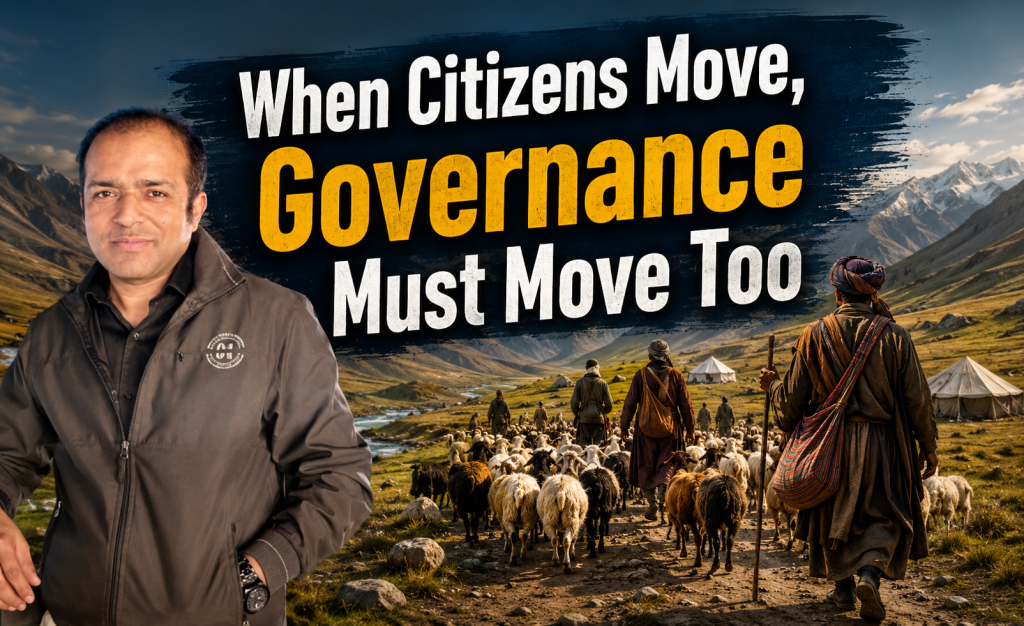
By Dr Abdul Khabir
The United Nations has declared 2026 the International Year of Rangelands and Pastoralists, with the Food and Agriculture Organization as the lead agency. Rangelands cover roughly half of the world’s land surface, and pastoralists are present in more than three-fourths of all countries, herding about a billion animals. The observance calls for greater recognition of pastoral livelihoods, responsible investment and policies that support mobility. Fittingly, the theme designated for July is services and infrastructure for pastoralists. For India, home to diverse transhumant systems extending from the Himalaya to the Deccan, this is a timely invitation to reflect on a distinct question of governance: how does the State serve citizens who move?
Transhumance, the seasonal movement of herders and their livestock between winter and summer pastures, is neither a relic nor an anomaly. It is a sophisticated economic and ecological system, refined over centuries, that converts sparse high-altitude vegetation into wool, milk, meat and livelihoods. In Jammu and Kashmir, many Gujjar and Bakarwal pastoral families undertake demanding seasonal journeys from winter grazing grounds in the Jammu region, across the Pir Panjal, to alpine pastures in the Kashmir Valley and beyond. The Gaddi and Sippi communities follow comparable cycles across shorter ranges. Similar systems animate the Changpa of Ladakh, the Van Gujjars of the Shivaliks, the Raika of Rajasthan and the Dhangar of the Deccan. Pastoral mobility can also be ecologically valuable. When well managed, seasonal mobility can distribute grazing pressure across landscapes, support pasture regeneration and contribute to biodiversity, which is why the United Nations frames pastoralists as custodians of rangelands rather than as users of them.
Also Read – Why Bishwanath Sinha Was Chosen to Lead Kerala’s Bureaucracy
A distinct governance question
Modern public administration evolved around the settled village and the fixed habitation. Schools, health centres, ration depots, veterinary services and administrative records are generally organised around fixed habitations and permanent addresses. A transhumant household, by contrast, may spend several months of the year on the move or at high-altitude pastures far from any of these institutions. The question is therefore not whether services exist, but whether they exist where the citizen actually is in each season. This reframing has a practical consequence for planners: for mobile communities, the meaningful unit of planning is not only the village but the migration route itself, with its halting points, passes, transit camps and summer pastures. Once the route becomes the unit of planning, a different administrative imagination follows. Enumeration must be seasonal. Service calendars must mirror migration calendars. Departments must converge at the points where families actually halt.
An evidence base is being built
Encouragingly, this administrative imagination is already taking shape. In Jammu and Kashmir, a dedicated survey and geotagging exercise undertaken in 2021 covered more than six lakh migratory persons, creating a more granular basis for planning around seasonal movement. Mobile and seasonal schools offer one example of services following families to summer pastures. The larger lesson is that route-level data, seasonal calendars and coordinated delivery can convert mobility from an administrative blind spot into a planning variable.
Designing for mobility
The next stage is to make this principle systematic, and four steps suggest themselves. First, comprehensive route mapping. Every major migration corridor should be documented with its halting points, water sources, pasture rights and seasonal calendars, so that departments plan against a shared geography of movement. Second, converged seasonal service camps. Veterinary care, immunisation, school enrolment, Aadhaar updation and entitlement verification can be delivered together at transit points during the migration windows, turning a dozen separate visits into one coordinated presence. Third, portability of entitlements. Ration cards, health coverage and school enrolment should follow the family across districts and divisions as smoothly as the family itself moves; digital platforms make such portability increasingly feasible, provided databases remain current and authentication and connectivity work reliably. India already possesses important building blocks. One Nation One Ration Card enables nationwide portability of food entitlements, while Ayushman Bharat-PM-JAY allows eligible beneficiaries to obtain cashless treatment at empanelled hospitals across the country. The task is to make such portability reliably usable along migration routes. Fourth, participation. Herders hold generations of knowledge about pastures, weather and routes; institutionalising their voice in pasture management and route planning will make public investment both fairer and more effective. The United Nations observance makes the same point globally: it calls for mobility corridors, adapted services and the recognition of indigenous knowledge as core elements of rangeland governance.
Also Read – Climate Change is Rewriting India’s Oceans
None of this requires new doctrine. It requires the familiar instruments of Indian administration, such as surveys, convergence, digital platforms and local participation, to be oriented around a moving citizen. The International Year of Rangelands and Pastoralists gives this effort a global stage. India has the administrative scale and digital foundations to develop a replicable model of public services designed around mobility.
Good governance is often described as taking the State to the citizen’s doorstep. For pastoral citizens, that doorstep moves seasonally across some of the country’s most demanding terrain. The real test of administrative imagination is whether public systems can recognise mobility not as an exception to be managed, but as a condition around which services must be designed.
About The Author – (Dr Abdul Khabir is a member of the Jammu and Kashmir Administrative Service and currently serves as Deputy Director, Tribal Affairs Department, with additional charge as Nodal Officer, Tribal Research Institute, Government of Jammu and Kashmir.)
Disclaimer – (The views and opinions expressed in this article are solely those of the author and do not necessarily reflect the views of Indian Masterminds. For feedback or queries, please write to [email protected].)