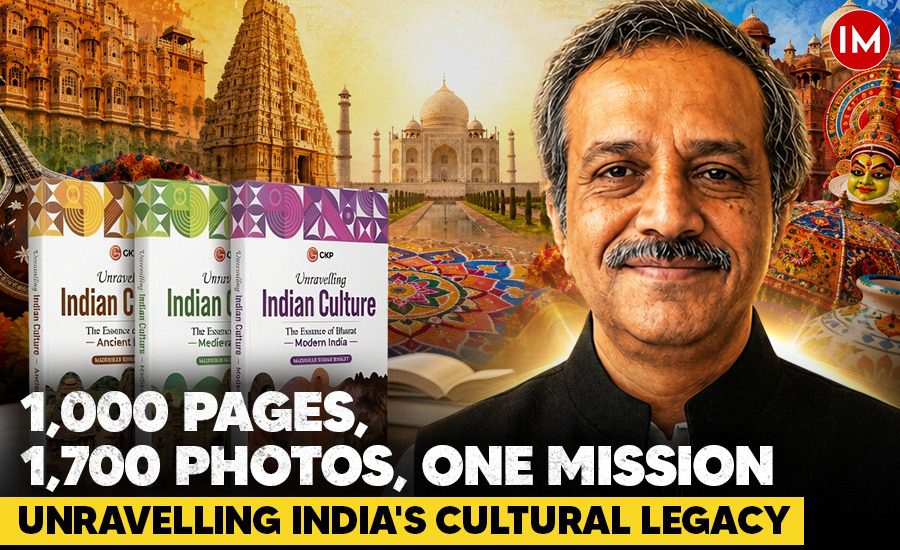
For most people, Indian culture is encountered in fragments—a temple visited during a pilgrimage, a painting admired in a museum, a classical dance performance watched on television, or a monument photographed during a holiday. But for Madhukar Kumar Bhagat, a 1995-batch Indian Revenue Service (IRS) officer and currently Joint Secretary in the Ministry of Health & Family Welfare, these fragments became pieces of a much larger puzzle.
What began as an ambitious attempt to create an accessible guide to Indian culture eventually transformed into a monumental literary project spanning three richly illustrated volumes: Unravelling Indian Culture: The Essence of Bharat – Ancient India, Unravelling Indian Culture: Medieval India, and GKP Unravelling Indian Culture: Modern India.
Containing nearly 1,000 pages and around 1,700 photographs, the trilogy is the culmination of years of research, travel, photography, and reflection. More than a history book and far more than a coffee-table publication, the series seeks to tell the story of India’s civilisational journey through a balanced blend of narrative, analysis, and visual storytelling.
Watch the interview here :
FROM RAILWAYS TO REVENUE SERVICE
Bhagat’s professional journey began long before the books took shape. After his academic years and success in competitive examinations, he joined government service and eventually became part of the Indian Revenue Service.
Writing, however, was never entirely absent from his life. His earliest books were technical publications related to taxation and income tax administration. Over time, he also became involved in mentoring civil services aspirants, which sharpened his ability to explain complex subjects in a simple and engaging manner.
Yet, culture remained a lingering passion.
The idea of documenting India’s cultural evolution emerged from his long-standing fascination with history, heritage, architecture, religion, art, and society. What initially appeared to be a manageable project soon revealed itself to be an intellectual challenge of enormous proportions.
Also Read – Mission Maidan: How Haryana Police Is Taking the Fight Against Drugs From the Streets to the Grassroots
THE IDEA THAT GREW INTO THREE VOLUMES
The original concept was straightforward: create a comprehensive yet reader-friendly book on Indian culture.
But as Bhagat immersed himself in the subject, he realised that Indian civilisation could not be reduced to a few chapters or simplified narratives.
Speaking to Indian Masterminds, he recalled how the project expanded as his understanding deepened.
“When I began writing about Sanatan traditions, Jainism and other aspects of Indian culture, I realised the subject was far more complex and nuanced than I had initially imagined. It was not something that could be understood superficially. Every chapter opened a new world of learning,” he said.
The Covid-19 lockdown provided an unexpected opportunity to devote uninterrupted time to the project. What started as a single volume gradually evolved into a three-part exploration of ancient, medieval, and modern India.
NOT A COFFEE-TABLE BOOK, NOT JUST AN ACADEMIC TEXT
One of the most distinctive features of the trilogy is its visual richness.
The books contain approximately 1,700 photographs, many of them captured by Bhagat himself during years of travel across the country. Yet, he is careful to distinguish the series from conventional coffee-table books.
While coffee-table publications often prioritise imagery over text, Bhagat wanted a balanced approach in which photographs would complement and strengthen the narrative rather than dominate it.
He envisioned an illustrated cultural guide where visuals would function as explanations, helping readers better understand architecture, sculpture, paintings, monuments, and traditions.
“The objective from the beginning was to create an illustrated book. It is neither a purely analytical work nor a coffee-table book. The photographs are not decorative additions; they help explain the subject and make it easier for readers to connect with what is being discussed,” Bhagat told Indian Masterminds.
FIVE YEARS, THOUSANDS OF IMAGES
The visual dimension of the project demanded years of effort.
Bhagat’s interest in photography dates back to the early 2000s when he purchased his first digital camera. Since then, photography became a constant companion during official visits, holidays, and personal travels.
Every journey became an opportunity to document India’s cultural landscape—from temples and sculptures to paintings and architectural marvels.
Ironically, collecting photographs was not the most difficult part. Selecting the right images from thousands of available photographs proved far more challenging. Every image had to serve a purpose and contribute meaningfully to the narrative.
The result is a carefully curated visual archive that enriches the reader’s experience while reinforcing the text.
UNDERSTANDING CULTURE THROUGH CONTEXT
A defining characteristic of the trilogy is its refusal to treat culture as a collection of isolated facts.
Instead of merely cataloguing artistic traditions, Bhagat places them within their historical and social contexts. Whether discussing temple architecture, Bhakti traditions, miniature paintings, Bengal School art, cinema, or modern reforms, he emphasises the importance of understanding the circumstances that shaped these developments.
For instance, a discussion on the Bengal School of Art is not limited to paintings alone. It explores the cultural resurgence that emerged as a response to colonial artistic dominance and examines how artists sought to reconnect with indigenous traditions.
Similarly, the books trace the evolution of Indian cinema, highlighting how storytelling, character archetypes, and social themes have changed across decades.
A CIVILISATIONAL JOURNEY ACROSS ERAS
Collectively, the three volumes traverse more than four millennia of Indian civilisation.
The journey begins with the Harappan civilisation and moves through ancient philosophical traditions, religious developments, temple architecture, literature, and art forms. The medieval volume examines cultural synthesis, Islamic influences, devotional movements, and evolving artistic traditions.
The modern volume explores colonial encounters, social reform movements, modern art, cinema, and the many ways in which Indian society adapted while retaining its civilisational identity.
Rather than presenting culture as static, the series portrays it as a living and evolving phenomenon shaped by interaction, adaptation, and continuity.
LOOKING THROUGH MANY WINDOWS
Perhaps the most fitting description of Bhagat’s work comes from his own metaphor.
He likens Indian culture to a vast palace filled with countless windows. Every window offers a different view, revealing a unique colour, perspective, and story. The author’s task, he believes, is to look through each of these windows and help readers glimpse the worlds beyond.
That philosophy lies at the heart of Unravelling Indian Culture. Through three expansive volumes, Madhukar Kumar Bhagat invites readers to embark on a journey across centuries—one that explores not only India’s past but also the cultural foundations that continue to shape its present and future.
Also Read – What Happened in Class 10 Changed His Entire Life: Aayush Swami’s Story Is About More Than UPSC